Back to the main page Back to category Pre1900
musical instrument details
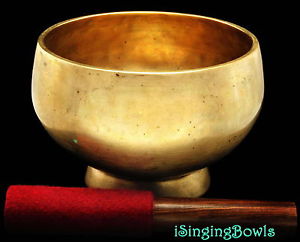
Antique Tibetan Singing Bowl: Stem 6 3/4", circa 19th Century, D#4 & G#3. VIDEO
Estimated price for orientation: 804 $
Category: Pre1900
Class:
Description UPC: Does not apply
Antique Tibetan Singing Bowl #8303: Diameter: 6 3/4" (17.1 cm) Weight: 2.11 lbs. (961 grams) Fundamental tone: D#4 -10 Hz. Rim tone: G#3 -4 Hz. Hand-forged, mixed-alloy bronze Circa 19th Century , Type: Stem About the Sound Sample: First you'll hear the sound of this singing bowl struck on its upper outside edge with the included Tibetan-wool padded mallet. This blends into the second sound which is the same singing bowl played around the outside rim with a leather mallet, then around the rim with the wood side of the mallet and last the struck tone again. For critical listening please use earphones.
Singing Bowl type: "Stem" A relatively rare type of singing bowl which has a raised ring attached (usually soldered) to the outside bottom of the bowl This ring is useful as a grip when the bowl is used in sound healing applications as the bowl can easily be waved around various parts of the patient's body. Stylistically a comparison can be made to the porcelain stem cups used by Tibetan nobility, although these have a longer stem. Package Also Includes: Certificate of Authenticity hand-signed by Rain Gray, Tibetan musicologist and Indo-Tibetan art & antique expert. Professional Mallet (handmade of Himalayan hardwood and Tibetan wool). Tips and Information Brochure (which includes: historical information, general metallurgical analysis, how to hold the mallet, playing around the rim, and advanced playing techniques). You will receive the EXACT singing bowl which you see and hear on this page. This fine-quality authentic antique Singing Bowl was personally hand-selected in the Himalayas by Tibetan musicologist Rain Gray. It is amongst the finest caliber of singing bowls available in the world. It has passed stringent tests for authentic antiquity, harmonic balance, smoothness and ease of playing, sound volume and long sustain. From over 50,000 singing bowls personally tested in the Himalayas each year, Rain only selects 1 out of 200 (equal to only one half a percent)!
About Tibetan Singing Bowls:
Singing bowls produce multi-harmonic sounds which invoke a deep state of relaxation which naturally assists one in entering into meditation. This is why they are a quintessential aid to meditation, and can be found in homes, churches, temples, monasteries, meditation halls, yoga studios and spas throughout the world. Legends claim that antique singing bowls from the Himalayas are hand-forged from bell-metal bronze alloy consisting of from 7 to 12 metals. These metals may include silver, nickel, copper, zinc, antimony, tin, lead, cobalt, bismuth, arsenic, cadmium and meteorite iron. However, without an analysis of each individual singing bowl, which is costly, it is impossible to accurately list the exact metals contained in a particular bowl. In addition to their traditional usage for meditation, Tibetan singing bowls are used for deep relaxation, stress reduction, holistic healing, Reiki, chakra balancing sound healing, sound massage, complementary and alternative medical treatments, birthing, relieving insomnia, hospice, relieving anxiety, toning, calming racehorses and other animals, and World music. Many people find that the rich blend of harmonic overtones which the singing bowls produce have a direct affect upon their chakras. Playing a singing bowl usually causes an immediate centering effect. The tones which they produce set up a "frequency following response" that creates a balancing left/right brain synchronization. Meditating on the subtle sounds of the Tibetan singing bowl tunes one in to the universal sound within and without.
How to play your singing bowl: The "Around-The-Rim" Technique--
Hold the singing bowl on the palm of the left hand. For smaller bowls, seven inches and under, hold on your fingertips. Grasp the mallet about mid-length, with all the fingertips pointing downwards and touching the wood. (If you are using one of our padded mallets, the red wool should be on top.) Palm downward. Gently tap the mallet against the side of the bowl to "warm-up" the bell. With a firm even pressure, rub the mallet clockwise around the outside edge of the rim of the bowl. Lock your wrist. Use a full
Description
| UPC: | Does not apply |
| About the Sound Sample: First you'll hear the sound of this singing bowl struck on its upper outside edge with the included Tibetan-wool padded mallet. This blends into the second sound which is the same singing bowl played around the outside rim with a leather mallet, then around the rim with the wood side of the mallet and last the struck tone again. For critical listening please use earphones. Singing Bowl type: "Stem" A relatively rare type of singing bowl which has a raised ring attached (usually soldered) to the outside bottom of the bowl This ring is useful as a grip when the bowl is used in sound healing applications as the bowl can easily be waved around various parts of the patient's body. Stylistically a comparison can be made to the porcelain stem cups used by Tibetan nobility, although these have a longer stem. Package Also Includes: Certificate of Authenticity hand-signed by Rain Gray, Tibetan musicologist and Indo-Tibetan art & antique expert. Professional Mallet (handmade of Himalayan hardwood and Tibetan wool). Tips and Information Brochure (which includes: historical information, general metallurgical analysis, how to hold the mallet, playing around the rim, and advanced playing techniques). You will receive the EXACT singing bowl which you see and hear on this page. This fine-quality authentic antique Singing Bowl was personally hand-selected in the Himalayas by Tibetan musicologist Rain Gray. It is amongst the finest caliber of singing bowls available in the world. It has passed stringent tests for authentic antiquity, harmonic balance, smoothness and ease of playing, sound volume and long sustain. From over 50,000 singing bowls personally tested in the Himalayas each year, Rain only selects 1 out of 200 (equal to only one half a percent)! |
| About Tibetan Singing Bowls: Singing bowls produce multi-harmonic sounds which invoke a deep state of relaxation which naturally assists one in entering into meditation. This is why they are a quintessential aid to meditation, and can be found in homes, churches, temples, monasteries, meditation halls, yoga studios and spas throughout the world. Legends claim that antique singing bowls from the Himalayas are hand-forged from bell-metal bronze alloy consisting of from 7 to 12 metals. These metals may include silver, nickel, copper, zinc, antimony, tin, lead, cobalt, bismuth, arsenic, cadmium and meteorite iron. However, without an analysis of each individual singing bowl, which is costly, it is impossible to accurately list the exact metals contained in a particular bowl. In addition to their traditional usage for meditation, Tibetan singing bowls are used for deep relaxation, stress reduction, holistic healing, Reiki, chakra balancing sound healing, sound massage, complementary and alternative medical treatments, birthing, relieving insomnia, hospice, relieving anxiety, toning, calming racehorses and other animals, and World music. Many people find that the rich blend of harmonic overtones which the singing bowls produce have a direct affect upon their chakras. Playing a singing bowl usually causes an immediate centering effect. The tones which they produce set up a "frequency following response" that creates a balancing left/right brain synchronization. Meditating on the subtle sounds of the Tibetan singing bowl tunes one in to the universal sound within and without. |
| How to play your singing bowl: The "Around-The-Rim" Technique-- Hold the singing bowl on the palm of the left hand. For smaller bowls, seven inches and under, hold on your fingertips. Grasp the mallet about mid-length, with all the fingertips pointing downwards and touching the wood. (If you are using one of our padded mallets, the red wool should be on top.) Palm downward. Gently tap the mallet against the side of the bowl to "warm-up" the bell. With a firm even pressure, rub the mallet clockwise around the outside edge of the rim of the bowl. Lock your wrist. Use a full |