Back to the main page Back to category Gibson Firebird
musical instrument details
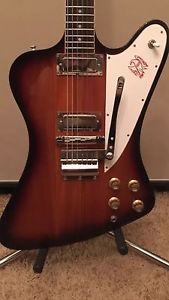
Gibson Firebird III Custom Shop
Estimated price for orientation: 6 999 $
Category: Gibson Firebird
Class:
Description Condition: Used: An item that has been used previously. The item may have some signs of cosmetic wear, but is fully operational and functions as intended. This item may be a floor model or store return that has been used. See the seller’s listing for full details and description of any imperfections. See all condition definitions- opens in a new window or tab ... Read moreabout the condition Brand: Gibson
This guitar is also listed on reverb.com for a cheaper price. One of the most rare guitars from the Gibson Custom shop. NOTE: this guitar comes with its original tremolo Arm ( modern plastic tremolo arm ) not the tea spoon arm that is on the guitar now. If you would like the tea spoon tremolo Arm please contact me before. There is an extra charge for that arm. This is a excellent firebird III custom That has been in my collection for the past 7 years. always played this guitar at home. Never been giged or played anywhere except my living room. This is an extremely rare and hard guitar to find And to find one in this condition well… just lucky. It has some swrill marks from polishing. And some oxidation from the guitar being 7 years old. There are some very hard to see blemishes that came with the guitar from the GIBSON custom shop. But nothing that one could see Unless I pointed it out and you rubbed your finger over. Playes perfectly no breaks or repairs. All original ,expect my tech put locks screws on the bridge. They look exactly like the originals but they actually keep the bridge in place. It comes with the original screws But you definitely need locks on it Or it will just fall off. That cost me about $100 to put it He used a German made ALL PARTS locking screws. Again look wise you would never know the difference. But functionality the bridge stays in place and will not move or fall out. This guitar comes with the original case and COA. 1964 Firebird III History Conceived amid the chrome and tailfins of the Motor City, forged on the workbenches of Kalamazoo, proven on rock and blues stages around the globe, the Gibson Firebird was one of the most radical instruments the world had ever experienced when it hit the scene in 1963, and it’s still a guaranteed head-turner today. Its classic reverse-body styling strikes a pose that is truly unique, and tonally it’s a bird apart too: its powerful yet bright mini-humbuckers and through-neck construction contribute to a sound that’s both cutting and sustainful. Roughly 2,500 Firebird III guitars were produced between 1963-’65, including the few “non-reverse” Firebirds in the transition period that marked the demise of the rare, original “reverse-body” styling. Body Seeking sleek new looks amid the competitive solidbody electric guitar market of the early ’60s, Gibson went right to the source of marketing style and hired automotive designer Ray Dietrich—designer of the Duesenberg car, among others—to take the standard vision of the instrument back to the drawing board. The result was a guitar that was clearly ahead of its time: the new Firebird had a body that appeared to be the reverse image of other solidbody styles on the market, an upside-down six-in-line headstock (using “banjo” tuners to avoid spoiling the lines of the phoenix-head profile), and a solid integral neck/body section with glued-on wings, a rarity in guitar manufacture at that time. Hardware In addition to the increased resonance and sustain given to the Firebird by its “through-body” construction, a new style of Gibson Mini-Humbucking pickup (two of them on the Firebird III) lent the model a bright, stinging tone. Although they look much like the Mini-Humbuckers that Gibson acquired from Epiphone, they are actually an entirely different design, employing a pair of alnico bar magnets with the pickups’ coils wound directly around them. Famous Players As has so often been the case with visionary Gibson designs, however, the rediscovery of this bold electric by a host of major artists—Brian Jones, Phil Manzanera, Allen Collens ,Ricky Medlocke ,Tom Petty,Eric Clapton,Mike Campbell and Johnny Winter among them—helped to make it a classic in the eyes of future generations of guitarists. Near-perfect Recreation
Description
| Condition: | Used: An item that has been used previously. The item may have some signs of cosmetic wear, but is fully operational and functions as intended. This item may be a floor model or store return that has been used. See the seller’s listing for full details and description of any imperfections. See all condition definitions- opens in a new window or tab ... Read moreabout the condition | Brand: | Gibson |
This guitar is also listed on reverb.com for a cheaper price. One of the most rare guitars from the Gibson Custom shop. NOTE: this guitar comes with its original tremolo Arm ( modern plastic tremolo arm ) not the tea spoon arm that is on the guitar now. If you would like the tea spoon tremolo Arm please contact me before. There is an extra charge for that arm. This is a excellent firebird III custom That has been in my collection for the past 7 years. always played this guitar at home. Never been giged or played anywhere except my living room. This is an extremely rare and hard guitar to find And to find one in this condition well… just lucky. It has some swrill marks from polishing. And some oxidation from the guitar being 7 years old. There are some very hard to see blemishes that came with the guitar from the GIBSON custom shop. But nothing that one could see Unless I pointed it out and you rubbed your finger over. Playes perfectly no breaks or repairs. All original ,expect my tech put locks screws on the bridge. They look exactly like the originals but they actually keep the bridge in place. It comes with the original screws But you definitely need locks on it Or it will just fall off. That cost me about $100 to put it He used a German made ALL PARTS locking screws. Again look wise you would never know the difference. But functionality the bridge stays in place and will not move or fall out. This guitar comes with the original case and COA. 1964 Firebird III History Conceived amid the chrome and tailfins of the Motor City, forged on the workbenches of Kalamazoo, proven on rock and blues stages around the globe, the Gibson Firebird was one of the most radical instruments the world had ever experienced when it hit the scene in 1963, and it’s still a guaranteed head-turner today. Its classic reverse-body styling strikes a pose that is truly unique, and tonally it’s a bird apart too: its powerful yet bright mini-humbuckers and through-neck construction contribute to a sound that’s both cutting and sustainful. Roughly 2,500 Firebird III guitars were produced between 1963-’65, including the few “non-reverse” Firebirds in the transition period that marked the demise of the rare, original “reverse-body” styling. Body Seeking sleek new looks amid the competitive solidbody electric guitar market of the early ’60s, Gibson went right to the source of marketing style and hired automotive designer Ray Dietrich—designer of the Duesenberg car, among others—to take the standard vision of the instrument back to the drawing board. The result was a guitar that was clearly ahead of its time: the new Firebird had a body that appeared to be the reverse image of other solidbody styles on the market, an upside-down six-in-line headstock (using “banjo” tuners to avoid spoiling the lines of the phoenix-head profile), and a solid integral neck/body section with glued-on wings, a rarity in guitar manufacture at that time. Hardware In addition to the increased resonance and sustain given to the Firebird by its “through-body” construction, a new style of Gibson Mini-Humbucking pickup (two of them on the Firebird III) lent the model a bright, stinging tone. Although they look much like the Mini-Humbuckers that Gibson acquired from Epiphone, they are actually an entirely different design, employing a pair of alnico bar magnets with the pickups’ coils wound directly around them. Famous Players As has so often been the case with visionary Gibson designs, however, the rediscovery of this bold electric by a host of major artists—Brian Jones, Phil Manzanera, Allen Collens ,Ricky Medlocke ,Tom Petty,Eric Clapton,Mike Campbell and Johnny Winter among them—helped to make it a classic in the eyes of future generations of guitarists. Near-perfect Recreation