Back to the main page Back to category Sanken CMS10 Con
musical instrument details
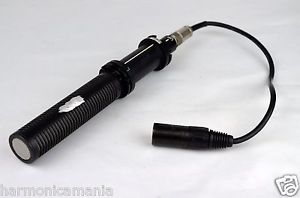
SANKEN CMS-10 MS STEREO & MONO SHOTGUN CONDENSER MICROPHONE MIC DETACHABLE CABLE
Estimated price for orientation: 750 $
Category: Sanken CMS10 Con
Class:
Description Condition: Used: An item that has been used previously. The item may have some signs of cosmetic wear, but is fully operational and functions as intended. This item may be a floor model or store return that has been used. See the seller’s listing for full details and description of any imperfections. See all condition definitions- opens in a new window or tab ... Read moreabout the condition Brand: Sanken Pickup Pattern: MS Stereo or Mono Model: CMS-10 Connector(s): XLR 5 Pin Microphone Form Factor: Shotgun condenser microphone
Stereo Shotgun for Camcorder・ Switchable very sharp mono-shotgun and stereo mic
・ Very short length (210.5mm) and light weight (170g)
・ Using PPS diaphragm, it maintains high durability and quality even in high humidity environments.
・ By use of a specially designed suspension holder, it can isolate camera motor noise in camera mount use.
・ Basic design is M-S, but it includes M-S to L-R circuitry, and allows a direct L-R signal.The CMS-10 provides extremely high-resolution audio to match today’s advanced picture quality. This versatile microphone is switchable between a very sharp directional Mono and rich Stereo in environmental imaging. Stereo angle is 127°.Unlike conventional shotgun microphones, the CMS-10 uses a unique second-order pressure gradient design, enabling precision directional response through multiple cardioid elements in a front-back array. The capsules combine line microphone performance and second-order gradient response in a single compact system. Stereophonic localization depends primarily on signal accuracy and channel separation in the 400Hz to 3kHz range. Pattern control of the CMS-10 has been optimized in this range. Very low and very high frequency response has been optimized along the frontal axis so that the "target" on-axis sounds are clearly delineated.
Description
| Condition: | Used: An item that has been used previously. The item may have some signs of cosmetic wear, but is fully operational and functions as intended. This item may be a floor model or store return that has been used. See the seller’s listing for full details and description of any imperfections. See all condition definitions- opens in a new window or tab ... Read moreabout the condition | Brand: | Sanken |
| Pickup Pattern: | MS Stereo or Mono | Model: | CMS-10 |
| Connector(s): | XLR 5 Pin | Microphone Form Factor: | Shotgun condenser microphone |
Stereo Shotgun for Camcorder・ Switchable very sharp mono-shotgun and stereo mic
・ Very short length (210.5mm) and light weight (170g)
・ Using PPS diaphragm, it maintains high durability and quality even in high humidity environments.
・ By use of a specially designed suspension holder, it can isolate camera motor noise in camera mount use.
・ Basic design is M-S, but it includes M-S to L-R circuitry, and allows a direct L-R signal.The CMS-10 provides extremely high-resolution audio to match today’s advanced picture quality. This versatile microphone is switchable between a very sharp directional Mono and rich Stereo in environmental imaging. Stereo angle is 127°.Unlike conventional shotgun microphones, the CMS-10 uses a unique second-order pressure gradient design, enabling precision directional response through multiple cardioid elements in a front-back array. The capsules combine line microphone performance and second-order gradient response in a single compact system. Stereophonic localization depends primarily on signal accuracy and channel separation in the 400Hz to 3kHz range. Pattern control of the CMS-10 has been optimized in this range. Very low and very high frequency response has been optimized along the frontal axis so that the "target" on-axis sounds are clearly delineated.
・ Very short length (210.5mm) and light weight (170g)
・ Using PPS diaphragm, it maintains high durability and quality even in high humidity environments.
・ By use of a specially designed suspension holder, it can isolate camera motor noise in camera mount use.
・ Basic design is M-S, but it includes M-S to L-R circuitry, and allows a direct L-R signal.The CMS-10 provides extremely high-resolution audio to match today’s advanced picture quality. This versatile microphone is switchable between a very sharp directional Mono and rich Stereo in environmental imaging. Stereo angle is 127°.Unlike conventional shotgun microphones, the CMS-10 uses a unique second-order pressure gradient design, enabling precision directional response through multiple cardioid elements in a front-back array. The capsules combine line microphone performance and second-order gradient response in a single compact system. Stereophonic localization depends primarily on signal accuracy and channel separation in the 400Hz to 3kHz range. Pattern control of the CMS-10 has been optimized in this range. Very low and very high frequency response has been optimized along the frontal axis so that the "target" on-axis sounds are clearly delineated.