Back to the main page Back to category Singing Bowls
musical instrument details
New Tibetan Singing Bowl: Jambati 10 7/8" Dia., Contemporary, A#2 & F4. VIDEO
Estimated price for orientation: 497 $
Category: Singing Bowls
Class:
Description Condition: New: A brand-new, unused, unopened, undamaged item (including handmade items). See the seller's listing for full details. See all condition definitions- opens in a new window or tab ... Read moreabout the condition Brand: iSingingBowls MPN: Does Not Apply UPC: Does not apply
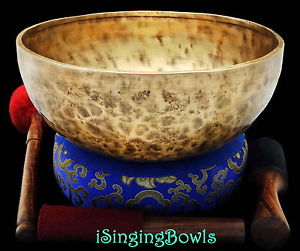
New Himalayan Singing Bowl #8352: Diameter: 10 7/8" (27.6 cm) Weight: 4.47 lbs. (2032 grams) Fundamental tone: A#2 +6 Hz. Rim tone: F4 349 Hz.(Concert Pitch) chakra Hand-forged, mixed-alloy bronze Circa 21st Century (contemporary/new) Extra-Thick Type: Jambati About the Sound Sample: Due to the deep bass tones it's highly recommended that you listen with earphones. First you'll hear the sound of this singing bowl struck on its upper outside edge with the included Professional gong mallet. Then you'll hear the same singing bowl played around the outside rim with the leather end of the included "Fat Boy" mallet. This blends into the sound of the same singing bowl played around the outside rim with the wood end of the included Himalayan hardwood wool-padded mallet, and last the struck tone again.
High-wall ("Jambati") Singing Bowl: Called Jambati in the Himalayas, the High-wall type is the largest diameter variety of the Tibetan singing bowls. They are highly prized for their deep basso profundo Om tones. Fundamental tones can range from the second to the third octave. The rim tones can reach into the fifth octave.
Package Also Includes: Tibetan silk-brocade Singing Bowl Cushion (color and style may vary). 2-piece Professional Mallet Set (A handmade Himalayan hardwood Tibetan-wool padded mallet, and a Himalayan hardwood with leather mallet). Tips and Information Brochure (which includes: historical information, general metallurgical analysis, how to hold the mallet, playing around the rim, and advanced playing techniques). You will receive the EXACT singing bowl which you see and hear on this page. This fine-quality authentic antique Singing Bowl was personally hand-selected in the Himalayas by Tibetan musicologist Rain Gray. It is amongst the finest caliber of singing bowls available in the world. It has passed stringent tests for authentic antiquity, harmonic balance, smoothness and ease of playing, sound volume and long sustain. From over 50,000 singing bowls personally tested in the Himalayas each year, Rain only selects 1 out of 200 (equal to only one half a percent)!
About Tibetan Singing Bowls:
Singing bowls produce multi-harmonic sounds which invoke a deep state of relaxation which naturally assists one in entering into meditation. This is why they are a quintessential aid to meditation, and can be found in homes, churches, temples, monasteries, meditation halls, yoga studios and spas throughout the world. Legends claim that antique singing bowls from the Himalayas are hand-forged from bell-metal bronze alloy consisting of from 7 to 12 metals. These metals may include silver, nickel, copper, zinc, antimony, tin, lead, cobalt, bismuth, arsenic, cadmium and meteorite iron. However, without an analysis of each individual singing bowl, which is costly, it is impossible to accurately list the exact metals contained in a particular bowl. In addition to their traditional usage for meditation, Tibetan singing bowls are used for deep relaxation, stress reduction, holistic healing, Reiki, chakra balancing sound healing, sound massage, complementary and alternative medical treatments, birthing, relieving insomnia, hospice, relieving anxiety, toning, calming racehorses and other animals, and World music. Many people find that the rich blend of harmonic overtones which the singing bowls produce have a direct affect upon their chakras. Playing a singing bowl usually causes an immediate centering effect. The tones which they produce set up a "frequency following response" that creates a balancing left/right brain synchronization. Meditating on the subtle sounds of the Tibetan singing bowl tunes one in to the universal sound within and without.
How to play your singing bowl: The "Around-The-Rim" Technique--
Hold the singing bowl on the palm of the left hand. For smaller bowls, seven in
Description
| Condition: | New: A brand-new, unused, unopened, undamaged item (including handmade items). See the seller's listing for full details. See all condition definitions- opens in a new window or tab ... Read moreabout the condition | Brand: | iSingingBowls |
| MPN: | Does Not Apply | UPC: | Does not apply |
| New Himalayan Singing Bowl #8352: Diameter: 10 7/8" (27.6 cm) Weight: 4.47 lbs. (2032 grams) Fundamental tone: A#2 +6 Hz. Rim tone: F4 349 Hz.(Concert Pitch) chakra Hand-forged, mixed-alloy bronze Circa 21st Century (contemporary/new) Extra-Thick Type: Jambati About the Sound Sample: Due to the deep bass tones it's highly recommended that you listen with earphones. First you'll hear the sound of this singing bowl struck on its upper outside edge with the included Professional gong mallet. Then you'll hear the same singing bowl played around the outside rim with the leather end of the included "Fat Boy" mallet. This blends into the sound of the same singing bowl played around the outside rim with the wood end of the included Himalayan hardwood wool-padded mallet, and last the struck tone again. High-wall ("Jambati") Singing Bowl: Called Jambati in the Himalayas, the High-wall type is the largest diameter variety of the Tibetan singing bowls. They are highly prized for their deep basso profundo Om tones. Fundamental tones can range from the second to the third octave. The rim tones can reach into the fifth octave. Package Also Includes: Tibetan silk-brocade Singing Bowl Cushion (color and style may vary). 2-piece Professional Mallet Set (A handmade Himalayan hardwood Tibetan-wool padded mallet, and a Himalayan hardwood with leather mallet). Tips and Information Brochure (which includes: historical information, general metallurgical analysis, how to hold the mallet, playing around the rim, and advanced playing techniques). You will receive the EXACT singing bowl which you see and hear on this page. This fine-quality authentic antique Singing Bowl was personally hand-selected in the Himalayas by Tibetan musicologist Rain Gray. It is amongst the finest caliber of singing bowls available in the world. It has passed stringent tests for authentic antiquity, harmonic balance, smoothness and ease of playing, sound volume and long sustain. From over 50,000 singing bowls personally tested in the Himalayas each year, Rain only selects 1 out of 200 (equal to only one half a percent)! |
| About Tibetan Singing Bowls: Singing bowls produce multi-harmonic sounds which invoke a deep state of relaxation which naturally assists one in entering into meditation. This is why they are a quintessential aid to meditation, and can be found in homes, churches, temples, monasteries, meditation halls, yoga studios and spas throughout the world. Legends claim that antique singing bowls from the Himalayas are hand-forged from bell-metal bronze alloy consisting of from 7 to 12 metals. These metals may include silver, nickel, copper, zinc, antimony, tin, lead, cobalt, bismuth, arsenic, cadmium and meteorite iron. However, without an analysis of each individual singing bowl, which is costly, it is impossible to accurately list the exact metals contained in a particular bowl. In addition to their traditional usage for meditation, Tibetan singing bowls are used for deep relaxation, stress reduction, holistic healing, Reiki, chakra balancing sound healing, sound massage, complementary and alternative medical treatments, birthing, relieving insomnia, hospice, relieving anxiety, toning, calming racehorses and other animals, and World music. Many people find that the rich blend of harmonic overtones which the singing bowls produce have a direct affect upon their chakras. Playing a singing bowl usually causes an immediate centering effect. The tones which they produce set up a "frequency following response" that creates a balancing left/right brain synchronization. Meditating on the subtle sounds of the Tibetan singing bowl tunes one in to the universal sound within and without. |
| How to play your singing bowl: The "Around-The-Rim" Technique-- Hold the singing bowl on the palm of the left hand. For smaller bowls, seven in |