Back to the main page Back to category Acoustic Guitars
musical instrument details
1964 EPIPHONE/GIBSON FT-45 CORTEZ Acoustic (LG-3), G'd Cond. Vintage CBC!
Estimated price for orientation: 1 095 $
Category: Acoustic Guitars
Class:
Description Condition: Used: An item that has been used previously. The item may have some signs of cosmetic wear, but is fully operational and functions as intended. This item may be a floor model or store return that has been used. See the seller’s listing for full details and description of any imperfections. See all condition definitions- opens in a new window or tab ... Read moreabout the condition Brand: EPIPHONE/GIBSON Dexterity: Right-Handed Model: FT-45 CORTEZ String Configuration: 6 String Body Type: LG-3 Country/Region of Manufacture: United States Series: FT Model Year: 1964
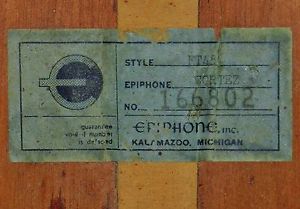
INTERNATIONAL BUYERS WELCOME!!! As you can see by googling ALUMPSTER’S GUITARS, I generally sell only Martin, Gibson, Guild, Taylor, Larrivee, and Alvarez-Yairi guitars because most of these models are made so well that they tend to increase in value and improve in the complexity and resonance of their sound as they age, regardless of their appearance; I can therefore sell them with confidence despite my lack of real expertise. This guitar, like all my guitars, is also available at a negotiable Buy It Now price in my store at any time. I will consider reasonable offers, even including installment payments and trade-ins, but generally unusual deals must be unusually sweet. If you have a particular model of any brand in which you are interested, please ask on-line by Googling ALUMPSTER’S GUITARS or at 803-731-0515, and I will be happy to let you know if it will be available soon.I apologize in advance for telling you folks what some of you already know and others of you don’t want to know, but it’s stuff which anybody who is considering buying this guitar ought to know, so here goes:Gibson introduced the LG-3 in 1942 as a kind of junior partner to the famous J-45, with the same solid spruce top and mahogany back, sides, and neck, according to George Gruhn’s Guide to Vintage Guitars. It had internal X-bracing, full 3-ply body binding (one ply on the back), a three-stripe rosette, a straight rosewood bridge with pearl dot inlay and white bridge pins, a 14/20-fret (after 1955) rosewood fingerboard with dot inlay, a blackface headstock with a screened gold logo, and three-on-a-side nickel Kluson Deluxe tuners with white plastic buttons. The LG-3 was a substantial upgrade both from its predecessor, the L-00, and the less expensive models in the series (LG-0, LG-1, and LG-2), both in its design and in its "specially selected" woods.The smaller dimensions of the LG models (14 1/8” lower bout, with a 24 ¾” scale) allowed Gibson to use straight-across ladder bracing on the top as well as the back of the LG-0 and the LG-1, but for the LG-2 and LG-3 they used the more responsive X-bracing of the J-45 itself. Similarly, for the less expensive models Gibson used a single piece mahogany back with no center seam; the LG-3 had a book-matched two-piece back. It was usually in a natural finish, showing off the grain of the fine spruce top--rather than covering up imperfections with a sunburst finish, as on the less expensive ladder-braced LG-1 and X-braced LG-2. While it was itself succeeded by the B-25 by 1966, the LG-3 is perhaps Gibson’s all-time best small-body acoustic. However, in 1958 Gibson also acquired the Epiphone trademark and equipment, lock, stock, and barrel, and as the Blue Book of Acoustic Guitars says, “It was decided that Epiphone would be re-established as a first-rate guitar manufacturer, so that Gibson’s parent company, CMI, could offer a product comparable in every way to Gibson....Gibson was (in effect) competing with itself,” selling virtually identical models of guitar. All were built at the Gibson plant in Kalamazoo to the same high standards, in many cases by the same designers and craftsmen, but with different labels and model numbers. While this situation only lasted until 1969, when most Epiphone production was shifted abroad, the Epiphone guitars produced during this period look and perform almost exactly like their Gibson counterparts, and are therefore highly prized by players and collectors alike. The Kalamazoo era is when this particular guitar was made: the label designates it as an Epiphone FT-45 Cortez, but it was the spitting image of the Gibson LG-3 described above. The serial number (166802) suggests that in the somewhat unreliable Gibson “system” it was produced in 1964. It had the tortoise pickguard which the Blue Book says was introduced with no logo in 1961, and at one time you could tell at a glance—as well as with a chord or two—that the DNA of this guitar was 98% Gibson; it looked li
Description
| Condition: | Used: An item that has been used previously. The item may have some signs of cosmetic wear, but is fully operational and functions as intended. This item may be a floor model or store return that has been used. See the seller’s listing for full details and description of any imperfections. See all condition definitions- opens in a new window or tab ... Read moreabout the condition | Brand: | EPIPHONE/GIBSON |
| Dexterity: | Right-Handed | Model: | FT-45 CORTEZ |
| String Configuration: | 6 String | Body Type: | LG-3 |
| Country/Region of Manufacture: | United States | Series: | FT |
| Model Year: | 1964 |
INTERNATIONAL BUYERS WELCOME!!! As you can see by googling ALUMPSTER’S GUITARS, I generally sell only Martin, Gibson, Guild, Taylor, Larrivee, and Alvarez-Yairi guitars because most of these models are made so well that they tend to increase in value and improve in the complexity and resonance of their sound as they age, regardless of their appearance; I can therefore sell them with confidence despite my lack of real expertise. This guitar, like all my guitars, is also available at a negotiable Buy It Now price in my store at any time. I will consider reasonable offers, even including installment payments and trade-ins, but generally unusual deals must be unusually sweet. If you have a particular model of any brand in which you are interested, please ask on-line by Googling ALUMPSTER’S GUITARS or at 803-731-0515, and I will be happy to let you know if it will be available soon.I apologize in advance for telling you folks what some of you already know and others of you don’t want to know, but it’s stuff which anybody who is considering buying this guitar ought to know, so here goes:Gibson introduced the LG-3 in 1942 as a kind of junior partner to the famous J-45, with the same solid spruce top and mahogany back, sides, and neck, according to George Gruhn’s Guide to Vintage Guitars. It had internal X-bracing, full 3-ply body binding (one ply on the back), a three-stripe rosette, a straight rosewood bridge with pearl dot inlay and white bridge pins, a 14/20-fret (after 1955) rosewood fingerboard with dot inlay, a blackface headstock with a screened gold logo, and three-on-a-side nickel Kluson Deluxe tuners with white plastic buttons. The LG-3 was a substantial upgrade both from its predecessor, the L-00, and the less expensive models in the series (LG-0, LG-1, and LG-2), both in its design and in its "specially selected" woods.The smaller dimensions of the LG models (14 1/8” lower bout, with a 24 ¾” scale) allowed Gibson to use straight-across ladder bracing on the top as well as the back of the LG-0 and the LG-1, but for the LG-2 and LG-3 they used the more responsive X-bracing of the J-45 itself. Similarly, for the less expensive models Gibson used a single piece mahogany back with no center seam; the LG-3 had a book-matched two-piece back. It was usually in a natural finish, showing off the grain of the fine spruce top--rather than covering up imperfections with a sunburst finish, as on the less expensive ladder-braced LG-1 and X-braced LG-2. While it was itself succeeded by the B-25 by 1966, the LG-3 is perhaps Gibson’s all-time best small-body acoustic. However, in 1958 Gibson also acquired the Epiphone trademark and equipment, lock, stock, and barrel, and as the Blue Book of Acoustic Guitars says, “It was decided that Epiphone would be re-established as a first-rate guitar manufacturer, so that Gibson’s parent company, CMI, could offer a product comparable in every way to Gibson....Gibson was (in effect) competing with itself,” selling virtually identical models of guitar. All were built at the Gibson plant in Kalamazoo to the same high standards, in many cases by the same designers and craftsmen, but with different labels and model numbers. While this situation only lasted until 1969, when most Epiphone production was shifted abroad, the Epiphone guitars produced during this period look and perform almost exactly like their Gibson counterparts, and are therefore highly prized by players and collectors alike. The Kalamazoo era is when this particular guitar was made: the label designates it as an Epiphone FT-45 Cortez, but it was the spitting image of the Gibson LG-3 described above. The serial number (166802) suggests that in the somewhat unreliable Gibson “system” it was produced in 1964. It had the tortoise pickguard which the Blue Book says was introduced with no logo in 1961, and at one time you could tell at a glance—as well as with a chord or two—that the DNA of this guitar was 98% Gibson; it looked li