Back to the main page Back to category Synthesizers
musical instrument details
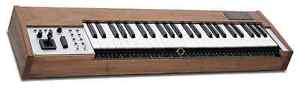
Analogue Systems French Connection Eurorack synth controller Radiohead Martenot
Estimated price for orientation: 3 900 $
Category: Synthesizers
Class:
Description Condition: New: A brand-new, unused, unopened, undamaged item in its original packaging (where packaging is applicable). Packaging should be the same as what is found in a retail store, unless the item is handmade or was packaged by the manufacturer in non-retail packaging, such as an unprinted box or plastic bag. See the seller's listing for full details. See all condition definitions- opens in a new window or tab ... Read moreabout the condition
The Ondes Martenot was developed by Maurice Martenot. A radio operator during the First World War, he noticed how the interaction of two pieces of similarly tuned electrical equipment could give rise to potentially musical oscillations.
After the war, Martenot began his research into the musical applications of electricity and the possibilities offered by allowing high frequency oscillators to interfere with one another. However, much of his work over the ensuing nine years is clouded in mystery because he did not unveil his eponymously named instrument until May 1928.
The first Ondes Martenot had a conventional keyboard but, more importantly, a wire that stretched the length of the keyboard, and which you moved from side to side using a little ring that you slipped over the index finger of your right hand. If you moved the ring to the right, the pitch of the sound produced by the instrument increased; if you moved the ring to the left, the pitch dropped. Had this been all the control offered by the Ondes Martenot, it would not have been a particularly musical instrument.
However, there was a second control that allowed you to articulate notes using your left hand. The combination of the two made it possible to determine both the pitch and the amplitude of a note, and the result was not unlike a human voice, or an instrument such as the ‘cello or violin. The French Connection offers the expressive potential of the Ondes Martenot coupled to the huge resources of the analogue synthesiser.
Controlling sounds is completely intuitive and musical; the depressions and studs on the fingerboard make it simple to locate conventional semitones, and the ring moves without any discontinuities or unevenness. With a little practice you will be able to articulate each note individually and smoothly using the amplitude "button", and create slides and vibrato without difficulty.
The control panel comprises three sections: the joystick, the amplitude Button, and the Controller Select Switches.
The joystick uses a high quality self-centring X/Y joystick mechanism that provides smooth response across its full range. (You can remove the internal springs to allow for non-centring action, if desired.) It provides two outputs for each CV generated.
RANGE At its far left extreme or its lowest point, the joystick will generate a voltage of -10V at the X outputs or Y outputs (respectively). At its far right extreme or its highest point, the joystick will generate a voltage of +10V at the X outputs or Y outputs (respectively). The RANGE controls reduce the maximum output CVs to approximately 0V at their MIN settings, while passing the full ±10V ranges when set to MAX.
The Button
If left untouched, this sits in its uppermost position, and generates a CV of 0V. As you depress the Button, the CV rises progressively to a maximum of approximately +10V.
RANGE
The RANGE offers fine control, reducing the output CV of the Button to 0V at its MIN settings, while passing the full ±10V range when set to MAX. Controller Select Switches
The first of these determines whether the pitch CV is controlled by the keyboard or by the wire controller.
The second determines whether the keyboard produces a conventional trigger and gate, or whether the Button produces an amplitude CV. There are four switch combinations: BUTTON + SLIDER Imitates the Ondes Martenot KEYBOARD + KEYBOARD Acts as a conventional CV+Trigger+Gate monosynth keyboardMore information:
http://www.analoguesystems.co.uk/pdf/FC2.pdfWelcome to our site:
http://www.analogmusic.com.au/
Description
| Condition: | New: A brand-new, unused, unopened, undamaged item in its original packaging (where packaging is applicable). Packaging should be the same as what is found in a retail store, unless the item is handmade or was packaged by the manufacturer in non-retail packaging, such as an unprinted box or plastic bag. See the seller's listing for full details. See all condition definitions- opens in a new window or tab ... Read moreabout the condition |
The Ondes Martenot was developed by Maurice Martenot. A radio operator during the First World War, he noticed how the interaction of two pieces of similarly tuned electrical equipment could give rise to potentially musical oscillations.
After the war, Martenot began his research into the musical applications of electricity and the possibilities offered by allowing high frequency oscillators to interfere with one another. However, much of his work over the ensuing nine years is clouded in mystery because he did not unveil his eponymously named instrument until May 1928.
The first Ondes Martenot had a conventional keyboard but, more importantly, a wire that stretched the length of the keyboard, and which you moved from side to side using a little ring that you slipped over the index finger of your right hand. If you moved the ring to the right, the pitch of the sound produced by the instrument increased; if you moved the ring to the left, the pitch dropped. Had this been all the control offered by the Ondes Martenot, it would not have been a particularly musical instrument.
However, there was a second control that allowed you to articulate notes using your left hand. The combination of the two made it possible to determine both the pitch and the amplitude of a note, and the result was not unlike a human voice, or an instrument such as the ‘cello or violin. The French Connection offers the expressive potential of the Ondes Martenot coupled to the huge resources of the analogue synthesiser.
Controlling sounds is completely intuitive and musical; the depressions and studs on the fingerboard make it simple to locate conventional semitones, and the ring moves without any discontinuities or unevenness. With a little practice you will be able to articulate each note individually and smoothly using the amplitude "button", and create slides and vibrato without difficulty.
The control panel comprises three sections: the joystick, the amplitude Button, and the Controller Select Switches.
The joystick uses a high quality self-centring X/Y joystick mechanism that provides smooth response across its full range. (You can remove the internal springs to allow for non-centring action, if desired.) It provides two outputs for each CV generated.
RANGE At its far left extreme or its lowest point, the joystick will generate a voltage of -10V at the X outputs or Y outputs (respectively). At its far right extreme or its highest point, the joystick will generate a voltage of +10V at the X outputs or Y outputs (respectively). The RANGE controls reduce the maximum output CVs to approximately 0V at their MIN settings, while passing the full ±10V ranges when set to MAX.
The Button
If left untouched, this sits in its uppermost position, and generates a CV of 0V. As you depress the Button, the CV rises progressively to a maximum of approximately +10V.
RANGE
The RANGE offers fine control, reducing the output CV of the Button to 0V at its MIN settings, while passing the full ±10V range when set to MAX. Controller Select Switches
The first of these determines whether the pitch CV is controlled by the keyboard or by the wire controller.
The second determines whether the keyboard produces a conventional trigger and gate, or whether the Button produces an amplitude CV. There are four switch combinations: BUTTON + SLIDER Imitates the Ondes Martenot KEYBOARD + KEYBOARD Acts as a conventional CV+Trigger+Gate monosynth keyboardMore information:
http://www.analoguesystems.co.uk/pdf/FC2.pdfWelcome to our site:
http://www.analogmusic.com.au/
After the war, Martenot began his research into the musical applications of electricity and the possibilities offered by allowing high frequency oscillators to interfere with one another. However, much of his work over the ensuing nine years is clouded in mystery because he did not unveil his eponymously named instrument until May 1928.
The first Ondes Martenot had a conventional keyboard but, more importantly, a wire that stretched the length of the keyboard, and which you moved from side to side using a little ring that you slipped over the index finger of your right hand. If you moved the ring to the right, the pitch of the sound produced by the instrument increased; if you moved the ring to the left, the pitch dropped. Had this been all the control offered by the Ondes Martenot, it would not have been a particularly musical instrument.
However, there was a second control that allowed you to articulate notes using your left hand. The combination of the two made it possible to determine both the pitch and the amplitude of a note, and the result was not unlike a human voice, or an instrument such as the ‘cello or violin. The French Connection offers the expressive potential of the Ondes Martenot coupled to the huge resources of the analogue synthesiser.
Controlling sounds is completely intuitive and musical; the depressions and studs on the fingerboard make it simple to locate conventional semitones, and the ring moves without any discontinuities or unevenness. With a little practice you will be able to articulate each note individually and smoothly using the amplitude "button", and create slides and vibrato without difficulty.
The control panel comprises three sections: the joystick, the amplitude Button, and the Controller Select Switches.
The joystick uses a high quality self-centring X/Y joystick mechanism that provides smooth response across its full range. (You can remove the internal springs to allow for non-centring action, if desired.) It provides two outputs for each CV generated.
RANGE At its far left extreme or its lowest point, the joystick will generate a voltage of -10V at the X outputs or Y outputs (respectively). At its far right extreme or its highest point, the joystick will generate a voltage of +10V at the X outputs or Y outputs (respectively). The RANGE controls reduce the maximum output CVs to approximately 0V at their MIN settings, while passing the full ±10V ranges when set to MAX.
The Button
If left untouched, this sits in its uppermost position, and generates a CV of 0V. As you depress the Button, the CV rises progressively to a maximum of approximately +10V.
RANGE
The RANGE offers fine control, reducing the output CV of the Button to 0V at its MIN settings, while passing the full ±10V range when set to MAX. Controller Select Switches
The first of these determines whether the pitch CV is controlled by the keyboard or by the wire controller.
The second determines whether the keyboard produces a conventional trigger and gate, or whether the Button produces an amplitude CV. There are four switch combinations: BUTTON + SLIDER Imitates the Ondes Martenot KEYBOARD + KEYBOARD Acts as a conventional CV+Trigger+Gate monosynth keyboardMore information:
http://www.analoguesystems.co.uk/pdf/FC2.pdfWelcome to our site:
http://www.analogmusic.com.au/