Back to the main page Back to category Vintage Marantz
musical instrument details
MARANTZ PMD-430 Professional Portable Cassette Recorder-NOS-Beautiful !!!
Estimated price for orientation: 599 $
Category: Vintage Marantz
Class:
Description Condition: New other (see details): A new, unused item with absolutely no signs of wear. The item may be missing the original packaging, or in the original packaging but not sealed. The item may be a factory second or a new, unused item with defects. See the seller’s listing for full details and description of any imperfections. See all condition definitions- opens in a new window or tab ... Read moreabout the condition Form Factor: Portable Brand: Marantz Model: PMD 430 Type: Analog Recorder Media Type: Cassette Tracks: 2 Features: Battery-Powered, Built-In Speaker(s) MPN: PMD-430 Country/Region of Manufacture: Japan
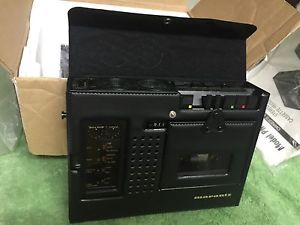
NOS. Recorder is an open Box. Documentation and all accessories are included and intact in the Box as seen in the Pictures. Strap and Pouch have not been opened. The Marantz PMD430 cassette deck seems to be particularly designed for audiophiles interested in making live, on-site recordings. The fully portable deck weighs only 4 pounds, and it can be powered either by batteries (three D cells or a rechargeable battery pack) or from a plug-in a.c.-line adaptor. Unlike typical portable recorders, however, the PMD430 has separate left- and right-channel microphone inputs, with a three-position attenuator (0, - 15, or - 30 dB) to prevent overload in extremely loud environments such as an on-stage recording of a rock concert. To accommodate the wide dynamic range of live music, dbx noise reduction is provided as well as the more common Dolby B. Even the PMD430's round, 1-1/4-inch VU-type meters and "European" styling recall professional on-site open-reel recorders. The PMD430 has separate record and playback tape heads, permitting a user to monitor the incoming signal and the recording alternately. Both heads are made of hardened permalloy. The tape transport uses a single capstan and a single d.c. servomotor. Presumably to conserve battery power, all the transport controls are mechanical rather than solenoid-operated. Cassettes are loaded into a compartment on top of the deck; its transparent door gives full label visibility. While the lid is not removable, the tape heads and rotating parts are easy to reach for cleaning and demagnetizing. A single knob adjusts the recording level for both channels. While a limiter circuit is provided for use in speech recording, it can be switched off, as is essential for taping music. There is a built-in limited-fidelity speaker that can be switched to monitor either the left or right channel or their sum (in other words, mono). The speaker's level control also affects the listening level at the headphone jacks but not the level at the regular line outputs you'd use for connecting the deck to a home stereo system. Record and playback levels are shown on two VU meters, one of which is also used to check the battery condition. The meters are calibrated from - 20 to +5 VU, though the numbers are so small as to be virtually unreadable. The yellow and red bands (below and above 0 VU) on the meter faces are more easily seen, however, and the meters are supplemented by a single peak-indicating LED that turns on at +4 VU. (Though it was not marked as such, we found that +4 VU corresponded to the IEC 0-dB level.) Again to conserve battery power, the meters are illuminated only when you press a button, and then only for 10 seconds at a time. A second compartment on top of the PMD430 contains switches for selecting dbx, Dolby B, or no noise reduction; for setting the proper bias and equalization for ferric, CrO2-type, or metal cassettes; and for activating memory rewind or the FM-multiplex filter. It also houses controls for varying the pitch (playback only) and for making fine adjustments of bias level. In addition to the usual input and output jacks, a European-style DIN connector is included. Microphone modes are switchable between stereo and mono. The deck measures only 9-1/2 inches wide, 6 inches deep, and 2 inches high; it weighs just under 4 pounds.
Description
| Condition: | New other (see details): A new, unused item with absolutely no signs of wear. The item may be missing the original packaging, or in the original packaging but not sealed. The item may be a factory second or a new, unused item with defects. See the seller’s listing for full details and description of any imperfections. See all condition definitions- opens in a new window or tab ... Read moreabout the condition | Form Factor: | Portable |
| Brand: | Marantz | Model: | PMD 430 |
| Type: | Analog Recorder | Media Type: | Cassette |
| Tracks: | 2 | Features: | Battery-Powered, Built-In Speaker(s) |
| MPN: | PMD-430 | Country/Region of Manufacture: | Japan |
NOS. Recorder is an open Box. Documentation and all accessories are included and intact in the Box as seen in the Pictures. Strap and Pouch have not been opened. The Marantz PMD430 cassette deck seems to be particularly designed for audiophiles interested in making live, on-site recordings. The fully portable deck weighs only 4 pounds, and it can be powered either by batteries (three D cells or a rechargeable battery pack) or from a plug-in a.c.-line adaptor. Unlike typical portable recorders, however, the PMD430 has separate left- and right-channel microphone inputs, with a three-position attenuator (0, - 15, or - 30 dB) to prevent overload in extremely loud environments such as an on-stage recording of a rock concert. To accommodate the wide dynamic range of live music, dbx noise reduction is provided as well as the more common Dolby B. Even the PMD430's round, 1-1/4-inch VU-type meters and "European" styling recall professional on-site open-reel recorders. The PMD430 has separate record and playback tape heads, permitting a user to monitor the incoming signal and the recording alternately. Both heads are made of hardened permalloy. The tape transport uses a single capstan and a single d.c. servomotor. Presumably to conserve battery power, all the transport controls are mechanical rather than solenoid-operated. Cassettes are loaded into a compartment on top of the deck; its transparent door gives full label visibility. While the lid is not removable, the tape heads and rotating parts are easy to reach for cleaning and demagnetizing. A single knob adjusts the recording level for both channels. While a limiter circuit is provided for use in speech recording, it can be switched off, as is essential for taping music. There is a built-in limited-fidelity speaker that can be switched to monitor either the left or right channel or their sum (in other words, mono). The speaker's level control also affects the listening level at the headphone jacks but not the level at the regular line outputs you'd use for connecting the deck to a home stereo system. Record and playback levels are shown on two VU meters, one of which is also used to check the battery condition. The meters are calibrated from - 20 to +5 VU, though the numbers are so small as to be virtually unreadable. The yellow and red bands (below and above 0 VU) on the meter faces are more easily seen, however, and the meters are supplemented by a single peak-indicating LED that turns on at +4 VU. (Though it was not marked as such, we found that +4 VU corresponded to the IEC 0-dB level.) Again to conserve battery power, the meters are illuminated only when you press a button, and then only for 10 seconds at a time. A second compartment on top of the PMD430 contains switches for selecting dbx, Dolby B, or no noise reduction; for setting the proper bias and equalization for ferric, CrO2-type, or metal cassettes; and for activating memory rewind or the FM-multiplex filter. It also houses controls for varying the pitch (playback only) and for making fine adjustments of bias level. In addition to the usual input and output jacks, a European-style DIN connector is included. Microphone modes are switchable between stereo and mono. The deck measures only 9-1/2 inches wide, 6 inches deep, and 2 inches high; it weighs just under 4 pounds.