Back to the main page Back to category Trombones
musical instrument details
Vintage German Style Bb/F Bass Trombone by Bohland & Fuchs Early 20th Century
Estimated price for orientation: 715 $
Category: Trombones
Class:
Description Brand: Bohland & Fuchs Items Included: Case, Mouthpiece Trombone Type: Bass Skill Level: Professional Key: Bb/F
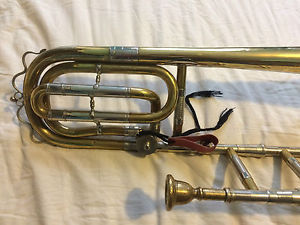
Up for your consideration here is a traditional German style bass trombone with an F attachment, made by Bohland und Fuchs in the first half of the 20th century.Borland and Fuchs was one of the largest brass instrument manufacturer of its time, and was located in the Bohemian city of Graslitz, in present-day Czech Republic. It was found in 1870, when the region was a part of Austrian-Hungarian Empire. It employed workforce of about 500 in 1925, and continued to produce brass instruments for every needs under this name until it was nationalized in 1945.While I am not sure of the exact date of manufacture of this particular bass trombone, my guess is that it was built shortly before (or during) the WW2. It has the typical characteristics of the traditional German bass trombone--in fact, it closely resembles older Kruspe bass trombone I had played, both on paper and actual playing characteristics.So, the specifications. The slide bore is a dual bore of about .531"/.551. The bell is just over 9", and has a krantz (garland) of about an inch. Back bow of the bell section, as well as the crook of the hand slide, features elaborate "snake" ornaments. Outer slide features "floating" brace, where one side of the brace is not soldered. Inner slide tubes are bare brass, with nickel silver stockings soldered on. There is no main tuning slide, but you can tune the instrument at the bell/slide connector that has a wing nut to keep them together in place. The valve is placed rather close to the bell/slide connector, without the very long neckpipe you would often see in German (tenor-bass) trombones. This is actually the trait you would see on older Kruspe BASS trombones as well (not on tenor-basses as far as I have seen), so there must be a good reason behind this. Maybe it allows for a more conical bell section. The F attachment does have its own tuning slide. All slides move as they should, and as does the valve--nothing is frozen. It can be played right out of the box. Cosmetically it is in very good condition as well--some minor dings, but no structural dents.It has what seems to be its original mouthpiece (very big, at least to me), as well as its original case. For mouthpiece, any large shank trombone mouthpiece should fit as well. The case is in very good condition--all latches work as they should.I am a professional historical trombone specialist, and this instrument is very much worthy of being played in historically informed Romantic orchestra concerts from Brahms to Mahler. Would work best with other section mates playing traditional German style trombones, but would also work as a lighter bass trombone when your section is "scaling down" with an alto trombone on top, and smaller tenor trombone on second.Thank you for looking!
Description
| Brand: | Bohland & Fuchs | Items Included: | Case, Mouthpiece |
| Trombone Type: | Bass | Skill Level: | Professional |
| Key: | Bb/F |
Up for your consideration here is a traditional German style bass trombone with an F attachment, made by Bohland und Fuchs in the first half of the 20th century.Borland and Fuchs was one of the largest brass instrument manufacturer of its time, and was located in the Bohemian city of Graslitz, in present-day Czech Republic. It was found in 1870, when the region was a part of Austrian-Hungarian Empire. It employed workforce of about 500 in 1925, and continued to produce brass instruments for every needs under this name until it was nationalized in 1945.While I am not sure of the exact date of manufacture of this particular bass trombone, my guess is that it was built shortly before (or during) the WW2. It has the typical characteristics of the traditional German bass trombone--in fact, it closely resembles older Kruspe bass trombone I had played, both on paper and actual playing characteristics.So, the specifications. The slide bore is a dual bore of about .531"/.551. The bell is just over 9", and has a krantz (garland) of about an inch. Back bow of the bell section, as well as the crook of the hand slide, features elaborate "snake" ornaments. Outer slide features "floating" brace, where one side of the brace is not soldered. Inner slide tubes are bare brass, with nickel silver stockings soldered on. There is no main tuning slide, but you can tune the instrument at the bell/slide connector that has a wing nut to keep them together in place. The valve is placed rather close to the bell/slide connector, without the very long neckpipe you would often see in German (tenor-bass) trombones. This is actually the trait you would see on older Kruspe BASS trombones as well (not on tenor-basses as far as I have seen), so there must be a good reason behind this. Maybe it allows for a more conical bell section. The F attachment does have its own tuning slide. All slides move as they should, and as does the valve--nothing is frozen. It can be played right out of the box. Cosmetically it is in very good condition as well--some minor dings, but no structural dents.It has what seems to be its original mouthpiece (very big, at least to me), as well as its original case. For mouthpiece, any large shank trombone mouthpiece should fit as well. The case is in very good condition--all latches work as they should.I am a professional historical trombone specialist, and this instrument is very much worthy of being played in historically informed Romantic orchestra concerts from Brahms to Mahler. Would work best with other section mates playing traditional German style trombones, but would also work as a lighter bass trombone when your section is "scaling down" with an alto trombone on top, and smaller tenor trombone on second.Thank you for looking!