Back to the main page Back to category Preamps and Channel Strips
musical instrument details
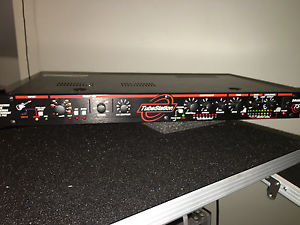
Drawmer Tube Station TS1 Tube Preamp & Compressor Tubestation EQ Guitar Mic Rare
Estimated price for orientation: 549 $
Category: Preamps and Channel Strips
Class:
Description
Unit comes with Power cord, not sure how long or what kind of tubes or present, just tested it out and is working fine.The unit combines stereo vacuum tube dynamics with a mic/instrument preamp, and these two sections can be used together to form a well-specified channel strip, albeit only in mono. It can also be fitted with the optional DC1 24-bit digital output card at a relatively low cost, capable of outputting at all the common sample rates from 44.1kHz to 96kHz. The stereo part of the unit comprises the compressor, a variable tube drive stage and an analogue output stage with limiter. The only tube circuitry resides in the tube drive stage where there are separate 12AX7/ECC83 tubes for each channel running at a full 200V HT. Half of each tube is used to handle the treble frequencies and the other half the bass frequencies, so as to reduce intermodulation effects. Feeding the compressor is a pair of balanced XLR line input sockets, but there's also a mono front end offering mic and instrument-level inputs that, when selected, feed the input to both compressor channels. In order to handle electric guitars and basses, the instrument input has a high impedance (1M(omega)) whereas the mic impedance is designed to take normal low-impedance studio microphones and has switchable phantom power plus a phase reverse switch. A button to the right of the Tube Station logo selects either Line (stereo) or Front End (mono) operation. Though the TS1 doesn't claim to have an EQ section, the front end is equipped with a variable-frequency high-pass filter (variable up to 250Hz) and an HF Contour control, which is generally all you need to add a touch of 'air' or enhancement while tracking. The mic amp gain is variable from 0 to 60dB while the same control sets the instrument gain from -20dB to +40dB. All switches are fitted with status LEDs and the input section includes a Clip LED that lights prior to the onset of clipping. An insert point is provided between the front end and the compressor section and immediately prior to this is a Preamp Output jack, enabling the preamp section to be used in isolation when the compressor section is being used as a stereo line compressor. There's also an insert point in the compressor side-chain making it possible to insert, for example, an equaliser to set up frequency-conscious compression (for de-essing, de-popping and so on). In order to keep the compressor section easy to use, the circuit has a fixed compression threshold. The Compress control effectively changes the level of the signal feeding the compressor, forcing the signal up against the compressor threshold so that more gain reduction takes place. There's no ratio control to adjust, but the user has full control over attack and release, both of which have fully variable, dedicated controls — Attack 0.5ms to 50ms, Release 0.05s to 5s. An eight-section LED meter tracks the amount of gain reduction being applied, up to a maximum of 30dB. Invisible to the user is Drawmer's enhancer circuit, designed to counter the loss of high-frequency information that can occur during heavy compression. No user adjustment is required — the circuit continually monitors the compressor action and works automatically. Following on from the compressor is the variable tube drive stage, with its own bypass switch. A single control regulates the amount of tube drive and hence coloration; the stage needs to be bypassed if no tube 'flavouring' is required as some distortion is always added by this section, even at the minimum control setting. A gain trim control follows the tube stage and essentially functions as a make-up gain control to compensate for any level imbalance caused by the compressor and the limiter, though with this fixed-threshold system, more compression equals more level, so perhaps 'make-down' gain would be a more accurate description.
Description
Unit comes with Power cord, not sure how long or what kind of tubes or present, just tested it out and is working fine.The unit combines stereo vacuum tube dynamics with a mic/instrument preamp, and these two sections can be used together to form a well-specified channel strip, albeit only in mono. It can also be fitted with the optional DC1 24-bit digital output card at a relatively low cost, capable of outputting at all the common sample rates from 44.1kHz to 96kHz. The stereo part of the unit comprises the compressor, a variable tube drive stage and an analogue output stage with limiter. The only tube circuitry resides in the tube drive stage where there are separate 12AX7/ECC83 tubes for each channel running at a full 200V HT. Half of each tube is used to handle the treble frequencies and the other half the bass frequencies, so as to reduce intermodulation effects. Feeding the compressor is a pair of balanced XLR line input sockets, but there's also a mono front end offering mic and instrument-level inputs that, when selected, feed the input to both compressor channels. In order to handle electric guitars and basses, the instrument input has a high impedance (1M(omega)) whereas the mic impedance is designed to take normal low-impedance studio microphones and has switchable phantom power plus a phase reverse switch. A button to the right of the Tube Station logo selects either Line (stereo) or Front End (mono) operation. Though the TS1 doesn't claim to have an EQ section, the front end is equipped with a variable-frequency high-pass filter (variable up to 250Hz) and an HF Contour control, which is generally all you need to add a touch of 'air' or enhancement while tracking. The mic amp gain is variable from 0 to 60dB while the same control sets the instrument gain from -20dB to +40dB. All switches are fitted with status LEDs and the input section includes a Clip LED that lights prior to the onset of clipping. An insert point is provided between the front end and the compressor section and immediately prior to this is a Preamp Output jack, enabling the preamp section to be used in isolation when the compressor section is being used as a stereo line compressor. There's also an insert point in the compressor side-chain making it possible to insert, for example, an equaliser to set up frequency-conscious compression (for de-essing, de-popping and so on). In order to keep the compressor section easy to use, the circuit has a fixed compression threshold. The Compress control effectively changes the level of the signal feeding the compressor, forcing the signal up against the compressor threshold so that more gain reduction takes place. There's no ratio control to adjust, but the user has full control over attack and release, both of which have fully variable, dedicated controls — Attack 0.5ms to 50ms, Release 0.05s to 5s. An eight-section LED meter tracks the amount of gain reduction being applied, up to a maximum of 30dB. Invisible to the user is Drawmer's enhancer circuit, designed to counter the loss of high-frequency information that can occur during heavy compression. No user adjustment is required — the circuit continually monitors the compressor action and works automatically. Following on from the compressor is the variable tube drive stage, with its own bypass switch. A single control regulates the amount of tube drive and hence coloration; the stage needs to be bypassed if no tube 'flavouring' is required as some distortion is always added by this section, even at the minimum control setting. A gain trim control follows the tube stage and essentially functions as a make-up gain control to compensate for any level imbalance caused by the compressor and the limiter, though with this fixed-threshold system, more compression equals more level, so perhaps 'make-down' gain would be a more accurate description.