Refined by:
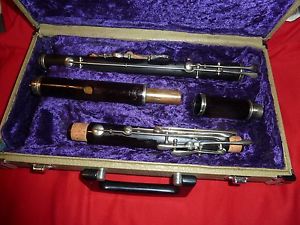
Physical Objects. nonprojected graphic | 1 sound disc : analog ; 12 in. | Instrument type: Flute in C Medium: Cocus, nickel silver keys and ferrules.; 65.5. cm. Key Holes System: 8 keys. Mark Maximum: NACH / H.F. MEYER / HANNOVER // H.P. Condition: Head joint cracked. Case: Case contains tenon cap covers and pads. Provenance: Laura Moran, Notre Dame, Indiana, 1999. Nonprojected Graphic ... Contributor: Anonymous Original Format: 3D Object - Photos, Prints, Drawings Date: 1900-00-00
DCM 1631: Anonymous / Piccolo in D-flat Physical Objects. nonprojected graphic | 1 sound disc : analog ; 12 in. | Instrument type: Piccolo in D-flat Medium: Cocus, ivory and cocus head, nickel silver keys and ferrules.; 28.8 cm. (as is) Key Holes System: 6 keys, modern style key cups, direct mount, post and rod. Mark Maximum: NACH / H. F. MEYER / HANNOVER Mark Additional: Mark on ivory upper head ... Contributor: Anonymous Original Format: 3D Object - Photos, Prints, Drawings Date: 1900-00-00 Pursuant to Library of Congress of US government, the flute was made in Circa 1875 and flute is 139 years old. C flute. It is German and an actual, genuine Nach H.F. Meyer Antique Hardwood 12 key Flute Meyer Grenadilla (1875 ). All pads and corks are new and have been replaced. Flute with original case . It is in pretty good shape considering how old it is. No cracks!!!. Pursuant to collection information, the firm of Heinrich Meyer Friedrich Meyer ( 1814-1897 ) flourished in Hannover from 1848 until the early 20th century. Buyer is responsible to pay for shipping returning cost and insurance in USA and buyer is responsible for liability in returning item without damage or lost to seller in order to be refunded .No international return accepted. The Flute is almost 28" long. The flute is also marked " Hannover " below and " Nach H.F. Meyer " stamp on flute.Free shipping cost is only inside of USA. Buyer is responsible for paying of shipping cost, insurance cost and custom cost out of USA. You can rarely find such antique and historical flute. No cracks at all!! You can rarely find antique 12 key Nach H.F. Meyer Flute. It is ready to play. Please read the following statement That contibutor of H.F Meyer and Nach H.F Meyer are the same in Hannover in Germany. Website of GOV of USA ( ) confirms that Nach H.F Meyer is collectable and antique.The Meyer name and flutes ("Meyerflöte") became so famous that such simple system instruments were often incorrectly referred to as being of the "Meyer System," which does not exist. As a prime example, 1890s issues of C. G. Conn's Truth (an advertising circular) offer the factory's simple system "Wonder Concert Flute" as a "Meyer System" instrument, and it thus appears that the Meyer name was expected to help sales in the United States well before 1900. Apparently seeking to share in any late-nineteenth-century flute sales that the Meyer name might generate, J. B. Claus of Boston began importing a standard conical Boehm system ring key instrument of the period and offering it on the American market as the "Meyer-Boehm" flute. Dayton Miller received this advertising circular from J. B. Claus around 1890.It is interesting to imagine how Theobald Boehm (1793-1881) might have reacted to this 1890s name-dropping approach to marketing. Meyer-Boehm poses an entertaining oxymoron in that the progressive Boehm establishment had ceased to manufacture or encourage the use of conical bore flutes of any key system by the middle of the century.The Miller Collection contains ten simple system flutes marked either H. F. MEYER or NACH H. F. MEYER, and the collection has numerous similar instruments that former owners may have considered to be "Meyer" flutes. Such flutes stayed in production as the archaic economy model for a curiously long time. The 1925 catalog from Lyon & Healy in Chicago, for example, still includes simple system conical bore flutes and piccolos along with the most modern Boehm system models of the period. In fact, the Lyon & Healy 1925 catalog even includes the simplest kind of simple system flute, a one-keyed model. Among the flute-related ephemera collected by Miller are several copies of a 1915 cartoon that lampoons the use of simple system flutes when the Boehm system instruments were so readily available. Museums occasionally receive inquiries about the discovery of yet another late-nineteenth- or early-twentieth-century . Its archaic design may lead the discoverer to assume that it is quite old and valuable, a hope that may be further raised if the instrument still has its quaint peri