Back to the main page Back to category Audio or MIDI Interfaces
musical instrument details
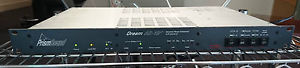
Prism Dream AD-124 Analogue (analog) to Digital Converter
Estimated price for orientation: 1 000 $
Category: Audio or MIDI Interfaces
Class:
Description Mic/Line Input: Line XLR Max. Number of Channels: 2 Brand: Prism Max. Sampling Rate: 24 Bit (48 kHz) MPN: Dream AD-124 Country/Region of Manufacture: United Kingdom Additional Inputs/Outputs: BNC In, BNC Out, AES/EBU XLR In, AES/EBU XLR Out, S/PDIF Optical In, S/PDIF Optical Out, World Clock I/O
In perfect working order, and great condition. Cost thousands when new.The Dream AD-124 converter is intended for professional audio use in applications wherea large dynamic range is required; for example in the production of high quality 16-Bit CDmasters - where noise shaping can provide a weighted dynamic range of more than110dB, or for conditions such as live recording where a large amount of headroom maybe required.In addition to the 24-Bit output mode the unit can provide 16-Bit or 20-Bit outputs withoptional Super Noise Shaping (SNS). With SNS activated the subjective signal to noiseratio is increased at the expense of a spectrally shaped noise floor with more noise at highfrequencies.The Prism Dynamic Range Enhancement (DRE) encoding system provided on the unitis used for professional recording where 20 or 24-Bit recording systems are not available.DRE is normally used to make high dynamic range, DRE-encoded, recordings onto 16-BitDAT. These recordings can then be transferred to a high resolution digital audioworkstation through a DRE decoding processor such as in the Dream AD-124 or theDream DA-1. Use of DRE allows an increased dynamic range to be carried in the 16-Bitrecorder data channel without using noise shaping (SNS) - which should not be applieduntil after the last stage of high resolution signal processing. Though not as transparent asa 20 or 24-Bit recorder, the DRE encode/decode process provides the ability to recordvirtually the full dynamic range of the Dream on a 16-Bit medium.SPECIFICATIONAnalogue PerformanceThese performance figures apply to operation in 24-Bit mode at a sample frequency of48kHz. DRE and SNS are disabled, and the input level for full scale output is set to+18dBu unless otherwise stated.Tests are performed to AES17-1991 (ANSI S4.51-1991) [3] except where stated.Input Impedance: 20kSAlias rejection: >80dB above 28kHzInput for full scale amplitudeFixed +28dBu, +18dBu, +12dBu (±0.2dB)Variable +8dBu to +24dBuInput gain stability: <0.01dB over an hourFrequency response deviation: +0.1 -0.3dB from 1Hz to 20kHzMaximum level vs frequency: 0dBFS from 10Hz to 20kHz(with <-90dB THD+N)Inter-channel phase deviation :< 1E from 10Hz to 20kHzPolarity: Non-invertingLevel-dependent gain linearity: < 0.001dBIdle channel noise: < -120dBFS unweighted< -120dBFS CCIR-RMS weighted< -122dBFS A weightedNoise with signal: (THD+N at -60dBFS, 20-20kHz) same as idle channel noiseTHD+N at 997 Hz, -1dBFS< -98dB (0.0012%)Linear cross-talk: < -90dB from 20Hz to 20kHzCommon mode rejection: > 70dB (20Hz - 1kHz)> 50dB (20Hz - 10kHz)ADC Delay: Mode 57 samples (48kHz = 1.19ms, 44.1kHz = 1.29ms)D-D Delay: mode 6 samples (48kHz = 125.00 µs, 44.1kHz = 136.05 µs)SynchronizationInternalSampling Frequency: 44.1 or 48kHz (+/- 10ppm)ExternalSampling Frequency: 30 to 50kHz on AES3 or IEC958 input.44.1 or 48kHz ±1000ppm on word clock input.Digital Output Phase: As AES11 standard [2]. (Matched to input phase within 5%of a sampling period.)Digital OutputFormatsXLR Professional, AES3 (110 S balanced)BNC Consumer, SPDIF/IEC958/CP340 (75 S coaxial)Optical Consumer, CP340 (TOSLink)(SDIF-2 coaxial output option is available)Word length16, 20 or 24-Bits, dithered or noise-shaped to eliminate truncation distortion.
Description
| Mic/Line Input: | Line XLR | Max. Number of Channels: | 2 |
| Brand: | Prism | Max. Sampling Rate: | 24 Bit (48 kHz) |
| MPN: | Dream AD-124 | Country/Region of Manufacture: | United Kingdom |
| Additional Inputs/Outputs: | BNC In, BNC Out, AES/EBU XLR In, AES/EBU XLR Out, S/PDIF Optical In, S/PDIF Optical Out, World Clock I/O |
In perfect working order, and great condition. Cost thousands when new.
The Dream AD-124 converter is intended for professional audio use in applications wherea large dynamic range is required; for example in the production of high quality 16-Bit CDmasters - where noise shaping can provide a weighted dynamic range of more than110dB, or for conditions such as live recording where a large amount of headroom maybe required.In addition to the 24-Bit output mode the unit can provide 16-Bit or 20-Bit outputs withoptional Super Noise Shaping (SNS). With SNS activated the subjective signal to noiseratio is increased at the expense of a spectrally shaped noise floor with more noise at highfrequencies.The Prism Dynamic Range Enhancement (DRE) encoding system provided on the unitis used for professional recording where 20 or 24-Bit recording systems are not available.DRE is normally used to make high dynamic range, DRE-encoded, recordings onto 16-BitDAT. These recordings can then be transferred to a high resolution digital audioworkstation through a DRE decoding processor such as in the Dream AD-124 or theDream DA-1. Use of DRE allows an increased dynamic range to be carried in the 16-Bitrecorder data channel without using noise shaping (SNS) - which should not be applieduntil after the last stage of high resolution signal processing. Though not as transparent asa 20 or 24-Bit recorder, the DRE encode/decode process provides the ability to recordvirtually the full dynamic range of the Dream on a 16-Bit medium.
SPECIFICATIONAnalogue PerformanceThese performance figures apply to operation in 24-Bit mode at a sample frequency of48kHz. DRE and SNS are disabled, and the input level for full scale output is set to+18dBu unless otherwise stated.Tests are performed to AES17-1991 (ANSI S4.51-1991) [3] except where stated.Input Impedance: 20kSAlias rejection: >80dB above 28kHzInput for full scale amplitudeFixed +28dBu, +18dBu, +12dBu (±0.2dB)Variable +8dBu to +24dBuInput gain stability: <0.01dB over an hourFrequency response deviation: +0.1 -0.3dB from 1Hz to 20kHzMaximum level vs frequency: 0dBFS from 10Hz to 20kHz(with <-90dB THD+N)Inter-channel phase deviation :< 1E from 10Hz to 20kHzPolarity: Non-invertingLevel-dependent gain linearity: < 0.001dBIdle channel noise: < -120dBFS unweighted< -120dBFS CCIR-RMS weighted< -122dBFS A weightedNoise with signal: (THD+N at -60dBFS, 20-20kHz) same as idle channel noiseTHD+N at 997 Hz, -1dBFS< -98dB (0.0012%)
Linear cross-talk: < -90dB from 20Hz to 20kHzCommon mode rejection: > 70dB (20Hz - 1kHz)> 50dB (20Hz - 10kHz)ADC Delay: Mode 57 samples (48kHz = 1.19ms, 44.1kHz = 1.29ms)D-D Delay: mode 6 samples (48kHz = 125.00 µs, 44.1kHz = 136.05 µs)SynchronizationInternalSampling Frequency: 44.1 or 48kHz (+/- 10ppm)ExternalSampling Frequency: 30 to 50kHz on AES3 or IEC958 input.44.1 or 48kHz ±1000ppm on word clock input.Digital Output Phase: As AES11 standard [2]. (Matched to input phase within 5%of a sampling period.)
Digital OutputFormatsXLR Professional, AES3 (110 S balanced)BNC Consumer, SPDIF/IEC958/CP340 (75 S coaxial)Optical Consumer, CP340 (TOSLink)(SDIF-2 coaxial output option is available)Word length16, 20 or 24-Bits, dithered or noise-shaped to eliminate truncation distortion.