Back to the main page Back to category Other Vintage String
musical instrument details
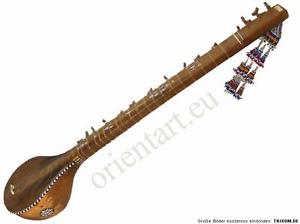
antique afghan folk music instrument Tambur Tanbur tanboor from Afghanaistan N1
Estimated price for orientation: 1 450 $
Category: Other Vintage String
Class:
Description Type: Tambur Tanbur tanboor تنبور
The tanbur is played in Northern Afghanistan from Kabul to Herat and Maza-E-Shariff amongst the Uzbeks and Tajiks in small ensembles or solo. length 127 cm ,Width about 24 cm and Height approx 19 cm The body of the tanbur is made from a a hollowed out piece of mulberry wood, and often smaller than the dutar. The front is made from mulberry.
The long neck (mulberry or apricot) is also the pegbox. The frets made of thick gut string are tied-on (3 windings) in some diatonic scale. At the left side of the neck is a groove to ease making the knots in the frets. There are 4 flat T-shaped friction pegs, two on the front, and two on the left. The 4 metal strings run over a small loose bridge to a bit of wood at the edge of the body. The first two strings are tuned the same, but they are so far apart that only the first one is fingered. The neck is often highly decorated with inlay bone (or white plastic nowadays) in squares, triangles, lines. The top of the back has triangle inlays, together forming a kind of windrose. The soundholes are a few drilled holes in a geometrical design. The entire instrument is varnished. The tanbur is always played with a wire plectrum on the index-finger, similar to the Indian sitar plectrum (mizrab), so you can pick forwards and backwards. The left hand plays mainly on the first course - the others are used as drones. The music is usually instrumental, but the tanbur is also used to accompany singing.
Die Tanbur (auch Tambur) ist eine Afghanische dreisensaitige Langhalslaute.Die Tanbur ist schon seit zweitausend Jahren bekannt. Ihren heutigen sakralen Status hat sie allerdings erst im 15. Jahrhundert erlangt, seitdem wird sie nicht für profane Musik oder zur Unterhaltung benutzt. Die Tanbur wird häufig in Verbindung mit Rahmentrommel Daf gespielt.Seit der Zeit der Sumerer, bzw. in religiöser Erwägung seit der Zeit vom Propheten David (König David), der ebenfalls dieses Instrument in Begleitung zu seinen Gedichte gespielt haben soll, ist es in vielen Völkern zu einem religiösen Symbol geworden.Länge Ca. 127 cm Breite Ca.24 cm und Höhe Ca. 19 cm
ink. Tasche
Description
| Type: | Tambur Tanbur tanboor تنبور |
The tanbur is played in Northern Afghanistan from Kabul to Herat and Maza-E-Shariff amongst the Uzbeks and Tajiks in small ensembles or solo. length 127 cm ,Width about 24 cm and Height approx 19 cm The body of the tanbur is made from a a hollowed out piece of mulberry wood, and often smaller than the dutar. The front is made from mulberry.
The long neck (mulberry or apricot) is also the pegbox. The frets made of thick gut string are tied-on (3 windings) in some diatonic scale. At the left side of the neck is a groove to ease making the knots in the frets. There are 4 flat T-shaped friction pegs, two on the front, and two on the left. The 4 metal strings run over a small loose bridge to a bit of wood at the edge of the body. The first two strings are tuned the same, but they are so far apart that only the first one is fingered. The neck is often highly decorated with inlay bone (or white plastic nowadays) in squares, triangles, lines. The top of the back has triangle inlays, together forming a kind of windrose. The soundholes are a few drilled holes in a geometrical design. The entire instrument is varnished. The tanbur is always played with a wire plectrum on the index-finger, similar to the Indian sitar plectrum (mizrab), so you can pick forwards and backwards. The left hand plays mainly on the first course - the others are used as drones. The music is usually instrumental, but the tanbur is also used to accompany singing.
Die Tanbur (auch Tambur) ist eine Afghanische dreisensaitige Langhalslaute.Die Tanbur ist schon seit zweitausend Jahren bekannt. Ihren heutigen sakralen Status hat sie allerdings erst im 15. Jahrhundert erlangt, seitdem wird sie nicht für profane Musik oder zur Unterhaltung benutzt. Die Tanbur wird häufig in Verbindung mit Rahmentrommel Daf gespielt.Seit der Zeit der Sumerer, bzw. in religiöser Erwägung seit der Zeit vom Propheten David (König David), der ebenfalls dieses Instrument in Begleitung zu seinen Gedichte gespielt haben soll, ist es in vielen Völkern zu einem religiösen Symbol geworden.Länge Ca. 127 cm Breite Ca.24 cm und Höhe Ca. 19 cm
ink. Tasche