Back to the main page Back to category Grand and Baby Grand Pianos
musical instrument details
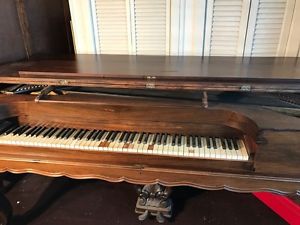
James & Holmstrom square piano - 1894 - ANTIQUE
Estimated price for orientation: 2 000 $
Category: Grand and Baby Grand Pianos
Class:
Description Condition: Used: An item that has been used previously. The item may have some signs of cosmetic wear, but is fully operational and functions as intended. This item may be a floor model or store return that has been used. See the seller’s listing for full details and description of any imperfections. See all condition definitions- opens in a new window or tab ... Read moreabout the condition
It is rare that anyone alive today has heard of a restored square piano playing, Let me start by saying that James & Holmstrom built exceptional pianos! They are consistently some of the finest square grand pianos. We have seen some vintage catalogs showing these square pianos selling for as much as several hundred dollars at the turn of the century...the cost of a small house of the era! In the past decade alone we have seen these pianos nearly DOUBLE in value, making their restoration a very good investment. This is a wonderful piano with a lot of potential. AGE: Based on the serial this piano was built in 1894. GENERAL INFORMATION: This piano is made of Brazilian Rosewood and is of the carved Rococo Victorian Style. Brazilian Rosewood is now endangered and is nearly impossible to get in the United States. It is very desirable as a result. The piano appears to be in original, unrestored condition with the old worn strings and felts still present. The average piano has about a 50-year life expectancy before the strings, felts, rubber & felt all break down so the fact that this piano is in this condition at this age is a real testament to the quality that went into building it! It is fascinating to think that with the endangered ivory and endangered Brazilian Rosewood, this piano could not be built today. GENERAL INFO: The Victorian Square Grand Piano: These magnificent instruments were once very popular in both America and Europe during the Victorian era. They were produced from about 1850 to about 1880, and were usually hand made with intricately carved rosewood, mahogany, or ebony cabinets. The last known production of square pianos seems to be about 1885 due to the new popularity of the upright piano. Before the upright piano gained its popularity in the late 19th century, the square grand piano was the instrument of choice in most fashionable homes. Although it is quite large and striking in appearance, its tone is very different than contemporary instruments. The square piano sounds reminiscent of the early pianoforte of Mozart's era with a tone that is best described as having a soft, harp-like quality. This instrument was well suited for small intimate gatherings, which were commonplace among the Victorians. At that time, society was accustomed to the square piano's delicate tone quality because it had been set as the standard for well over a hundred years. The new and more powerful grand and upright pianos of the 19th century were initially considered harsh and unpleasant to listen to, so the more primitive square piano remained popular with the general public well into the 20th century. Today, society is accustomed to the tone of the conventional piano, so square pianos sound very light and delicate to modern listeners. Musicians and collectors alike have begun to realize how valuable and historically significant these instruments really are. Most piano tuners, on the other hand, are intimidated by square pianos and frequently advise against investing in their preservation. Because of this sort of attitude among professionals in the piano industry, many people have been given the misconception that "square pianos are white elephants worth only their weight in firewood. VALUE: After they are restored, , They sell for as much as $30,000-$45,000 USD. This is not an inflated figure, but a real and actual amount we see these pianos sell for after restoration. The past decade alone has seen these pianos nearly double in value, a trend that will only continue. There is no doubt that your piano is worth restorationTHIS IS A TRUE COLLECTORS ITEM.PLEASE CONTACT ME FOR ANY QUESTION YOU MAY HAVE.THANK YOU :)
Description
| Condition: | Used: An item that has been used previously. The item may have some signs of cosmetic wear, but is fully operational and functions as intended. This item may be a floor model or store return that has been used. See the seller’s listing for full details and description of any imperfections. See all condition definitions- opens in a new window or tab ... Read moreabout the condition |
It is rare that anyone alive today has heard of a restored square piano playing, Let me start by saying that James & Holmstrom built exceptional pianos! They are consistently some of the finest square grand pianos. We have seen some vintage catalogs showing these square pianos selling for as much as several hundred dollars at the turn of the century...the cost of a small house of the era! In the past decade alone we have seen these pianos nearly DOUBLE in value, making their restoration a very good investment. This is a wonderful piano with a lot of potential. AGE: Based on the serial this piano was built in 1894. GENERAL INFORMATION: This piano is made of Brazilian Rosewood and is of the carved Rococo Victorian Style. Brazilian Rosewood is now endangered and is nearly impossible to get in the United States. It is very desirable as a result. The piano appears to be in original, unrestored condition with the old worn strings and felts still present. The average piano has about a 50-year life expectancy before the strings, felts, rubber & felt all break down so the fact that this piano is in this condition at this age is a real testament to the quality that went into building it! It is fascinating to think that with the endangered ivory and endangered Brazilian Rosewood, this piano could not be built today. GENERAL INFO: The Victorian Square Grand Piano: These magnificent instruments were once very popular in both America and Europe during the Victorian era. They were produced from about 1850 to about 1880, and were usually hand made with intricately carved rosewood, mahogany, or ebony cabinets. The last known production of square pianos seems to be about 1885 due to the new popularity of the upright piano. Before the upright piano gained its popularity in the late 19th century, the square grand piano was the instrument of choice in most fashionable homes. Although it is quite large and striking in appearance, its tone is very different than contemporary instruments. The square piano sounds reminiscent of the early pianoforte of Mozart's era with a tone that is best described as having a soft, harp-like quality. This instrument was well suited for small intimate gatherings, which were commonplace among the Victorians. At that time, society was accustomed to the square piano's delicate tone quality because it had been set as the standard for well over a hundred years. The new and more powerful grand and upright pianos of the 19th century were initially considered harsh and unpleasant to listen to, so the more primitive square piano remained popular with the general public well into the 20th century. Today, society is accustomed to the tone of the conventional piano, so square pianos sound very light and delicate to modern listeners. Musicians and collectors alike have begun to realize how valuable and historically significant these instruments really are. Most piano tuners, on the other hand, are intimidated by square pianos and frequently advise against investing in their preservation. Because of this sort of attitude among professionals in the piano industry, many people have been given the misconception that "square pianos are white elephants worth only their weight in firewood. VALUE: After they are restored, , They sell for as much as $30,000-$45,000 USD. This is not an inflated figure, but a real and actual amount we see these pianos sell for after restoration. The past decade alone has seen these pianos nearly double in value, a trend that will only continue. There is no doubt that your piano is worth restorationTHIS IS A TRUE COLLECTORS ITEM.PLEASE CONTACT ME FOR ANY QUESTION YOU MAY HAVE.THANK YOU :)