Back to the main page Back to category Other Vintage Guitars
musical instrument details
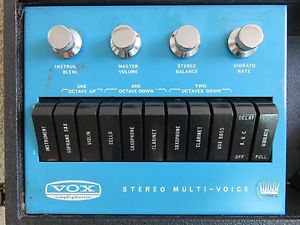
Vintage 1967 Vox Stereo Multi-Voice Rare Odd Ball Guitar Effects Unit Works
Estimated price for orientation: 650 $
Category: Other Vintage Guitars
Class:
Description
Vintage 1967 Vox Stereo Multi-Voice Rare Odd Ball Guitar Effects Unit Works Perfect But Missing Original Footswitch The Thomas Organ Vox guitar company was on fire in the 1960s! Not only did they have some seriously cool guitars, basses, amps, organs and instruments-they were way of ahead of their time going for effects units like this. The multi-voice is hard to explain basically it would change any instrument into a woodwind preset instrument. You combine instruments and have a (warped version?!) on an ensemble! I've put some catalog info below that explains it better but thats the jist of it! Its missing its original foot switch but the unit itself works perfect. Overall this guitar unit is in great shape. The guitar effects unit has minor superficial dings, scratches, wear and tear around various parts of the guitar. Typical of a guitar effects unit of this age. Please consider this when bidding on my items. Its vintage folks and anything this old could need a minor tune up.the Stereo Multi Voice as follows: "A revolutionay idea in Music! Vox's Stereo Multi-Voice lets one musician sound like an entire section. Here's how it works: Preset tabs for the octaves and voices that you want. Then with the tap of a foot, change or mix octaves; swing back and forth between different voices. You can make a sax sound like a clarinet or like several musicians playing all at once."The electronic design of the Stereo Multi -Voice was based on the tone generation circuitry used in Thomas home organs. These organs used twelve individual tone generator circuit cards, one for each tone in the scale. Each of these cards had a "master tone oscillator" circuit that generated the highest pitched tones in the organ. The signal from each of these master tone oscillators was then fed serially through a number of analog frequency "divider" network circuits. Each frequency divider network would drop the frequency of the master tone oscillator by one octave. Through the use of five of these serial frequency divider networks in each of the twelve tone generator circuit cards, the pitches needed to complete a five octave organ were derived.The Stereo Multi Voice worked on a similar principle. The Multi-Voice was inserted in the line between the instrument and the amplifier. The Stereo Multi-Voice substituted the signal from the brass or reed instrument pickup for the "master tone oscillator" in an electronic organ. The audio output from the instrument was fed through either a single doubler network to raise the pitch an octave, or one or two serial dividers to drop the pitch one or two octaves.As an example, one could drop the amplified tone of a tenor sax one octave using the Stereo Multi-Voice and make it sound like a baritone sax when played through through an amplifier.In addition to pitch adjustment, the Stereo Multi-Voice offered eight tone shaping switches to modify the tone of the instrument run through the processor. A four button foot switch similar to those supplied with Vox amps was also included for remote switching of effects.The Stereo Multi-Voice not only worked with amplified woodwind and brass instruments. It also gained favor with guitarists.Shipping, Payment & Important DetailsYour item will be shipped immediately after I receive payment. I use parcel post on most items. If you need it ASAP, please contact after the sale to make arrangements. If there is problem, please contact me before leaving feedback. I will do my best to work out any issues.
Description
Vintage 1967 Vox Stereo Multi-Voice Rare Odd Ball Guitar Effects Unit Works Perfect But Missing Original Footswitch The Thomas Organ Vox guitar company was on fire in the 1960s! Not only did they have some seriously cool guitars, basses, amps, organs and instruments-they were way of ahead of their time going for effects units like this. The multi-voice is hard to explain basically it would change any instrument into a woodwind preset instrument. You combine instruments and have a (warped version?!) on an ensemble! I've put some catalog info below that explains it better but thats the jist of it! Its missing its original foot switch but the unit itself works perfect. Overall this guitar unit is in great shape. The guitar effects unit has minor superficial dings, scratches, wear and tear around various parts of the guitar. Typical of a guitar effects unit of this age. Please consider this when bidding on my items. Its vintage folks and anything this old could need a minor tune up.the Stereo Multi Voice as follows: "A revolutionay idea in Music! Vox's Stereo Multi-Voice lets one musician sound like an entire section. Here's how it works: Preset tabs for the octaves and voices that you want. Then with the tap of a foot, change or mix octaves; swing back and forth between different voices. You can make a sax sound like a clarinet or like several musicians playing all at once."The electronic design of the Stereo Multi -Voice was based on the tone generation circuitry used in Thomas home organs. These organs used twelve individual tone generator circuit cards, one for each tone in the scale. Each of these cards had a "master tone oscillator" circuit that generated the highest pitched tones in the organ. The signal from each of these master tone oscillators was then fed serially through a number of analog frequency "divider" network circuits. Each frequency divider network would drop the frequency of the master tone oscillator by one octave. Through the use of five of these serial frequency divider networks in each of the twelve tone generator circuit cards, the pitches needed to complete a five octave organ were derived.The Stereo Multi Voice worked on a similar principle. The Multi-Voice was inserted in the line between the instrument and the amplifier. The Stereo Multi-Voice substituted the signal from the brass or reed instrument pickup for the "master tone oscillator" in an electronic organ. The audio output from the instrument was fed through either a single doubler network to raise the pitch an octave, or one or two serial dividers to drop the pitch one or two octaves.As an example, one could drop the amplified tone of a tenor sax one octave using the Stereo Multi-Voice and make it sound like a baritone sax when played through through an amplifier.In addition to pitch adjustment, the Stereo Multi-Voice offered eight tone shaping switches to modify the tone of the instrument run through the processor. A four button foot switch similar to those supplied with Vox amps was also included for remote switching of effects.The Stereo Multi-Voice not only worked with amplified woodwind and brass instruments. It also gained favor with guitarists.Shipping, Payment & Important DetailsYour item will be shipped immediately after I receive payment. I use parcel post on most items. If you need it ASAP, please contact after the sale to make arrangements. If there is problem, please contact me before leaving feedback. I will do my best to work out any issues.