Back to the main page Back to category Classical Guitars
musical instrument details
1992 Masaru Kohno Professional - R Classical Guitar
Estimated price for orientation: 2 750 $
Category: Classical Guitars
Class:
Description Condition: Used: An item that has been used previously. The item may have some signs of cosmetic wear, but is fully operational and functions as intended. This item may be a floor model or store return that has been used. See the seller’s listing for full details and description of any imperfections. See all condition definitions- opens in a new window or tab ... Read moreabout the condition
Thank you for looking.
Please also view my other listings for classical guitar.I have always listed my guitars with a starting bid of $100 regardless of the actual value and sound quality of the guitars. But I would like to make an exception for this 1992 Kohno Professional R guitar because it has an exceptional sound and because, if it is not sold, I am happy to keep it. I am listing this guitar with a Buy It Now price; I also accept best offer. I am quite sure that the next owner of this fine instrument will love its sound which is deep, soulful, and very resonant in the bass and clear piano-like in the treble. The balance and sustain are excellent as well. I have owned and sold many good guitars and this Kohno is one of the best sounding guitars I have ever owned. To me, it has the same value as that of my Sebastian Stenzel and Kohno No.50.This Kohno guitar has a sligthly smaller body size and slightly narrower neck than most other Kohnos.
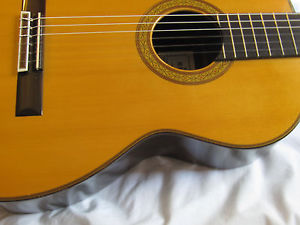
It has Indian rosewood back (thus, the model Professional R), spruce top, 650mm scale length, 50mm nut width, and excellent playability. The neck is straight and the frets and fingerboard are in excellent condition.The top has some dings behind the bridge on the bass side (Please see the photos).
There are also some slight fingernail marks right by the sound-hole on the treble side.
I just could not capture those on the photos.
Any blemishes this guitar has are made up for by its wonderful sound.Please read this very interesting and informative article about Kohno from vintagekohnoguitars :Ivor Mairants writes about Masaru Kohno in his book "My Fifty Fretting Years" published in 1980. "In 1963 I first met Masaru Kono who has since changed the spelling of his last name to Kohno. He then produced a whole range of excellent classical guitars from No 2 to No 10, and when my order was delivered in London in the autumn, Julian Bream happened to come into the shop and asked if I had any "new machines" I showed him the Kohnos and it did not take long for him to select one of the lower priced models (about 80 pounds), take it away, and use it in concerts. He tells me he still has it and uses it. The people who still may be wondering what caused the Japanese to become guitar makers may well wonder how Masaru Kohno learnt his craft. Well, during 1959 he went to Madrid and presented himself at No 12 Jesus y Maria, the workshop of Arcangel Fernandez, and, through a friend who spoke Spanish, asked if he could watch Arcangel at work, Arcangel, being a most friendly and straightforward person, did not object, and so the visits began. Masaru Kohno would often take Arcangel out to lunch or dinner, and generally treated him with great friendship which Arcangel reciprocated. Between interpreters and drawings, Arcangel's work was carefully noted by Kohno, and after visits almost every day for about six months, Masaru had seen enough for his purpose, and left Madrid to establish his own workshop in Tokyo. Ivor Mairants relates the story below without comment as it was told to him by Arcangel. Masaru Kohno entered one of his guitars at the Liege Concours National de Guitares in 1967, and won the first prize for guitar making out of 31 entrants. The chairman of the adjudicators was my late lamented friend Ignacio Fleta (who died in 1977) and he told me that when he examined Kohno's guitar (which of course was unlabeled at the time) he thought it was very much like his own." (On the judge's panel were, among others, Ignacio Fleta, Robert Bouchet, Joaquin Rodrigo, and Alirio Diaz, Noted French Luthier Daniel Frederich won the Silver medal in the competition, a sale of a Frederich in 2015 brought $60,000 US dollars). In the Development of Modern Guitar John Huber writes, "Kohno, already considered Japan's best maker, studied in Barcelona with Fleta. Upon his return to Tokyo (1960), he buried the western stereotype of Japanese production by not showing the slightest inclination to merely make polite imitations of Spanish guitars. Indeed, he proceeded to challenge them for market supremacy. He developed his own "Torres" model, with a comfortable neck for hands smaller and less powerful than Segovia's and a strong voice with brilliant trebles and clear bases. It soon won the prestigious Queen Elizabeth prize for its tone. By the late 60's Kohono's guitars had won not only a worldwide reputation for consistent excellence at low price, but also a worldwide market for far more than he ever could produce himself. With the assistance of his nephew (Sakurai), he responded with a modern factory, which for the next two decades provided the world with a Ramirez alternative in quality. Kohno's segment of the market continued to increase until the mid-80's when a general decline in guitar sales, after an uninterrupted 30 year market expansion, restricted growth of both Kohno's and most other competing guitar makers. Similar to the situation in Madrid, where many craftsman can trace their origins to the Ramirez workshops, in Tokyo, many of the best independent guitar makers to emerge in the 70' were former Kohno employees." Bill Baker on Masaru Kohno Over the years I have played several Fletas and remember a most distinctive aromatic smell inside the guitar. Not having known the above, when I purchased my first Kohno (a 1971 No 7) I held up the guitar and the scent transported me back thirty years to that same distinct smell the Fleta I played possessed. Its sound reminded me so much of the Fletas, that I wrote Mr. Sakurai (Kohno's nephew and protégé) asking if Kohno had studied with Fleta. He wrote back confirming that Masaru Kohno indeed did study with Fleta. While we have a documented writing of the history of Kohno studying with Archangel Fernandez, little is known of Kohno's association with Fleta other than the fact that upon his return to Tokyo in 1960, the head design of his guitars changed to a style closely resembling the Fleta head, a drastic change from his 1959 head style, and nothing even remotely resembling Archangel Fernandez's head design. Fleta's comment at the Belgium competition in 1967 was he thought the unlabeled Kohno closely resembled his own guitars. It was apparent then that Kohno was an international master builder. Ignacio Fleta, Robert Bouchet, Joaquin Rodrigo, and Alirio Diaz agreed giving Kohno's guitar first prize in a field of 31 competitors the included Danial Frederich.
I have owned many Kohnos and they have all been concert quality guitars. The guitars offered on this site are top-level concert guitars at an affordable price for the player that appreciates a vintage instrument with minor cosmetic flaws. My background includes 40 years of guitar playing, a BFA in classical guitar performance from the University of New Mexico, four summers of playing and studying under Emilio Pujol at his International Course of Guitar Lute and Vihue`la in Cervera Spain. Associate professor under Hector Garcia at UNM, numerous recordings, and concerts. I play with fingertips so the sound will be somewhat different than those who play with fingernails. The sound recordings of the guitars are my own. As Kohno grew his business over the years his numbering system changed. First he started with simple numbers like 421 and 821. I suspect those numbers stood for finish dates 421 being April 21. Then he started model numbers like no 4, no 5 no 10 etc. Where the number reflected the price in Japanese yen. As time passed the numbers grew in size to reflect new pricing. So a model No 30 would have been 300,000 yen and a model No15 would have been 150,000 yen. I suspect he did this because of the high level of inflation in Japan in the early '70s and the increase in demand for his guitars. He needed to raise his model numbers to keep up with the changing Yen value. The numbers grew to a No 50 model and finally a number 80 model. Around 1982 he began calling his models, Maestro, Special, Professional, and Concert. While the numbers reflected the fanciness of the guitar, the sound quality of the instruments wasn't necessarily better as Julian Bream proved when he chose a lower priced model number out of a batch of Kohnos in Ivor Mairants's shop. My good friend and renown painter Manuel Lopez Cia would comment at shows when people would stick ther noses up to one of his works. "Paintings are meant to be seen, not smelled." The same can be said of vintage guitars. They are meant to be heard and not nitpicked for cosmetic flaws. You want structural integrity, playability and sound to be the driving factors in your decision to purchase any vintage guitar.``` Guitars improve with age, but more than anything else they improve by being constanty played. . Below is courtesy of Dave Tate "Masaru Kohno (1926-1998) is not only the most important luthier to emerge from Japan, but also one of the best worldwide. He was born in Mito City, Japan, and in 1948 he graduated from the Tokyo College of Arts and Crafts with a degree in woodcraft. It was during this time that he became interested in guitar construction, and in 1959 he traveled to Spain to learn the craft.
Kohno apprenticed for six months at the workshop of Arcangel Fernandez, and although neither could speak a word of the other's language, they managed to communicate. Kohno's apprenticeship consisted mostly of sitting in the back of the shop and quietly–-but attentively--observing the master Fernandez at work.
Kohno's quiet learning paid off. Upon his return to Tokyo he established his own workshop and quickly gained recognition among Japanese guitarists. His international debut came in 1967, when he was awarded the Gold Medal at the Elizabeth's Concourse International Guitar Building Competition in Belgium. On the judge's panel were, among others, Ignacio Fleta, Robert Bouchet, Joaquin Rodrigo, and Alirio Diaz.
Since then, many players of world renown have used Kohno guitars; among them are Julian Bream, Oscar Gighlia, and Sharon Isbin, to name a few." Graham Wade writes in The Classical Guitar Complete History "A wide variety of recitalists have played his guitars, including Julian Bream, Vladimir Mikulka and John Mills. Both Sharon Isbin's Classical Guitar Vol II: Bach, Britten, Brower and Martin Mysilveck's Umlecky Portret Martina Msylivecka, (Panton, 1981) were recorded on Kohno guitars. Frederic Zigante is currently using a Kohno guitar in concert and on his recordings which include the complete guitar works of Villa-Lobos and Paganini. He is currently professor of guitar at the Conservatory of Trieste, Italy, and has concertizes over Europe, Japan and China.
"
Description
| Condition: | Used: An item that has been used previously. The item may have some signs of cosmetic wear, but is fully operational and functions as intended. This item may be a floor model or store return that has been used. See the seller’s listing for full details and description of any imperfections. See all condition definitions- opens in a new window or tab ... Read moreabout the condition |
Thank you for looking.
Please also view my other listings for classical guitar.I have always listed my guitars with a starting bid of $100 regardless of the actual value and sound quality of the guitars. But I would like to make an exception for this 1992 Kohno Professional R guitar because it has an exceptional sound and because, if it is not sold, I am happy to keep it. I am listing this guitar with a Buy It Now price; I also accept best offer. I am quite sure that the next owner of this fine instrument will love its sound which is deep, soulful, and very resonant in the bass and clear piano-like in the treble. The balance and sustain are excellent as well. I have owned and sold many good guitars and this Kohno is one of the best sounding guitars I have ever owned. To me, it has the same value as that of my Sebastian Stenzel and Kohno No.50.This Kohno guitar has a sligthly smaller body size and slightly narrower neck than most other Kohnos.
It has Indian rosewood back (thus, the model Professional R), spruce top, 650mm scale length, 50mm nut width, and excellent playability. The neck is straight and the frets and fingerboard are in excellent condition.The top has some dings behind the bridge on the bass side (Please see the photos).
There are also some slight fingernail marks right by the sound-hole on the treble side.
I just could not capture those on the photos.
Any blemishes this guitar has are made up for by its wonderful sound.Please read this very interesting and informative article about Kohno from vintagekohnoguitars :Ivor Mairants writes about Masaru Kohno in his book "My Fifty Fretting Years" published in 1980. "In 1963 I first met Masaru Kono who has since changed the spelling of his last name to Kohno. He then produced a whole range of excellent classical guitars from No 2 to No 10, and when my order was delivered in London in the autumn, Julian Bream happened to come into the shop and asked if I had any "new machines" I showed him the Kohnos and it did not take long for him to select one of the lower priced models (about 80 pounds), take it away, and use it in concerts. He tells me he still has it and uses it. The people who still may be wondering what caused the Japanese to become guitar makers may well wonder how Masaru Kohno learnt his craft. Well, during 1959 he went to Madrid and presented himself at No 12 Jesus y Maria, the workshop of Arcangel Fernandez, and, through a friend who spoke Spanish, asked if he could watch Arcangel at work, Arcangel, being a most friendly and straightforward person, did not object, and so the visits began. Masaru Kohno would often take Arcangel out to lunch or dinner, and generally treated him with great friendship which Arcangel reciprocated. Between interpreters and drawings, Arcangel's work was carefully noted by Kohno, and after visits almost every day for about six months, Masaru had seen enough for his purpose, and left Madrid to establish his own workshop in Tokyo. Ivor Mairants relates the story below without comment as it was told to him by Arcangel. Masaru Kohno entered one of his guitars at the Liege Concours National de Guitares in 1967, and won the first prize for guitar making out of 31 entrants. The chairman of the adjudicators was my late lamented friend Ignacio Fleta (who died in 1977) and he told me that when he examined Kohno's guitar (which of course was unlabeled at the time) he thought it was very much like his own." (On the judge's panel were, among others, Ignacio Fleta, Robert Bouchet, Joaquin Rodrigo, and Alirio Diaz, Noted French Luthier Daniel Frederich won the Silver medal in the competition, a sale of a Frederich in 2015 brought $60,000 US dollars). In the Development of Modern Guitar John Huber writes, "Kohno, already considered Japan's best maker, studied in Barcelona with Fleta. Upon his return to Tokyo (1960), he buried the western stereotype of Japanese production by not showing the slightest inclination to merely make polite imitations of Spanish guitars. Indeed, he proceeded to challenge them for market supremacy. He developed his own "Torres" model, with a comfortable neck for hands smaller and less powerful than Segovia's and a strong voice with brilliant trebles and clear bases. It soon won the prestigious Queen Elizabeth prize for its tone. By the late 60's Kohono's guitars had won not only a worldwide reputation for consistent excellence at low price, but also a worldwide market for far more than he ever could produce himself. With the assistance of his nephew (Sakurai), he responded with a modern factory, which for the next two decades provided the world with a Ramirez alternative in quality. Kohno's segment of the market continued to increase until the mid-80's when a general decline in guitar sales, after an uninterrupted 30 year market expansion, restricted growth of both Kohno's and most other competing guitar makers. Similar to the situation in Madrid, where many craftsman can trace their origins to the Ramirez workshops, in Tokyo, many of the best independent guitar makers to emerge in the 70' were former Kohno employees." Bill Baker on Masaru Kohno Over the years I have played several Fletas and remember a most distinctive aromatic smell inside the guitar. Not having known the above, when I purchased my first Kohno (a 1971 No 7) I held up the guitar and the scent transported me back thirty years to that same distinct smell the Fleta I played possessed. Its sound reminded me so much of the Fletas, that I wrote Mr. Sakurai (Kohno's nephew and protégé) asking if Kohno had studied with Fleta. He wrote back confirming that Masaru Kohno indeed did study with Fleta. While we have a documented writing of the history of Kohno studying with Archangel Fernandez, little is known of Kohno's association with Fleta other than the fact that upon his return to Tokyo in 1960, the head design of his guitars changed to a style closely resembling the Fleta head, a drastic change from his 1959 head style, and nothing even remotely resembling Archangel Fernandez's head design. Fleta's comment at the Belgium competition in 1967 was he thought the unlabeled Kohno closely resembled his own guitars. It was apparent then that Kohno was an international master builder. Ignacio Fleta, Robert Bouchet, Joaquin Rodrigo, and Alirio Diaz agreed giving Kohno's guitar first prize in a field of 31 competitors the included Danial Frederich.
I have owned many Kohnos and they have all been concert quality guitars. The guitars offered on this site are top-level concert guitars at an affordable price for the player that appreciates a vintage instrument with minor cosmetic flaws. My background includes 40 years of guitar playing, a BFA in classical guitar performance from the University of New Mexico, four summers of playing and studying under Emilio Pujol at his International Course of Guitar Lute and Vihue`la in Cervera Spain. Associate professor under Hector Garcia at UNM, numerous recordings, and concerts. I play with fingertips so the sound will be somewhat different than those who play with fingernails. The sound recordings of the guitars are my own. As Kohno grew his business over the years his numbering system changed. First he started with simple numbers like 421 and 821. I suspect those numbers stood for finish dates 421 being April 21. Then he started model numbers like no 4, no 5 no 10 etc. Where the number reflected the price in Japanese yen. As time passed the numbers grew in size to reflect new pricing. So a model No 30 would have been 300,000 yen and a model No15 would have been 150,000 yen. I suspect he did this because of the high level of inflation in Japan in the early '70s and the increase in demand for his guitars. He needed to raise his model numbers to keep up with the changing Yen value. The numbers grew to a No 50 model and finally a number 80 model. Around 1982 he began calling his models, Maestro, Special, Professional, and Concert. While the numbers reflected the fanciness of the guitar, the sound quality of the instruments wasn't necessarily better as Julian Bream proved when he chose a lower priced model number out of a batch of Kohnos in Ivor Mairants's shop. My good friend and renown painter Manuel Lopez Cia would comment at shows when people would stick ther noses up to one of his works. "Paintings are meant to be seen, not smelled." The same can be said of vintage guitars. They are meant to be heard and not nitpicked for cosmetic flaws. You want structural integrity, playability and sound to be the driving factors in your decision to purchase any vintage guitar.``` Guitars improve with age, but more than anything else they improve by being constanty played. . Below is courtesy of Dave Tate "Masaru Kohno (1926-1998) is not only the most important luthier to emerge from Japan, but also one of the best worldwide. He was born in Mito City, Japan, and in 1948 he graduated from the Tokyo College of Arts and Crafts with a degree in woodcraft. It was during this time that he became interested in guitar construction, and in 1959 he traveled to Spain to learn the craft.
Kohno apprenticed for six months at the workshop of Arcangel Fernandez, and although neither could speak a word of the other's language, they managed to communicate. Kohno's apprenticeship consisted mostly of sitting in the back of the shop and quietly–-but attentively--observing the master Fernandez at work.
Kohno's quiet learning paid off. Upon his return to Tokyo he established his own workshop and quickly gained recognition among Japanese guitarists. His international debut came in 1967, when he was awarded the Gold Medal at the Elizabeth's Concourse International Guitar Building Competition in Belgium. On the judge's panel were, among others, Ignacio Fleta, Robert Bouchet, Joaquin Rodrigo, and Alirio Diaz.
Since then, many players of world renown have used Kohno guitars; among them are Julian Bream, Oscar Gighlia, and Sharon Isbin, to name a few." Graham Wade writes in The Classical Guitar Complete History "A wide variety of recitalists have played his guitars, including Julian Bream, Vladimir Mikulka and John Mills. Both Sharon Isbin's Classical Guitar Vol II: Bach, Britten, Brower and Martin Mysilveck's Umlecky Portret Martina Msylivecka, (Panton, 1981) were recorded on Kohno guitars. Frederic Zigante is currently using a Kohno guitar in concert and on his recordings which include the complete guitar works of Villa-Lobos and Paganini. He is currently professor of guitar at the Conservatory of Trieste, Italy, and has concertizes over Europe, Japan and China.
"
Please also view my other listings for classical guitar.I have always listed my guitars with a starting bid of $100 regardless of the actual value and sound quality of the guitars. But I would like to make an exception for this 1992 Kohno Professional R guitar because it has an exceptional sound and because, if it is not sold, I am happy to keep it. I am listing this guitar with a Buy It Now price; I also accept best offer. I am quite sure that the next owner of this fine instrument will love its sound which is deep, soulful, and very resonant in the bass and clear piano-like in the treble. The balance and sustain are excellent as well. I have owned and sold many good guitars and this Kohno is one of the best sounding guitars I have ever owned. To me, it has the same value as that of my Sebastian Stenzel and Kohno No.50.This Kohno guitar has a sligthly smaller body size and slightly narrower neck than most other Kohnos.
It has Indian rosewood back (thus, the model Professional R), spruce top, 650mm scale length, 50mm nut width, and excellent playability. The neck is straight and the frets and fingerboard are in excellent condition.The top has some dings behind the bridge on the bass side (Please see the photos).
There are also some slight fingernail marks right by the sound-hole on the treble side.
I just could not capture those on the photos.
Any blemishes this guitar has are made up for by its wonderful sound.Please read this very interesting and informative article about Kohno from vintagekohnoguitars :Ivor Mairants writes about Masaru Kohno in his book "My Fifty Fretting Years" published in 1980. "In 1963 I first met Masaru Kono who has since changed the spelling of his last name to Kohno. He then produced a whole range of excellent classical guitars from No 2 to No 10, and when my order was delivered in London in the autumn, Julian Bream happened to come into the shop and asked if I had any "new machines" I showed him the Kohnos and it did not take long for him to select one of the lower priced models (about 80 pounds), take it away, and use it in concerts. He tells me he still has it and uses it. The people who still may be wondering what caused the Japanese to become guitar makers may well wonder how Masaru Kohno learnt his craft. Well, during 1959 he went to Madrid and presented himself at No 12 Jesus y Maria, the workshop of Arcangel Fernandez, and, through a friend who spoke Spanish, asked if he could watch Arcangel at work, Arcangel, being a most friendly and straightforward person, did not object, and so the visits began. Masaru Kohno would often take Arcangel out to lunch or dinner, and generally treated him with great friendship which Arcangel reciprocated. Between interpreters and drawings, Arcangel's work was carefully noted by Kohno, and after visits almost every day for about six months, Masaru had seen enough for his purpose, and left Madrid to establish his own workshop in Tokyo. Ivor Mairants relates the story below without comment as it was told to him by Arcangel. Masaru Kohno entered one of his guitars at the Liege Concours National de Guitares in 1967, and won the first prize for guitar making out of 31 entrants. The chairman of the adjudicators was my late lamented friend Ignacio Fleta (who died in 1977) and he told me that when he examined Kohno's guitar (which of course was unlabeled at the time) he thought it was very much like his own." (On the judge's panel were, among others, Ignacio Fleta, Robert Bouchet, Joaquin Rodrigo, and Alirio Diaz, Noted French Luthier Daniel Frederich won the Silver medal in the competition, a sale of a Frederich in 2015 brought $60,000 US dollars). In the Development of Modern Guitar John Huber writes, "Kohno, already considered Japan's best maker, studied in Barcelona with Fleta. Upon his return to Tokyo (1960), he buried the western stereotype of Japanese production by not showing the slightest inclination to merely make polite imitations of Spanish guitars. Indeed, he proceeded to challenge them for market supremacy. He developed his own "Torres" model, with a comfortable neck for hands smaller and less powerful than Segovia's and a strong voice with brilliant trebles and clear bases. It soon won the prestigious Queen Elizabeth prize for its tone. By the late 60's Kohono's guitars had won not only a worldwide reputation for consistent excellence at low price, but also a worldwide market for far more than he ever could produce himself. With the assistance of his nephew (Sakurai), he responded with a modern factory, which for the next two decades provided the world with a Ramirez alternative in quality. Kohno's segment of the market continued to increase until the mid-80's when a general decline in guitar sales, after an uninterrupted 30 year market expansion, restricted growth of both Kohno's and most other competing guitar makers. Similar to the situation in Madrid, where many craftsman can trace their origins to the Ramirez workshops, in Tokyo, many of the best independent guitar makers to emerge in the 70' were former Kohno employees." Bill Baker on Masaru Kohno Over the years I have played several Fletas and remember a most distinctive aromatic smell inside the guitar. Not having known the above, when I purchased my first Kohno (a 1971 No 7) I held up the guitar and the scent transported me back thirty years to that same distinct smell the Fleta I played possessed. Its sound reminded me so much of the Fletas, that I wrote Mr. Sakurai (Kohno's nephew and protégé) asking if Kohno had studied with Fleta. He wrote back confirming that Masaru Kohno indeed did study with Fleta. While we have a documented writing of the history of Kohno studying with Archangel Fernandez, little is known of Kohno's association with Fleta other than the fact that upon his return to Tokyo in 1960, the head design of his guitars changed to a style closely resembling the Fleta head, a drastic change from his 1959 head style, and nothing even remotely resembling Archangel Fernandez's head design. Fleta's comment at the Belgium competition in 1967 was he thought the unlabeled Kohno closely resembled his own guitars. It was apparent then that Kohno was an international master builder. Ignacio Fleta, Robert Bouchet, Joaquin Rodrigo, and Alirio Diaz agreed giving Kohno's guitar first prize in a field of 31 competitors the included Danial Frederich.
I have owned many Kohnos and they have all been concert quality guitars. The guitars offered on this site are top-level concert guitars at an affordable price for the player that appreciates a vintage instrument with minor cosmetic flaws. My background includes 40 years of guitar playing, a BFA in classical guitar performance from the University of New Mexico, four summers of playing and studying under Emilio Pujol at his International Course of Guitar Lute and Vihue`la in Cervera Spain. Associate professor under Hector Garcia at UNM, numerous recordings, and concerts. I play with fingertips so the sound will be somewhat different than those who play with fingernails. The sound recordings of the guitars are my own. As Kohno grew his business over the years his numbering system changed. First he started with simple numbers like 421 and 821. I suspect those numbers stood for finish dates 421 being April 21. Then he started model numbers like no 4, no 5 no 10 etc. Where the number reflected the price in Japanese yen. As time passed the numbers grew in size to reflect new pricing. So a model No 30 would have been 300,000 yen and a model No15 would have been 150,000 yen. I suspect he did this because of the high level of inflation in Japan in the early '70s and the increase in demand for his guitars. He needed to raise his model numbers to keep up with the changing Yen value. The numbers grew to a No 50 model and finally a number 80 model. Around 1982 he began calling his models, Maestro, Special, Professional, and Concert. While the numbers reflected the fanciness of the guitar, the sound quality of the instruments wasn't necessarily better as Julian Bream proved when he chose a lower priced model number out of a batch of Kohnos in Ivor Mairants's shop. My good friend and renown painter Manuel Lopez Cia would comment at shows when people would stick ther noses up to one of his works. "Paintings are meant to be seen, not smelled." The same can be said of vintage guitars. They are meant to be heard and not nitpicked for cosmetic flaws. You want structural integrity, playability and sound to be the driving factors in your decision to purchase any vintage guitar.``` Guitars improve with age, but more than anything else they improve by being constanty played. . Below is courtesy of Dave Tate "Masaru Kohno (1926-1998) is not only the most important luthier to emerge from Japan, but also one of the best worldwide. He was born in Mito City, Japan, and in 1948 he graduated from the Tokyo College of Arts and Crafts with a degree in woodcraft. It was during this time that he became interested in guitar construction, and in 1959 he traveled to Spain to learn the craft.
Kohno apprenticed for six months at the workshop of Arcangel Fernandez, and although neither could speak a word of the other's language, they managed to communicate. Kohno's apprenticeship consisted mostly of sitting in the back of the shop and quietly–-but attentively--observing the master Fernandez at work.
Kohno's quiet learning paid off. Upon his return to Tokyo he established his own workshop and quickly gained recognition among Japanese guitarists. His international debut came in 1967, when he was awarded the Gold Medal at the Elizabeth's Concourse International Guitar Building Competition in Belgium. On the judge's panel were, among others, Ignacio Fleta, Robert Bouchet, Joaquin Rodrigo, and Alirio Diaz.
Since then, many players of world renown have used Kohno guitars; among them are Julian Bream, Oscar Gighlia, and Sharon Isbin, to name a few." Graham Wade writes in The Classical Guitar Complete History "A wide variety of recitalists have played his guitars, including Julian Bream, Vladimir Mikulka and John Mills. Both Sharon Isbin's Classical Guitar Vol II: Bach, Britten, Brower and Martin Mysilveck's Umlecky Portret Martina Msylivecka, (Panton, 1981) were recorded on Kohno guitars. Frederic Zigante is currently using a Kohno guitar in concert and on his recordings which include the complete guitar works of Villa-Lobos and Paganini. He is currently professor of guitar at the Conservatory of Trieste, Italy, and has concertizes over Europe, Japan and China.
"