Back to the main page Back to category Signal Processors or Rack Effect
musical instrument details
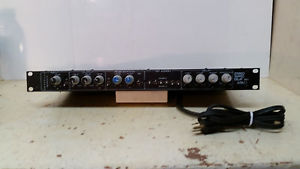
ADA STD-1 Stereo Tapped Delay Vintage Chorus Flanger (Holdsworth) A/DA
Estimated price for orientation: 600 $
Category: Signal Processors or Rack Effect
Class:
Description Condition: Used: An item that has been used previously. The item may have some signs of cosmetic wear, but is fully operational and functions as intended. This item may be a floor model or store return that has been used. See the seller’s listing for full details and description of any imperfections. See all condition definitions- opens in a new window or tab ... Read moreabout the condition Type: Single-Effect Processor Form Factor: Rack-Mountable Effect/Enhancement: Chorus Number of Channels: 2 Model: Stereo Tapped Delay Brand: ADA
Killer vintage unit with 6 chorus taps for unique chorus, delay and flange effects. Allan Holdsworth used one of these as part of his unique chorus tones.The STD-1 is a tapped delay, meaning that it has multiple delay outputs at enharmonic taps in the MN3011 bucket brigade delay (BBD). This is not intended to be an echo unit as the longest delay time is 55.5ms. Rather, it is designed for multi-voiced modulated delays (chorus, flange), doubling, ambience effects, and crude reverb.A garden variety analog delay is based around a BBD with a single output at the end of the chain. The STD-1 uses the MN3011 which is a 3328 stage BBD with six outputs, one at the end of the chain and the other five at "taps" throughout the middle of the BBD chain hence the name "tapped delay". These taps are non-harmonically related at 1.3ms, 2.2ms, 4.6ms, 5.8ms, 8.3ms, 11.1ms outputs whose delay times can be increased by a factor of five. The purpose of non-harmonic taps was to emulate reverb as the multiple reflections of natural reverb are not a fixed time displacement. This is not just a conventional delay unit. Each of the six taps is assignable to the A/B (left/right) output field. Feedback is interesting in that it can be tapped at tap 1, 3, or 6 and the behavior is dependent on the delay time. At short delays it creates a resonance which is useful for changing the timbre of the signal, while longer delays it is designed to emulate reverb reflections. A high cut control reduces the high frequency content to emulate natural sounding echoes. The modulation section provides not one but two modulation sources. This system produces complex chorus effects such as ensembles, realistic doubling, random pitch shifts, and sweeping ambience.The short delay taps are excellent for stereo imaging effects. When you add LFO modulation to produce chorus/flange effects, the STD-1 provides up to six modulated delays all at different time delays. This multi-voiced modulated delay configuration can sound a lot thicker and more complex than a conventional delay unit. This is one of the best flanging units due to the resonant flanging made possible with the feedback architecture. The regeneration system does nice work of making a tinny instrument into a fat resonant honker. Probably the sole celebrity attachment to the STD-1 is Allan Holdsworth - he used two of them in his guitar system. Kirk Hammett of Metallica later used them. This isn't a conventional delay unit and it didn't start to earn appreciation until ten years after it was discontinued. Today they are in demand but they do not turn up for sale often.
Description
| Condition: | Used: An item that has been used previously. The item may have some signs of cosmetic wear, but is fully operational and functions as intended. This item may be a floor model or store return that has been used. See the seller’s listing for full details and description of any imperfections. See all condition definitions- opens in a new window or tab ... Read moreabout the condition | Type: | Single-Effect Processor |
| Form Factor: | Rack-Mountable | Effect/Enhancement: | Chorus |
| Number of Channels: | 2 | Model: | Stereo Tapped Delay |
| Brand: | ADA |
Killer vintage unit with 6 chorus taps for unique chorus, delay and flange effects. Allan Holdsworth used one of these as part of his unique chorus tones.The STD-1 is a tapped delay, meaning that it has multiple delay outputs at enharmonic taps in the MN3011 bucket brigade delay (BBD). This is not intended to be an echo unit as the longest delay time is 55.5ms. Rather, it is designed for multi-voiced modulated delays (chorus, flange), doubling, ambience effects, and crude reverb.A garden variety analog delay is based around a BBD with a single output at the end of the chain. The STD-1 uses the MN3011 which is a 3328 stage BBD with six outputs, one at the end of the chain and the other five at "taps" throughout the middle of the BBD chain hence the name "tapped delay". These taps are non-harmonically related at 1.3ms, 2.2ms, 4.6ms, 5.8ms, 8.3ms, 11.1ms outputs whose delay times can be increased by a factor of five. The purpose of non-harmonic taps was to emulate reverb as the multiple reflections of natural reverb are not a fixed time displacement. This is not just a conventional delay unit. Each of the six taps is assignable to the A/B (left/right) output field. Feedback is interesting in that it can be tapped at tap 1, 3, or 6 and the behavior is dependent on the delay time. At short delays it creates a resonance which is useful for changing the timbre of the signal, while longer delays it is designed to emulate reverb reflections. A high cut control reduces the high frequency content to emulate natural sounding echoes. The modulation section provides not one but two modulation sources. This system produces complex chorus effects such as ensembles, realistic doubling, random pitch shifts, and sweeping ambience.The short delay taps are excellent for stereo imaging effects. When you add LFO modulation to produce chorus/flange effects, the STD-1 provides up to six modulated delays all at different time delays. This multi-voiced modulated delay configuration can sound a lot thicker and more complex than a conventional delay unit. This is one of the best flanging units due to the resonant flanging made possible with the feedback architecture. The regeneration system does nice work of making a tinny instrument into a fat resonant honker. Probably the sole celebrity attachment to the STD-1 is Allan Holdsworth - he used two of them in his guitar system. Kirk Hammett of Metallica later used them. This isn't a conventional delay unit and it didn't start to earn appreciation until ten years after it was discontinued. Today they are in demand but they do not turn up for sale often.