Back to the main page Back to category Vintage Pro Audio Equipment
musical instrument details
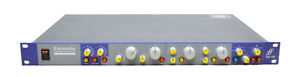
Focusrite ISA 110 Mono Mic Pre and Equalizer - Limited Edition
Estimated price for orientation: 1 699 $
Category: Vintage Pro Audio Equipment
Class:
Description Type: Vintage Mic Pre and Equalizer Model: ISA 110 - Limited Edition Brand: Focusrite Country/Region of Manufacture: United Kingdom
The Focusrite ISA 110 Original Mono Mic-Pre & Equalizer is a limited-edition version of the famed single-channel ISA 110 EQ module. The original ISA 110/130 units were developed by Rupert Neve, who had been commissioned to supply 16 extra inputs for a Neve console at AIR Studios. These 1984-era ancillary input modules fitted vertically into a rackmounted card cage that required an external power supply. Around 1986, Focusrite began selling outboard racks containing two, four or eight ISA 110/130 modules, and in 1989 the module became the basis of the Focusrite Studio console (of which only ten were made). The Focusrite Red Range products and the ISA 215 units are also derived in part from the original 110 module.The new ISA 110 differs from the original in that it is packaged in a horizontal one-rackspace unit with an internal power supply. However, the electronic circuit design, the componentry and the performance specifications are all exactly the same as the original ISA 110. The original printed circuit board has been extended to include the integral power supply and accessible rear panel insert jacks, both new features.Popping the hood reveals why this preamplifier sounds and works the way it does. Focusrite has designed proprietary transformers specifically for the ISA 110, for both line and microphone level inputs. The mic input transformer and the high-capacity power supply transformer both use mu-metal shielding for maximum low-noise performance. All the rotary switches are U.S.-made gold-plated switches, the push buttons are Swiss-made, and all the pots are manufactured in France using conductive plastic for maximum accuracy and smooth feel. The equalizer's shelving bands use rotary switches with individual capacitors for each frequency and one op amp for maximum fidelity and minimum distortion. Because rotary switches are much more expensive than pots, this qualifies as a costly "audiophile" design; switching individual capacitors are usually replaced by a cheaper single-capacitor circuit design and another pot.All circuit functions are switched in and out of circuit by way of relays featuring gold-plated silver levers sealed in inert gas containers (compared to FET switching, relays are best for preventing breakthrough and distortion). The main audio op amp used through out the ISA 110 is the 5534.MIC PRE SECTIONThe ISA 110 has four sections: mic preamp, highpass and lowpass filters, shelving equalizer and a separate parametric equalizer. The preamp has up to 60 dB of gain, which is switchable via the mic rotary switch in 6dB steps. There is also a gain trim control for additional gain from 0 dB to 10 dB. THD is measured at 0.0008%, and noise is measured at -123 dB with a 150-ohm input termination and 60 dB of gain. With an input impedance of 1.2 kilohms and a maximum input level at +26 dBu, there is not much to complain about. However, I wish the trim control had a center detent at 0 dB and a larger knob like the equalizer sections, which would make it easier to manually "ride" mic gain up or down while recording widely dynamic sources. Individual front panel buttons engage +48 phantom on/off and phase reverse.FILTER AND EQUALIZER SECTIONSThe highpass and lowpass sections provide 18 dB per octave roll-offs. The rotary switch for the lowpass filter has 3.9, 5.6, 8.2, 12 and 16kHz corner frequency choices and an Off position that switches the section completely out of circuit. Likewise, the rotary highpass has settings for 30, 60, 105, 185, 330 Hz and Off.The two bands of the parametric equalizer section each feature continuously variable boost/cut controls (+/-18 dB) with center detent. The two selectable frequency ranges overlap, and there is a variable Q (bandwidth) control. Each of the two bands also has a yellow X3 button that triples the indicated frequency. The tripled frequency is read on a yellow-colored scale. The first band is sweepable from 40 to 400 Hz (which triples to 120 to 1.2k Hz). The second band goes from 600 to 6k Hz (triples to 1.8 to 18 kHz). A slightly larger control for EQ frequency would have been a nice touch.Variable Q is selected by a single knob that is the same size as the frequency select knob and is positioned directly above it. This is a smooth pot, and I would have preferred it being placed below the EQ frequency knob. I also found it difficult to read EQ frequency as the silk-screened legend for the two concentric frequency ranges is in small type and somewhat obscured by the Q knob. (Because it was a vertical unit and the two controls sat side by side, this wasn't a problem on the original ISA 110.) Q is adjustable from 0.8 at the broadest to a tight 3.0, sharp enough for most surgical needs. The entire section has its own bypass button that is globally controlled by the master All EQ bypass switch.For me, the defining difference that characterizes Focusrite EQ is the combination of the shelving and parametric equalizers, and the shelving equalizer sells this unit all by itself. The shelving EQ offers both high- and low-frequency shelving sections with six-position frequency selection switches and section bypass button. Low-frequency choices are 33, 56, 95, 160, 270 and 330 Hz. High-frequency positions are 3.3, 4.7, 6.8, 10, 15 and 18 kHz. The shelving EQ shape is 6 dB per octave with a maximum boost and cut of 18 dB.MORE FEATURESThe ISA 110 also has a line input with a rotary line gain switch that adjusts +/-18 dB in 6dB steps. The same trim control used for the mic preamp doubles as additional line gain adjustment from 0 to 10 dB. There are both Mic and Line selector buttons, and toggling one button untoggles the other--I tend to use the Line button as a "mute" button when directly recording vocals. All switching as well as all knob changes on the ISA 110 are dead-quiet and seamless--no pops, clicks or buzzes.The rear panel Insert Send jack provides a +4dBu output (up to +20 dBu) after the mic pre and before the equalizer. The companion Insert Return jack requires a +4dB signal (up to +26 dBu). The original ISA 110 unit had the insert point electronics on the printed circuit board but no front panel switch or rear panel connectors. Therefore, there isn't an insert in/out button, but the All EQ switch disconnects the insert along with the equalizer, allowing you to A/B the entire chain--EQ and insert processing --together.Focusrite's decision to remain faithful to the original in every detail also reproduces what I would call a quirk --the Overload indicator looks just like another button and is placed between two real buttons.ALL OF THESE UNITS HAVE BEEN TESTED PRIOR TO SALE AND ARE FULLY FUNCTIONAL. ITEMS WILL SHIP WITH INSURANCE. SORRY BUT NO REFUNDS/NO RETURNS.
Description
| Type: | Vintage Mic Pre and Equalizer | Model: | ISA 110 - Limited Edition |
| Brand: | Focusrite | Country/Region of Manufacture: | United Kingdom |
The Focusrite ISA 110 Original Mono Mic-Pre & Equalizer is a limited-edition version of the famed single-channel ISA 110 EQ module. The original ISA 110/130 units were developed by Rupert Neve, who had been commissioned to supply 16 extra inputs for a Neve console at AIR Studios. These 1984-era ancillary input modules fitted vertically into a rackmounted card cage that required an external power supply. Around 1986, Focusrite began selling outboard racks containing two, four or eight ISA 110/130 modules, and in 1989 the module became the basis of the Focusrite Studio console (of which only ten were made). The Focusrite Red Range products and the ISA 215 units are also derived in part from the original 110 module.The new ISA 110 differs from the original in that it is packaged in a horizontal one-rackspace unit with an internal power supply. However, the electronic circuit design, the componentry and the performance specifications are all exactly the same as the original ISA 110. The original printed circuit board has been extended to include the integral power supply and accessible rear panel insert jacks, both new features.Popping the hood reveals why this preamplifier sounds and works the way it does. Focusrite has designed proprietary transformers specifically for the ISA 110, for both line and microphone level inputs. The mic input transformer and the high-capacity power supply transformer both use mu-metal shielding for maximum low-noise performance. All the rotary switches are U.S.-made gold-plated switches, the push buttons are Swiss-made, and all the pots are manufactured in France using conductive plastic for maximum accuracy and smooth feel. The equalizer's shelving bands use rotary switches with individual capacitors for each frequency and one op amp for maximum fidelity and minimum distortion. Because rotary switches are much more expensive than pots, this qualifies as a costly "audiophile" design; switching individual capacitors are usually replaced by a cheaper single-capacitor circuit design and another pot.All circuit functions are switched in and out of circuit by way of relays featuring gold-plated silver levers sealed in inert gas containers (compared to FET switching, relays are best for preventing breakthrough and distortion). The main audio op amp used through out the ISA 110 is the 5534.MIC PRE SECTIONThe ISA 110 has four sections: mic preamp, highpass and lowpass filters, shelving equalizer and a separate parametric equalizer. The preamp has up to 60 dB of gain, which is switchable via the mic rotary switch in 6dB steps. There is also a gain trim control for additional gain from 0 dB to 10 dB. THD is measured at 0.0008%, and noise is measured at -123 dB with a 150-ohm input termination and 60 dB of gain. With an input impedance of 1.2 kilohms and a maximum input level at +26 dBu, there is not much to complain about. However, I wish the trim control had a center detent at 0 dB and a larger knob like the equalizer sections, which would make it easier to manually "ride" mic gain up or down while recording widely dynamic sources. Individual front panel buttons engage +48 phantom on/off and phase reverse.FILTER AND EQUALIZER SECTIONSThe highpass and lowpass sections provide 18 dB per octave roll-offs. The rotary switch for the lowpass filter has 3.9, 5.6, 8.2, 12 and 16kHz corner frequency choices and an Off position that switches the section completely out of circuit. Likewise, the rotary highpass has settings for 30, 60, 105, 185, 330 Hz and Off.The two bands of the parametric equalizer section each feature continuously variable boost/cut controls (+/-18 dB) with center detent. The two selectable frequency ranges overlap, and there is a variable Q (bandwidth) control. Each of the two bands also has a yellow X3 button that triples the indicated frequency. The tripled frequency is read on a yellow-colored scale. The first band is sweepable from 40 to 400 Hz (which triples to 120 to 1.2k Hz). The second band goes from 600 to 6k Hz (triples to 1.8 to 18 kHz). A slightly larger control for EQ frequency would have been a nice touch.Variable Q is selected by a single knob that is the same size as the frequency select knob and is positioned directly above it. This is a smooth pot, and I would have preferred it being placed below the EQ frequency knob. I also found it difficult to read EQ frequency as the silk-screened legend for the two concentric frequency ranges is in small type and somewhat obscured by the Q knob. (Because it was a vertical unit and the two controls sat side by side, this wasn't a problem on the original ISA 110.) Q is adjustable from 0.8 at the broadest to a tight 3.0, sharp enough for most surgical needs. The entire section has its own bypass button that is globally controlled by the master All EQ bypass switch.For me, the defining difference that characterizes Focusrite EQ is the combination of the shelving and parametric equalizers, and the shelving equalizer sells this unit all by itself. The shelving EQ offers both high- and low-frequency shelving sections with six-position frequency selection switches and section bypass button. Low-frequency choices are 33, 56, 95, 160, 270 and 330 Hz. High-frequency positions are 3.3, 4.7, 6.8, 10, 15 and 18 kHz. The shelving EQ shape is 6 dB per octave with a maximum boost and cut of 18 dB.MORE FEATURESThe ISA 110 also has a line input with a rotary line gain switch that adjusts +/-18 dB in 6dB steps. The same trim control used for the mic preamp doubles as additional line gain adjustment from 0 to 10 dB. There are both Mic and Line selector buttons, and toggling one button untoggles the other--I tend to use the Line button as a "mute" button when directly recording vocals. All switching as well as all knob changes on the ISA 110 are dead-quiet and seamless--no pops, clicks or buzzes.The rear panel Insert Send jack provides a +4dBu output (up to +20 dBu) after the mic pre and before the equalizer. The companion Insert Return jack requires a +4dB signal (up to +26 dBu). The original ISA 110 unit had the insert point electronics on the printed circuit board but no front panel switch or rear panel connectors. Therefore, there isn't an insert in/out button, but the All EQ switch disconnects the insert along with the equalizer, allowing you to A/B the entire chain--EQ and insert processing --together.Focusrite's decision to remain faithful to the original in every detail also reproduces what I would call a quirk --the Overload indicator looks just like another button and is placed between two real buttons.ALL OF THESE UNITS HAVE BEEN TESTED PRIOR TO SALE AND ARE FULLY FUNCTIONAL. ITEMS WILL SHIP WITH INSURANCE. SORRY BUT NO REFUNDS/NO RETURNS.