Back to the main page Back to category Electric Guitar
musical instrument details
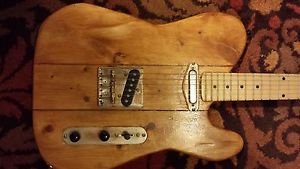
Luthier made Telecaster ONE OF A KIND handbuilt with Fender locking tuners
Estimated price for orientation: 689 $
Category: Electric Guitar
Class:
Description Condition: New: A brand-new, unused, unopened, undamaged item in its original packaging (where packaging is applicable). Packaging should be the same as what is found in a retail store, unless the item is handmade or was packaged by the manufacturer in non-retail packaging, such as an unprinted box or plastic bag. See the seller's listing for full details. See all condition definitions- opens in a new window or tab ... Read moreabout the condition Brand: ReeseHall Body Color: Brown Body Type: Solid Body Material: Solid Wood Model: Chiricahua Custom (Apache Series) Model Year: 2015 String Configuration: 6 String Country/Region of Manufacture: United States Dexterity: Right-Handed
Price for LIMITED TIME ONLY. This Fender’s 50’s era inspired telecaster custom shop is more than ready to accommodate your dramatic bends, your clean runs and late night emotional flourishes. When this guitar is gone, it’s gone. A Telecaster with an actual sculpted body, comfort cuts and similar components will not be found for this price. Special features: Fender staggered Locking Tuners Maple neck custom ©Ridgeline. FlashCharred Walnut-Maple finish Western motifs body art. Metal “reliced’ aka deliberately made to look old/worn single coil ring and bridge Particulars include: Fender staggered locking Machine heads/tuners. PAf ©Ridgline Canadian Maple Neck with truss 22 fret, 25.5 scale (9.25r / 1.65 nut/ Medium Jumbo frets) Metal hardware control knobs. Hex key adjustable. Standard Teleetwang© pickups. (Wilkinsons neck/ ChopperWb bridge) 3 saddle bridge Compensated saddles Medium jumbo frets PiD body art. (the rustic "paid its' dues" look) Streamline1. body width (similar to a Strat) Comfort cuts. Body and arm. Chrome roller string tree Black strap pegs with felt washers Poly-seal tri coat finish. Protected, but not to the point that it looks like plastic and not buffed. You're welcome. Cup style input jack Body through ferrules Creatively designed with Eastern Pine taken from an old school in Alamance co. North Carolina, and built for the true artist by an artist, this Telecaster reflects the spirit of a “Player’s Player” with integrity and character. It’s not a make a quick buck “barn-caster”; it’s a creative and carefully conceived instrument. This Telecaster wasn't cut with CNC machines in a factory; it was designed and shaped by a human being. It was affectionately sculpted by one person and it was brought into being for one person...not one million. There isn't another identical to it on the planet. Like you, it is one of a kind. This beautiful body was crafted, not assembled. It wasn't compiled from "crush and rush" stockpiles of soulless wood; it was matched carefully and mindfully with a creative purpose; striations, knots and all. It doesn't come in a variety of colors; it comes with natural wood tones. It isn't Meglo-Mart pretty; it's a raw yet refined beauty. When it comes to unique Tone Mojo, which cannot be duplicated, naturally aged woods with personality win out over factory cardboard cutouts every time. Guitar will be insured for shipping and buyer must sign for it. PayPal requires me ship to the address on the transaction and the address must be confirmed. I cannot ship to a different address that isn’t on the PayPal account. Also, a note to International buyers: import duties, taxes are not included in the guitar price or shipping cost. These charges are your responsibility. This guitar will ship within 48hrs if ordered and paid for by 1 PM EST Monday through Friday. All shipments will be made using Fedex or UPS Ground. I can’t ship to a PO Box. Will require a signature upon delivery. The guitar is NOS (new old stock) The wiring has been refurbished from its original design; all connections are solid- no 60 cycle hum and all controls work perfectly as modified. I prefer to offer a no questions asked return policy, but I simply can’t afford hobbyist whom get handcrafted Tele “fever” one week, then Gretsch Fever the next. You are protected by Ebay’s return policy however there should be no objective reason to return this guitar, it plays and sounds beautifully and has been fully described and explained. Thank you all for viewing! *= this guitar sports traditional Fender style components and genuine Fender locking tuners. The artistic design and creation of the build is by artist/luthier Tobias H. Reese. List of Telecaster playersFrom Wikipedia, the free encyclopediaJump to: , This is a and may never be able to satisfy particular standards for completeness. You can help by with entries.Fender Telecaster 50th Anniversary Edition is a manufacturer of stringed instruments and amplifiers which was founded by . Among the best-known products made by Fender were the , the Broadcaster and the . Because of the great popularity of these models, musicians are listed here only if their use of this instrument was especially significant—that is, they are players with long careers who have a history of faithful Telecaster use, or the particular guitar they used was unique or of historical importance, or their use of the Telecaster contributed significantly to the popularization of the instrument.Esquire players are here listed alongside players of the more famous Telecaster, since Fender regards it as part of the "family of Telecaster guitars". While the one-pickup Esquire has been marketed as a separate model from the two-pickup Telecaster (which was originally named the Broadcaster) since its reintroduction in 1951, the Esquire and Telecaster are so intimately linked in their development and history, and so similar in design and tonal characteristics, that they are considered variations of the same model.Contents [] A-E[] (1946–2006), guitarist/singer/songwriter of the band ; used a unique mirror-disk covered Esquire. (1936–1990), a hot country guitarist whose song "Country Guitar" with Verne Stovall, recorded on his Telecaster, was a hit in 1964 and earned him numerous awards. He worked as a popular session guitarist in Nashville from 1975 until his death in 1990. (born 1944) Emerging in the mid 1960s with , Beck proved that a ragged Fender Esquire could moan like a fuzzed-out violin. His lines in “Heart Full of Soul” and “Evil Hearted You” defined psychedelic guitar. (born 1932) is a premier jazz player who started playing a Telecaster when his regular guitar was in the shop, and he has used it for the rest of his career. (born 1965) of the is a long-time Telecaster player. (1925–1980), a prolific session musician, was given one of the first Broadcasters by Fender engineer . Fullerton compared this gift to "starting a prairie fire," and said that " pretty soon we couldn't make enough of those guitars." (1939–1988), a blues/rock musician whose playing inspired the likes of , earning him the title "The Guitarist's Guitarist's Guitarist," was a faithful Tele man during his solo career. (1966–1997), an American singer-songwriter and guitarist, used a borrowed '83 toploader Telecaster that became a staple of his performances and recordings. (born 1939) has played a Telecaster since he was 13, and he has influenced many other guitarists. He was the most visible player of the Tele in the late '50s, appearing on television with almost every week on the Adventures of Ozzie & Harriet. His most famous guitar is the Paisley Red Tele, which he first used while performing with . He has also played with and . As a long-time Tele player, he wrote a foreword to A. R. Duchossoir's book detailing the history of the guitar. (born 1950), best known for his work with , has stated that his 1950 Broadcaster has been one of his live mainstay guitars since the beginning of the . On their and albums, he recorded most of his solos & rhythm parts on songs such as "", "", and "" using his Broadcaster exclusively. Mike also played an early-'70s Telecaster with two and nicknamed "Big Red". MBE (born 21 May 1941) is an English folk singer and guitarist who has remained one of the most influential figures in British traditional music. He played a blue Telecaster, with a white pickguard and two single-coil pickups, while a member of the renown British folk-rock band, , from 1970-1972, 1977-1978 and 1999. (1932–1993) ("The Master of the Telecaster") created his original blues sound using minor open tunings and a capo placed high up on the neck. Fender offers an based on his '66 model, which features a humbucker in the neck position. (born 1969), guitarist of , has relied on the Telecaster for the majority of his career, achieving a distinctive sound underlined by an inventive use of effects that played an integral part in Blur's success during the 1990s. He uses a blonde 1968 Telecaster with a Gibson PAF Pickup, a 1960 Lake Placid blue Telecaster Relic, and a 1972 Telecaster Deluxe, while his time with Blur saw him use a reissue 1952 blonde Telecaster. (born 1941) creates rhythm work known to be spare and crisp using the bridge pickup of the Telecaster, playing with session band , who backed such stars as and . of presaged the 1970s trend for dual-humbucker Teles by replacing both of the single coils in his guitar with humbuckers and installing a -style bridge. (born 1946) of released a solo album in 1986 called Telecasting and was a member of the Telecaster trio called the . (born 1941) owned a black-and-white 1958 Telecaster which became one of his first electric guitars, shaping his . He used this guitar on his epic 1966 tour of Australia and Europe. F-J[] (born 1951) jazz guitarist noted for his atmospheric legato sounds, has, for the last several years, used the Telecaster as his primary guitar. Bill Frisell (1945–1994) played a customized '53 Tele whose specifications were replicated by Fender for his Signature model, including unique angled bridge saddles for improved intonation of the classic 3-saddle bridge, and use of Joe Barden pickups. (born 1957), who replaced fellow Tele-player Albert Lee in backing band, uses a '53 Telecaster as his primary stage guitar. (born 1946) has used a Telecaster and Esquire from Fender in addition to his regularly used . His beat-up looking Esquire was used on his 1978 solo album on backing tracks, the studio version of "" from , and recently on 's album. It was also pictured on the back of his 1984 solo album . He used a Telecaster for some early recordings, and used a sunburst Telecaster for all of the guitar solos (both live and in studio) on the track "" from Pink Floyd's 1977 album . He used a 1952 reissue yellow Telecaster on live performances of "Run Like Hell" on the live albums and home videos and , as well as on performances of "" (as originally written and performed by Esquire player —see above) on the European leg of the tour in support of . A recording of the song was included on Pulse. (1946–2005), a Southern California guitarist, helped Fender design an accurate '52 Telecaster vintage reissue (their first such reissue) by referencing his extensive collection of old Telecasters, Broadcasters and . Ted was most famous as being one of the top jazz guitar instructors on the west coast. He was also the author of several instructional books "Chord Chemistry," "Modern Chord Progressions," and Single Note Soloing Volumes 1 and 2." (born 1971) of has made extensive use of the Telecaster since the late 80's. He notably uses a Telecaster Plus model with an added cutoff switch. (1937-2016) - revolutionized country music with his twangy Telecaster sound, along with Buck Owens and Roy Nichols. (1943–2001) of received a prototype Rosewood Telecaster as a planned gift from Fender in 1968, which is now the basis for a Fender George Harrison Signature Telecaster. Fender selected the better of two prototypes built, flew it to England in its own personal seat along with a courier, and hand-delivered the guitar to Apple offices in December 1968. Harrison used this guitar during famous 'Get Back Sessions' as well as on the Beatles' 1970 album and 1969's . Of equal notability, Harrison used the rosewood Tele for the Beatles' last public performance in 1969, famously referred to as . Harrison subsequently gave this instrument to Delaney Bramlett. (born 1969) used to play a borrowed 1967 Telecaster (from friend John Parish) during her early career. In a 1995 interview to Guitar Player, she declared: "John's Telecaster is closer to my heart. It's on all my records — I used to nick it all the time." Later, in 2000, when she received the , she bought her own 60s Telecaster. (born 1953) has used a Telecaster since 1979 for his distinctive English electric psychedelic sound, and said that it "... chose itself for me as my favourite electric guitar, because so many of my favourite guitar riffs were played on it." (born 1947) has used a 1955 Telecaster, customized with a different toggle switch and a humbucker in the neck position for the first time in the entire 1974 album "", and after that frequently uses his Telecaster in various live performances and in several studio recordings. (born 1951) has often used her blue Telecaster with , and it was pictured on the jacket of their album . (1937–2002), a country legend, played many 1953 Telecasters which were covered with white-and-black leather carved in an oak leaf and floral motif. He also had some other Teles, but he mostly played two of his '53s. He has been honored by Fender with a Waylon Jennings Tribute Telecaster. (born John Wilkinson, 12 July 1947, Canvey Island, Essex), a British R&B and Pub Rock legend, exponent of 'machine gun' rhythm/lead style that has inspired punk and speed metal players alike. He has played the same black tele with red pickguard for years as founder member of Dr Feelgood and subsequently with Ian Dury's Blockheads as well as his own bands. "The punk guitarist's punk guitarist was Wilko Johnson of Dr Feelgood" (born 1971) is a heavy metal/country guitarist who has played with and who is known for his proficiency at . Fender now produces a J5 Signature Telecaster which John 5 co-designed. K-P[] (born 1947), longtime Telecaster devotee who played in during the 1970s and continues to drive his well-abused Tele to the limits of the rockabilly sound. Known for his barnstorming live licks and stylisitic diversity, Kirchen's first Telecaster came to him in a 1967 even trade with a stranger he met on bus, Kirchen exchanging his own in the deal Richie Kotzen (!) (born 1943), whose instrumental work has influenced many other guitarists, has played a Telecaster since 1963. As a long-time Tele player, he wrote a foreword to A. R. Duchossoir's book detailing the history of the guitar. (born 1953), the guitarist of , frequently uses the Telecaster in live performances and in studio recordings. (born 1959), a prolific Nashville session musician. Gibson produces a , which is modeled after Mason's heavily customized 1968 Telecaster. It features 2 "stacked" pick-ups (bridge and middle) and one mini humbucker (neck position), and an additional volume control to "bleed in" the middle pick-up. (born 1963), famously used a Telecaster on The Smith's hit "This Charming Man." (1932–2001) was a guitarist in 's group The Strangers, and famously used the "" technique for which the Telecaster is so well suited. Fittingly, an image of a Telecaster is engraved on his tombstone. (born 1953), aged 16, got a 66 blonde Telecaster which used to belong to . He performed all the guitar parts of his breakthrough album with this guitar, and most parts of his next albums. (1929–2006), along with and their custom sparkle-finish Telecasters, helped create the distinctive of country music in the early 1960s. Owens' personal Telecaster was gold with a red, white, and blue pickguard, reminiscent of his famous American Flag style Acoustic guitar. (born 1944), though more known for his use of the , used a Telecaster in his earlier work with and on first album, as well as on , one of Led Zeppelin's most famous tracks. Page later used the Telecaster in recording and touring for his solo album . (born 1948) of , "one of Britain's longest-lived bands," is a faithful Tele player. (born 1972) plays guitars from an extensive collection of Telecasters and Tele-inspired models, including his "warhorse," a '68 Red Paisley model (the same model that James Burton made famous) named "Old Pink." One notable feature on some of his guitars is a device. Paisley has custom Tele-inspired models made by Crook Custom Guitars. (1928–1968), a member of backing band used his Esquire to create the "boom-chicka" rhythms that came to characterize much of Cash's music. Q-Z[]Keith Richards (born 1950) has been part of the Telecaster trio the from 1993-on. He is known for extensive use of the and finger-mount slide on his Telecaster. In recognition of the Hellecasters' contributions to the Telecaster, Fender has produced more signature models for the group than for any other group, including two Will Ray signature models: the Jazz-a-Caster and the Mojo-Tele. (1942–1974) made the bassy rhythms and "" of his custom sparkle-finish Telecaster an indispensable part of the while playing with & The Buckaroos. (born 1943) has composed many classic riffs with using a variety of Telecasters. His main axe is a '53 Tele named Micawber, which features a 5-string open G tuning and a humbucker in the neck position. (born 1943) of , used a Telecaster from 1958 to 1974. His trusty Telecaster can be heard on many of the Band's recordings. (born 1971) of , , now plays Fender Telecasters, Stratocasters and Jazzmasters, after trying other brands like Charvel (born 1949) of , "one of Britain's longest-lived bands," is a faithful Tele player. (born 1953) has been a respected artist ever since his first solo album won the Montreaux Critics’ Award for Best Instrumental Album of the Year in 1978. He was Guitar Player Magazine's top columnist from 1982 to 1992. He has performed with such diverse artists as , , and . He is a Telecaster enthusiast, and has written the book Masters of the Telecaster, which details the licks of many famous Tele players. (born 1949) has long played a 1952 Esquire upgraded with a Telecaster neck pickup. The guitar appears on the cover of his 1975 album . (born 1953) is one of the few Tele-playing jazz musicians, played guitar with in the early 1980s before going solo. Stern's first Telecaster, which he purchased from in 1975, had originally belonged to . This guitar was stolen, and was replaced by a custom-built Telecaster-style instrument by Michael Aronson. Yamaha subsequently introduced the Pacifica 1511 Mike Stern signature model in 1996, a Telecaster-style instrument based on the Aronson guitar. (1952–2002) of was "the most visible Tele player" in late 1970s punk, using his famous stickered instrument throughout his career, up until his death. His black Tele was a 1964 Sunburst that he painted when he started to play with , he also used a White Telecaster in the late 70's (born 1958) has been a career-long devotee of the guitar. The Fender Custom Shop makes a Limited Edition Marty Stuart Tribute Telecaster which blends features from his favorite historical guitars, as played by Buck Owens, Don Rich, Mick Ronson and Clarence White. Stuart is also the owner of the original Parsons/White prototype B-bender Telecaster originally owned by Clarence White and given to Stuart by the White family. Stuart also owns Don Rich's silver metal-flake Telecaster that was given to him by Buck Owens. (born 1942) of almost always used his '61/'63 Telecaster Custom, which was customized with a Gibson neck humbucker, a preamp and a phase switch. Fender now make the Andy Summers Tribute Telecaster. (1930–1997), veteran L.A. session guitarist, used a white Telecaster as his workhorse electric guitar for most of his career. (born 1945), though famous for his Tele smashing in the 1960s with , spared his favorite guitar, a 1952 vintage Telecaster. (born 1967) regularly plays Telecasters, one of which features decorative binding and three pickups. (born 1958) was a successor to Roy Nichols in Merle Haggard's backing band, and is "among the country’s top Telecaster guitar slingers." (1913–1983) helped build a bridge between the blues and rock with his "walls of electrified sound," played on his red '59 Telecaster. Until 2010, Fender sold a Muddy Waters Telecaster, one of the guitars in its Signature series. (1944–1973) of , along with drummer , invented the device for the Tele for emulating effects.
Description
| Condition: | New: A brand-new, unused, unopened, undamaged item in its original packaging (where packaging is applicable). Packaging should be the same as what is found in a retail store, unless the item is handmade or was packaged by the manufacturer in non-retail packaging, such as an unprinted box or plastic bag. See the seller's listing for full details. See all condition definitions- opens in a new window or tab ... Read moreabout the condition | Brand: | ReeseHall |
| Body Color: | Brown | Body Type: | Solid |
| Body Material: | Solid Wood | Model: | Chiricahua Custom (Apache Series) |
| Model Year: | 2015 | String Configuration: | 6 String |
| Country/Region of Manufacture: | United States | Dexterity: | Right-Handed |
Price for LIMITED TIME ONLY. This Fender’s 50’s era inspired telecaster custom shop is more than ready to accommodate your dramatic bends, your clean runs and late night emotional flourishes. When this guitar is gone, it’s gone. A Telecaster with an actual sculpted body, comfort cuts and similar components will not be found for this price. Special features: Fender staggered Locking Tuners Maple neck custom ©Ridgeline. FlashCharred Walnut-Maple finish Western motifs body art. Metal “reliced’ aka deliberately made to look old/worn single coil ring and bridge Particulars include: Fender staggered locking Machine heads/tuners. PAf ©Ridgline Canadian Maple Neck with truss 22 fret, 25.5 scale (9.25r / 1.65 nut/ Medium Jumbo frets) Metal hardware control knobs. Hex key adjustable. Standard Teleetwang© pickups. (Wilkinsons neck/ ChopperWb bridge) 3 saddle bridge Compensated saddles Medium jumbo frets PiD body art. (the rustic "paid its' dues" look) Streamline1. body width (similar to a Strat) Comfort cuts. Body and arm. Chrome roller string tree Black strap pegs with felt washers Poly-seal tri coat finish. Protected, but not to the point that it looks like plastic and not buffed. You're welcome. Cup style input jack Body through ferrules Creatively designed with Eastern Pine taken from an old school in Alamance co. North Carolina, and built for the true artist by an artist, this Telecaster reflects the spirit of a “Player’s Player” with integrity and character. It’s not a make a quick buck “barn-caster”; it’s a creative and carefully conceived instrument. This Telecaster wasn't cut with CNC machines in a factory; it was designed and shaped by a human being. It was affectionately sculpted by one person and it was brought into being for one person...not one million. There isn't another identical to it on the planet. Like you, it is one of a kind. This beautiful body was crafted, not assembled. It wasn't compiled from "crush and rush" stockpiles of soulless wood; it was matched carefully and mindfully with a creative purpose; striations, knots and all. It doesn't come in a variety of colors; it comes with natural wood tones. It isn't Meglo-Mart pretty; it's a raw yet refined beauty. When it comes to unique Tone Mojo, which cannot be duplicated, naturally aged woods with personality win out over factory cardboard cutouts every time. Guitar will be insured for shipping and buyer must sign for it. PayPal requires me ship to the address on the transaction and the address must be confirmed. I cannot ship to a different address that isn’t on the PayPal account. Also, a note to International buyers: import duties, taxes are not included in the guitar price or shipping cost. These charges are your responsibility. This guitar will ship within 48hrs if ordered and paid for by 1 PM EST Monday through Friday. All shipments will be made using Fedex or UPS Ground. I can’t ship to a PO Box. Will require a signature upon delivery. The guitar is NOS (new old stock) The wiring has been refurbished from its original design; all connections are solid- no 60 cycle hum and all controls work perfectly as modified. I prefer to offer a no questions asked return policy, but I simply can’t afford hobbyist whom get handcrafted Tele “fever” one week, then Gretsch Fever the next. You are protected by Ebay’s return policy however there should be no objective reason to return this guitar, it plays and sounds beautifully and has been fully described and explained. Thank you all for viewing! *= this guitar sports traditional Fender style components and genuine Fender locking tuners. The artistic design and creation of the build is by artist/luthier Tobias H. Reese. List of Telecaster playersFrom Wikipedia, the free encyclopediaJump to: , This is a and may never be able to satisfy particular standards for completeness. You can help by with entries.Fender Telecaster 50th Anniversary Edition is a manufacturer of stringed instruments and amplifiers which was founded by . Among the best-known products made by Fender were the , the Broadcaster and the . Because of the great popularity of these models, musicians are listed here only if their use of this instrument was especially significant—that is, they are players with long careers who have a history of faithful Telecaster use, or the particular guitar they used was unique or of historical importance, or their use of the Telecaster contributed significantly to the popularization of the instrument.Esquire players are here listed alongside players of the more famous Telecaster, since Fender regards it as part of the "family of Telecaster guitars". While the one-pickup Esquire has been marketed as a separate model from the two-pickup Telecaster (which was originally named the Broadcaster) since its reintroduction in 1951, the Esquire and Telecaster are so intimately linked in their development and history, and so similar in design and tonal characteristics, that they are considered variations of the same model.Contents [] A-E[] (1946–2006), guitarist/singer/songwriter of the band ; used a unique mirror-disk covered Esquire. (1936–1990), a hot country guitarist whose song "Country Guitar" with Verne Stovall, recorded on his Telecaster, was a hit in 1964 and earned him numerous awards. He worked as a popular session guitarist in Nashville from 1975 until his death in 1990. (born 1944) Emerging in the mid 1960s with , Beck proved that a ragged Fender Esquire could moan like a fuzzed-out violin. His lines in “Heart Full of Soul” and “Evil Hearted You” defined psychedelic guitar. (born 1932) is a premier jazz player who started playing a Telecaster when his regular guitar was in the shop, and he has used it for the rest of his career. (born 1965) of the is a long-time Telecaster player. (1925–1980), a prolific session musician, was given one of the first Broadcasters by Fender engineer . Fullerton compared this gift to "starting a prairie fire," and said that " pretty soon we couldn't make enough of those guitars." (1939–1988), a blues/rock musician whose playing inspired the likes of , earning him the title "The Guitarist's Guitarist's Guitarist," was a faithful Tele man during his solo career. (1966–1997), an American singer-songwriter and guitarist, used a borrowed '83 toploader Telecaster that became a staple of his performances and recordings. (born 1939) has played a Telecaster since he was 13, and he has influenced many other guitarists. He was the most visible player of the Tele in the late '50s, appearing on television with almost every week on the Adventures of Ozzie & Harriet. His most famous guitar is the Paisley Red Tele, which he first used while performing with . He has also played with and . As a long-time Tele player, he wrote a foreword to A. R. Duchossoir's book detailing the history of the guitar. (born 1950), best known for his work with , has stated that his 1950 Broadcaster has been one of his live mainstay guitars since the beginning of the . On their and albums, he recorded most of his solos & rhythm parts on songs such as "", "", and "" using his Broadcaster exclusively. Mike also played an early-'70s Telecaster with two and nicknamed "Big Red". MBE (born 21 May 1941) is an English folk singer and guitarist who has remained one of the most influential figures in British traditional music. He played a blue Telecaster, with a white pickguard and two single-coil pickups, while a member of the renown British folk-rock band, , from 1970-1972, 1977-1978 and 1999. (1932–1993) ("The Master of the Telecaster") created his original blues sound using minor open tunings and a capo placed high up on the neck. Fender offers an based on his '66 model, which features a humbucker in the neck position. (born 1969), guitarist of , has relied on the Telecaster for the majority of his career, achieving a distinctive sound underlined by an inventive use of effects that played an integral part in Blur's success during the 1990s. He uses a blonde 1968 Telecaster with a Gibson PAF Pickup, a 1960 Lake Placid blue Telecaster Relic, and a 1972 Telecaster Deluxe, while his time with Blur saw him use a reissue 1952 blonde Telecaster. (born 1941) creates rhythm work known to be spare and crisp using the bridge pickup of the Telecaster, playing with session band , who backed such stars as and . of presaged the 1970s trend for dual-humbucker Teles by replacing both of the single coils in his guitar with humbuckers and installing a -style bridge. (born 1946) of released a solo album in 1986 called Telecasting and was a member of the Telecaster trio called the . (born 1941) owned a black-and-white 1958 Telecaster which became one of his first electric guitars, shaping his . He used this guitar on his epic 1966 tour of Australia and Europe. F-J[] (born 1951) jazz guitarist noted for his atmospheric legato sounds, has, for the last several years, used the Telecaster as his primary guitar. Bill Frisell (1945–1994) played a customized '53 Tele whose specifications were replicated by Fender for his Signature model, including unique angled bridge saddles for improved intonation of the classic 3-saddle bridge, and use of Joe Barden pickups. (born 1957), who replaced fellow Tele-player Albert Lee in backing band, uses a '53 Telecaster as his primary stage guitar. (born 1946) has used a Telecaster and Esquire from Fender in addition to his regularly used . His beat-up looking Esquire was used on his 1978 solo album on backing tracks, the studio version of "" from , and recently on 's album. It was also pictured on the back of his 1984 solo album . He used a Telecaster for some early recordings, and used a sunburst Telecaster for all of the guitar solos (both live and in studio) on the track "" from Pink Floyd's 1977 album . He used a 1952 reissue yellow Telecaster on live performances of "Run Like Hell" on the live albums and home videos and , as well as on performances of "" (as originally written and performed by Esquire player —see above) on the European leg of the tour in support of . A recording of the song was included on Pulse. (1946–2005), a Southern California guitarist, helped Fender design an accurate '52 Telecaster vintage reissue (their first such reissue) by referencing his extensive collection of old Telecasters, Broadcasters and . Ted was most famous as being one of the top jazz guitar instructors on the west coast. He was also the author of several instructional books "Chord Chemistry," "Modern Chord Progressions," and Single Note Soloing Volumes 1 and 2." (born 1971) of has made extensive use of the Telecaster since the late 80's. He notably uses a Telecaster Plus model with an added cutoff switch. (1937-2016) - revolutionized country music with his twangy Telecaster sound, along with Buck Owens and Roy Nichols. (1943–2001) of received a prototype Rosewood Telecaster as a planned gift from Fender in 1968, which is now the basis for a Fender George Harrison Signature Telecaster. Fender selected the better of two prototypes built, flew it to England in its own personal seat along with a courier, and hand-delivered the guitar to Apple offices in December 1968. Harrison used this guitar during famous 'Get Back Sessions' as well as on the Beatles' 1970 album and 1969's . Of equal notability, Harrison used the rosewood Tele for the Beatles' last public performance in 1969, famously referred to as . Harrison subsequently gave this instrument to Delaney Bramlett. (born 1969) used to play a borrowed 1967 Telecaster (from friend John Parish) during her early career. In a 1995 interview to Guitar Player, she declared: "John's Telecaster is closer to my heart. It's on all my records — I used to nick it all the time." Later, in 2000, when she received the , she bought her own 60s Telecaster. (born 1953) has used a Telecaster since 1979 for his distinctive English electric psychedelic sound, and said that it "... chose itself for me as my favourite electric guitar, because so many of my favourite guitar riffs were played on it." (born 1947) has used a 1955 Telecaster, customized with a different toggle switch and a humbucker in the neck position for the first time in the entire 1974 album "", and after that frequently uses his Telecaster in various live performances and in several studio recordings. (born 1951) has often used her blue Telecaster with , and it was pictured on the jacket of their album . (1937–2002), a country legend, played many 1953 Telecasters which were covered with white-and-black leather carved in an oak leaf and floral motif. He also had some other Teles, but he mostly played two of his '53s. He has been honored by Fender with a Waylon Jennings Tribute Telecaster. (born John Wilkinson, 12 July 1947, Canvey Island, Essex), a British R&B and Pub Rock legend, exponent of 'machine gun' rhythm/lead style that has inspired punk and speed metal players alike. He has played the same black tele with red pickguard for years as founder member of Dr Feelgood and subsequently with Ian Dury's Blockheads as well as his own bands. "The punk guitarist's punk guitarist was Wilko Johnson of Dr Feelgood" (born 1971) is a heavy metal/country guitarist who has played with and who is known for his proficiency at . Fender now produces a J5 Signature Telecaster which John 5 co-designed. K-P[] (born 1947), longtime Telecaster devotee who played in during the 1970s and continues to drive his well-abused Tele to the limits of the rockabilly sound. Known for his barnstorming live licks and stylisitic diversity, Kirchen's first Telecaster came to him in a 1967 even trade with a stranger he met on bus, Kirchen exchanging his own in the deal Richie Kotzen (!) (born 1943), whose instrumental work has influenced many other guitarists, has played a Telecaster since 1963. As a long-time Tele player, he wrote a foreword to A. R. Duchossoir's book detailing the history of the guitar. (born 1953), the guitarist of , frequently uses the Telecaster in live performances and in studio recordings. (born 1959), a prolific Nashville session musician. Gibson produces a , which is modeled after Mason's heavily customized 1968 Telecaster. It features 2 "stacked" pick-ups (bridge and middle) and one mini humbucker (neck position), and an additional volume control to "bleed in" the middle pick-up. (born 1963), famously used a Telecaster on The Smith's hit "This Charming Man." (1932–2001) was a guitarist in 's group The Strangers, and famously used the "" technique for which the Telecaster is so well suited. Fittingly, an image of a Telecaster is engraved on his tombstone. (born 1953), aged 16, got a 66 blonde Telecaster which used to belong to . He performed all the guitar parts of his breakthrough album with this guitar, and most parts of his next albums. (1929–2006), along with and their custom sparkle-finish Telecasters, helped create the distinctive of country music in the early 1960s. Owens' personal Telecaster was gold with a red, white, and blue pickguard, reminiscent of his famous American Flag style Acoustic guitar. (born 1944), though more known for his use of the , used a Telecaster in his earlier work with and on first album, as well as on , one of Led Zeppelin's most famous tracks. Page later used the Telecaster in recording and touring for his solo album . (born 1948) of , "one of Britain's longest-lived bands," is a faithful Tele player. (born 1972) plays guitars from an extensive collection of Telecasters and Tele-inspired models, including his "warhorse," a '68 Red Paisley model (the same model that James Burton made famous) named "Old Pink." One notable feature on some of his guitars is a device. Paisley has custom Tele-inspired models made by Crook Custom Guitars. (1928–1968), a member of backing band used his Esquire to create the "boom-chicka" rhythms that came to characterize much of Cash's music. Q-Z[]Keith Richards (born 1950) has been part of the Telecaster trio the from 1993-on. He is known for extensive use of the and finger-mount slide on his Telecaster. In recognition of the Hellecasters' contributions to the Telecaster, Fender has produced more signature models for the group than for any other group, including two Will Ray signature models: the Jazz-a-Caster and the Mojo-Tele. (1942–1974) made the bassy rhythms and "" of his custom sparkle-finish Telecaster an indispensable part of the while playing with & The Buckaroos. (born 1943) has composed many classic riffs with using a variety of Telecasters. His main axe is a '53 Tele named Micawber, which features a 5-string open G tuning and a humbucker in the neck position. (born 1943) of , used a Telecaster from 1958 to 1974. His trusty Telecaster can be heard on many of the Band's recordings. (born 1971) of , , now plays Fender Telecasters, Stratocasters and Jazzmasters, after trying other brands like Charvel (born 1949) of , "one of Britain's longest-lived bands," is a faithful Tele player. (born 1953) has been a respected artist ever since his first solo album won the Montreaux Critics’ Award for Best Instrumental Album of the Year in 1978. He was Guitar Player Magazine's top columnist from 1982 to 1992. He has performed with such diverse artists as , , and . He is a Telecaster enthusiast, and has written the book Masters of the Telecaster, which details the licks of many famous Tele players. (born 1949) has long played a 1952 Esquire upgraded with a Telecaster neck pickup. The guitar appears on the cover of his 1975 album . (born 1953) is one of the few Tele-playing jazz musicians, played guitar with in the early 1980s before going solo. Stern's first Telecaster, which he purchased from in 1975, had originally belonged to . This guitar was stolen, and was replaced by a custom-built Telecaster-style instrument by Michael Aronson. Yamaha subsequently introduced the Pacifica 1511 Mike Stern signature model in 1996, a Telecaster-style instrument based on the Aronson guitar. (1952–2002) of was "the most visible Tele player" in late 1970s punk, using his famous stickered instrument throughout his career, up until his death. His black Tele was a 1964 Sunburst that he painted when he started to play with , he also used a White Telecaster in the late 70's (born 1958) has been a career-long devotee of the guitar. The Fender Custom Shop makes a Limited Edition Marty Stuart Tribute Telecaster which blends features from his favorite historical guitars, as played by Buck Owens, Don Rich, Mick Ronson and Clarence White. Stuart is also the owner of the original Parsons/White prototype B-bender Telecaster originally owned by Clarence White and given to Stuart by the White family. Stuart also owns Don Rich's silver metal-flake Telecaster that was given to him by Buck Owens. (born 1942) of almost always used his '61/'63 Telecaster Custom, which was customized with a Gibson neck humbucker, a preamp and a phase switch. Fender now make the Andy Summers Tribute Telecaster. (1930–1997), veteran L.A. session guitarist, used a white Telecaster as his workhorse electric guitar for most of his career. (born 1945), though famous for his Tele smashing in the 1960s with , spared his favorite guitar, a 1952 vintage Telecaster. (born 1967) regularly plays Telecasters, one of which features decorative binding and three pickups. (born 1958) was a successor to Roy Nichols in Merle Haggard's backing band, and is "among the country’s top Telecaster guitar slingers." (1913–1983) helped build a bridge between the blues and rock with his "walls of electrified sound," played on his red '59 Telecaster. Until 2010, Fender sold a Muddy Waters Telecaster, one of the guitars in its Signature series. (1944–1973) of , along with drummer , invented the device for the Tele for emulating effects.