Back to the main page Back to category Classical Guitars
musical instrument details
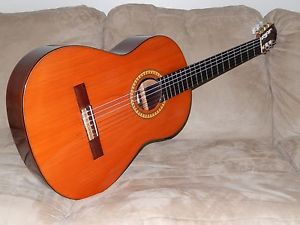
RARE HIROSHI TAMURA CLASSICO 40 1972 CLASSICAL GUITAR IN EXCELLENT CONDITION
Estimated price for orientation: 1 500 $
Category: Classical Guitars
Class:
Description Brand: Hiroshi Tamura Country/Region of Manufacture: Japan
Please read my 7 days return policy at the bottom of the page.*************************************************************************If you are thinking about a purchase of a used vintage guitar you need to accept the fact that such guitars may have cosmetic flaws solely associated with their age, but not related to any particular damage. For example their finishes change their look over the years and are not glossy and cristal clear like on brand new guitar. I see guitars as musical instruments, not a furniture. When I describe guitar as being in excellent condtion I don't talk only about its cosmetics but mostly about its structural & functional condition, sound and playbility. If you are seeking a perfect looking guitar you should abandon a thought about buying a used vintage one, especially from me. ******************************************************************************************* 1972 HIROSHI TAMURA Classico 40 This guitar was made in 1972 by Hiroshi Tamura, one of the best luthiers in Japanese history. Some experts say that he was actually the best Japanese luthier, who had collected many international awards for his works, even more than great Masaru Kohno.This guitar, although not Tamura's high end model at that time, is still a high grade instrument, way better that many higher priced guitars that you might have encountered in the past and considered as great. This guitar produces very characteristic to all Hiroshi Tamura guitars, truly Spanish, gentle and very seducing sound. Guitar is very responsive. Trebles are sweet and clear, basses vibrant and colorful. All well balanced, at very good volume with great sustain. You will have a hard time to put it down.This guitar was priced 40 000 yen in 1972, an amount equal to 65% of yearly salary of Japanese college graduate. Most Hiroshi Tamura P series guitars distributed in US in 1970’s have developed a network of internal wrinkles within the finish. They often break at the very top and create a network of hair-like fissures. It must have been caused by light induced chemical degradation of at least one of the ingredients of the original lacquer. This particular guitar shows very little of such changes in the finish. Besides that it has only few small marks on its soundboard. Guitar is structurally sound. Specifications:Top: High Grade Solid Cedar / finish Cashew LacquerBack and Sides: Rosewood Doubleplate / finish Cashew LacquerCalling this construction "laminates" would actually be very incorrect and quite misleading. This genuine Japanese invention has really nothing in common with modern era cheap particle-board laminates. This construction is nothing but 2 solid wood plates glued together, hence in fact nothing but reinforced solid woods. Such plates perform no different from solid woods, while don't crack as easily, are much easier to work with, and allow for much lower prices of these instruments. Such guitars have always been and still are a true blessing for all guitar enthusiasts with limited funds. Neck: MahoganyFingerboard: EbonyNut and Saddle: BoneNut Width: 52 mmScale: 658 mmAction is set to 3.50 mm under E6 and 3.00 mm under E1, with little of extra room for experiments with lower action.This guitar will be shipped in old used hard case of minimal value.In order to ship a package with guitar to Australia at affordable rate +/- $150.00 (USPS International Priority Mail), length of such package can’t exceed 42” and its girth (2 x times width + 2 x height) + length can’t exceed total of 97”. If you want original or non-original hard shell case, the size of the package will qualify it only for USPS/Fedex Global Express Guaranteed at $400.00 price. Real Value of Japanese Vintage GuitarsThe key to understand value of vintage Japanese guitars is to acknowledge galloping devaluation of Japanese yen in 1960s & 1970s. This devaluation was somewhat slower in 1980s. The best measure of this devaluation is Starting Yearly Salary of Japanese College Graduate (SYSJCG).SYSJCG in in 1965 was 19 600 yen, in 1969 – 34 600 yen, in 1970 39 200 yen, in 1972 – 62 300 yen, in 1975 79 200 yen, in 1977 121 200 yen and in 1980 - 163 000 yen.During 1960s and most of 1970s model numbers of Japanese guitars were strictly interconnected with their prices in Japanese yen. In late 1970s and during following decades model numbers were no longer strictly associated with their prices. Many Japanese guitar makers introduced model names instead of model numbers. Others were still using model numbers with addition of letter abbreviations or other symbols. The best and only logical approach while evaluating real value (real grade) of vintage Japanese guitar is to compare its price in Japanese yen with SYSJCG during the year guitar was made.Any guitar priced 100 000 in 1970 (labelled usually as No10) would be priced 200 000 yen in 1975 (relabeled to No20 or 2000), 300 000 yen in 1977 (labelled as No3, No30 or 3000). Starting in 1977 Masaru Kohno introduced his model No50 priced at 500 000 (and likely model 40 ). Soon other famous Japanese luthiers did the same. By 1983-84 Kohno started to use model names instead numbers and was raising their prices as he was pleased. Naturally soon other great Master luthiers did the same.Knowing all of that, you can bet on that Masaru Kohno No50 made in 1982 is practically the same quality as Kohno No15 made in 1972, or Kohno no20 made in 1975 or Kohno No30 made in 1977. I know it for a fact.The lowest grade models currently made by Matsuoka workshop are M75 and MH75. They are commonly considered as “beginner guitars”. Matsuoka model M30 made in 1973 is simply far, far better instrument. It is naturally better than model M50 made in 1977, model 80 made in 1982 or model M100 made in 1990. At present, the highest grade Matsuoka models are M300 and MH300. They absolutely stand no chance in competition with model M150 made in 1975… or model M200 made in 1977.It is very important to mention that if modern era luthiers are using 40 years old woods to make a classical guitar, its price is at least $8000.Some important info regarding Tamura brothers and their guitars:Guitarsite.comHiroshi Tamura Classical Guitar Model P60 made in Japan by Hiroshi Tamura.This guitar has a warm, mature voice that plays very easily.
The scale length is 658 mm.
The knut and saddle are made of micarta.
The neck is Honduras Cedar with an Ebony fretboard and Ebony re-enforcing strip.
The top is solid Spruce with beautiful purfling around the soundhole and inlaid banding around the sides and on the back.
The sides are Rosewood veneer, the turners are gold plate.
The neck is straight and there are no cracks or flaws in the guitar but the frets show a small bit of wear.Please email me with offers. Interested in knowing more about the lutheir too. Filcker | These are very good guitars. I have owned several. a friend of mine was a salesman for the Wilson trading company in Ohio [in the 70's] that imported high end Japanese classical and flamenco guitars.[Tamura,Kohno,Nakati,]
The Tamura guitars won many international guitar building awards in the late 60's. As a previous comment was made, the c series were flamenco [cypress back], the p series were classical [rosewood back]. Many were built to the same spec's and then graded for sound, which determined the price. A p-30 was 300 dollars, a p-50 was 500 dollars. The workmanship is exceptional. I have owned at least 12 of them. I have not had one for several years and have not seen one recently. They are becoming rare. I am still looking for the cypress body ones, preferable a c-60 with wooden tuning pegs [like a violin], I could be interested in all models for the right price. I am happy to pay what would be considered reasonable. I do not believe them to be too expensive, just good. Thanks | Tamura brothers were Japanese luthiers living in Kochi-prefecture, Japan. They produced Classical and Flamenco guitars from 1950s to early 1980s. Both of them passed away so there are not many information now. Hiroshi Tamura is older brother and the guitar you have was made by him.
The model on the label can be read "Jupitar" in Japanese language is a flamenco model.
Usually, each model has number which we can know its grade. Classical guitar has "P" but not sure for flamencos. Unfortunately I can't find on your guitar.
For example, P-150 means the price at that time was $1500. P-40 means $400.
Current price for Tamura varies depending on the condition. You can find them through eBay or Japanese auction site or other guitar shops. Sometimes I find $4500 for P-150 and $400 for P-100. Recently I found P-40 for around $500 on eBay.
Description
| Brand: | Hiroshi Tamura | Country/Region of Manufacture: | Japan |
Please read my 7 days return policy at the bottom of the page.*************************************************************************If you are thinking about a purchase of a used vintage guitar you need to accept the fact that such guitars may have cosmetic flaws solely associated with their age, but not related to any particular damage. For example their finishes change their look over the years and are not glossy and cristal clear like on brand new guitar. I see guitars as musical instruments, not a furniture. When I describe guitar as being in excellent condtion I don't talk only about its cosmetics but mostly about its structural & functional condition, sound and playbility. If you are seeking a perfect looking guitar you should abandon a thought about buying a used vintage one, especially from me. ******************************************************************************************* 1972 HIROSHI TAMURA Classico 40 This guitar was made in 1972 by Hiroshi Tamura, one of the best luthiers in Japanese history. Some experts say that he was actually the best Japanese luthier, who had collected many international awards for his works, even more than great Masaru Kohno.This guitar, although not Tamura's high end model at that time, is still a high grade instrument, way better that many higher priced guitars that you might have encountered in the past and considered as great. This guitar produces very characteristic to all Hiroshi Tamura guitars, truly Spanish, gentle and very seducing sound. Guitar is very responsive. Trebles are sweet and clear, basses vibrant and colorful. All well balanced, at very good volume with great sustain. You will have a hard time to put it down.This guitar was priced 40 000 yen in 1972, an amount equal to 65% of yearly salary of Japanese college graduate. Most Hiroshi Tamura P series guitars distributed in US in 1970’s have developed a network of internal wrinkles within the finish. They often break at the very top and create a network of hair-like fissures. It must have been caused by light induced chemical degradation of at least one of the ingredients of the original lacquer. This particular guitar shows very little of such changes in the finish. Besides that it has only few small marks on its soundboard. Guitar is structurally sound. Specifications:Top: High Grade Solid Cedar / finish Cashew LacquerBack and Sides: Rosewood Doubleplate / finish Cashew LacquerCalling this construction "laminates" would actually be very incorrect and quite misleading. This genuine Japanese invention has really nothing in common with modern era cheap particle-board laminates. This construction is nothing but 2 solid wood plates glued together, hence in fact nothing but reinforced solid woods. Such plates perform no different from solid woods, while don't crack as easily, are much easier to work with, and allow for much lower prices of these instruments. Such guitars have always been and still are a true blessing for all guitar enthusiasts with limited funds. Neck: MahoganyFingerboard: EbonyNut and Saddle: BoneNut Width: 52 mmScale: 658 mmAction is set to 3.50 mm under E6 and 3.00 mm under E1, with little of extra room for experiments with lower action.This guitar will be shipped in old used hard case of minimal value.In order to ship a package with guitar to Australia at affordable rate +/- $150.00 (USPS International Priority Mail), length of such package can’t exceed 42” and its girth (2 x times width + 2 x height) + length can’t exceed total of 97”. If you want original or non-original hard shell case, the size of the package will qualify it only for USPS/Fedex Global Express Guaranteed at $400.00 price. Real Value of Japanese Vintage GuitarsThe key to understand value of vintage Japanese guitars is to acknowledge galloping devaluation of Japanese yen in 1960s & 1970s. This devaluation was somewhat slower in 1980s. The best measure of this devaluation is Starting Yearly Salary of Japanese College Graduate (SYSJCG).SYSJCG in in 1965 was 19 600 yen, in 1969 – 34 600 yen, in 1970 39 200 yen, in 1972 – 62 300 yen, in 1975 79 200 yen, in 1977 121 200 yen and in 1980 - 163 000 yen.During 1960s and most of 1970s model numbers of Japanese guitars were strictly interconnected with their prices in Japanese yen. In late 1970s and during following decades model numbers were no longer strictly associated with their prices. Many Japanese guitar makers introduced model names instead of model numbers. Others were still using model numbers with addition of letter abbreviations or other symbols. The best and only logical approach while evaluating real value (real grade) of vintage Japanese guitar is to compare its price in Japanese yen with SYSJCG during the year guitar was made.Any guitar priced 100 000 in 1970 (labelled usually as No10) would be priced 200 000 yen in 1975 (relabeled to No20 or 2000), 300 000 yen in 1977 (labelled as No3, No30 or 3000). Starting in 1977 Masaru Kohno introduced his model No50 priced at 500 000 (and likely model 40 ). Soon other famous Japanese luthiers did the same. By 1983-84 Kohno started to use model names instead numbers and was raising their prices as he was pleased. Naturally soon other great Master luthiers did the same.Knowing all of that, you can bet on that Masaru Kohno No50 made in 1982 is practically the same quality as Kohno No15 made in 1972, or Kohno no20 made in 1975 or Kohno No30 made in 1977. I know it for a fact.The lowest grade models currently made by Matsuoka workshop are M75 and MH75. They are commonly considered as “beginner guitars”. Matsuoka model M30 made in 1973 is simply far, far better instrument. It is naturally better than model M50 made in 1977, model 80 made in 1982 or model M100 made in 1990. At present, the highest grade Matsuoka models are M300 and MH300. They absolutely stand no chance in competition with model M150 made in 1975… or model M200 made in 1977.It is very important to mention that if modern era luthiers are using 40 years old woods to make a classical guitar, its price is at least $8000.Some important info regarding Tamura brothers and their guitars:Guitarsite.comHiroshi Tamura Classical Guitar Model P60 made in Japan by Hiroshi Tamura.This guitar has a warm, mature voice that plays very easily.
The scale length is 658 mm.
The knut and saddle are made of micarta.
The neck is Honduras Cedar with an Ebony fretboard and Ebony re-enforcing strip.
The top is solid Spruce with beautiful purfling around the soundhole and inlaid banding around the sides and on the back.
The sides are Rosewood veneer, the turners are gold plate.
The neck is straight and there are no cracks or flaws in the guitar but the frets show a small bit of wear.Please email me with offers. Interested in knowing more about the lutheir too. Filcker | These are very good guitars. I have owned several. a friend of mine was a salesman for the Wilson trading company in Ohio [in the 70's] that imported high end Japanese classical and flamenco guitars.[Tamura,Kohno,Nakati,]
The Tamura guitars won many international guitar building awards in the late 60's. As a previous comment was made, the c series were flamenco [cypress back], the p series were classical [rosewood back]. Many were built to the same spec's and then graded for sound, which determined the price. A p-30 was 300 dollars, a p-50 was 500 dollars. The workmanship is exceptional. I have owned at least 12 of them. I have not had one for several years and have not seen one recently. They are becoming rare. I am still looking for the cypress body ones, preferable a c-60 with wooden tuning pegs [like a violin], I could be interested in all models for the right price. I am happy to pay what would be considered reasonable. I do not believe them to be too expensive, just good. Thanks | Tamura brothers were Japanese luthiers living in Kochi-prefecture, Japan. They produced Classical and Flamenco guitars from 1950s to early 1980s. Both of them passed away so there are not many information now. Hiroshi Tamura is older brother and the guitar you have was made by him.
The model on the label can be read "Jupitar" in Japanese language is a flamenco model.
Usually, each model has number which we can know its grade. Classical guitar has "P" but not sure for flamencos. Unfortunately I can't find on your guitar.
For example, P-150 means the price at that time was $1500. P-40 means $400.
Current price for Tamura varies depending on the condition. You can find them through eBay or Japanese auction site or other guitar shops. Sometimes I find $4500 for P-150 and $400 for P-100. Recently I found P-40 for around $500 on eBay.
The scale length is 658 mm.
The knut and saddle are made of micarta.
The neck is Honduras Cedar with an Ebony fretboard and Ebony re-enforcing strip.
The top is solid Spruce with beautiful purfling around the soundhole and inlaid banding around the sides and on the back.
The sides are Rosewood veneer, the turners are gold plate.
The neck is straight and there are no cracks or flaws in the guitar but the frets show a small bit of wear.Please email me with offers. Interested in knowing more about the lutheir too. Filcker | These are very good guitars. I have owned several. a friend of mine was a salesman for the Wilson trading company in Ohio [in the 70's] that imported high end Japanese classical and flamenco guitars.[Tamura,Kohno,Nakati,]
The Tamura guitars won many international guitar building awards in the late 60's. As a previous comment was made, the c series were flamenco [cypress back], the p series were classical [rosewood back]. Many were built to the same spec's and then graded for sound, which determined the price. A p-30 was 300 dollars, a p-50 was 500 dollars. The workmanship is exceptional. I have owned at least 12 of them. I have not had one for several years and have not seen one recently. They are becoming rare. I am still looking for the cypress body ones, preferable a c-60 with wooden tuning pegs [like a violin], I could be interested in all models for the right price. I am happy to pay what would be considered reasonable. I do not believe them to be too expensive, just good. Thanks | Tamura brothers were Japanese luthiers living in Kochi-prefecture, Japan. They produced Classical and Flamenco guitars from 1950s to early 1980s. Both of them passed away so there are not many information now. Hiroshi Tamura is older brother and the guitar you have was made by him.
The model on the label can be read "Jupitar" in Japanese language is a flamenco model.
Usually, each model has number which we can know its grade. Classical guitar has "P" but not sure for flamencos. Unfortunately I can't find on your guitar.
For example, P-150 means the price at that time was $1500. P-40 means $400.
Current price for Tamura varies depending on the condition. You can find them through eBay or Japanese auction site or other guitar shops. Sometimes I find $4500 for P-150 and $400 for P-100. Recently I found P-40 for around $500 on eBay.