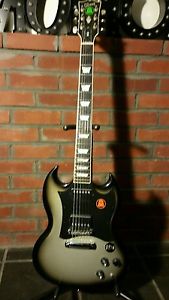
Back to the main page Back to category Gibson SG Specia
musical instrument details
Gibson SG Special Bot
Estimated price for orientation: 1 250 $
Category: Gibson SG Specia
Class:
Description Brand: Gibson Model Year: 2008 MPN: Does Not Apply Body Material: Maple Series: Special Country/Region of Manufacture: United States String Configuration: 6 String Size: Full Size Body Type: Solid Dexterity: Right-Handed Model: SG Special Soundboard Style: Fretted UPC: Does not apply
MEMOEMUSIC If you have compared the prices of the items I SELL you will notice my prices are lower in comparison and I'm selling for a lot less than my competitors. But more importantly is the Honesty and the Quality of the items that I sell as described and the Price at which I sell them. As with my previous Store, my Customer Rating was 100% and not 95%. This was and is still my practice.. So therefore I personally would like to Thank You for stopping by even if just to looking.Sincerely,Me Moe Music Attention Buyers - WatchersThe Best way to Enter your offerSince this item is a fixed price and if you find that you are interested in the item and you entered an offer on the item page and it was turned down. Then e-mail me on EBAY with your best offer this is the best way to insure your offer has and will be considered. No reasonable will be turned away. Gibson's Robot SG Special Controls
At the heart of Gibson's revolutionary Robot SG Special Limited are its ground-breaking controls. At first glance, the four control knobs seem to be indistinguishable from those on any other SG. But look again. While the four knobs do provide the standard tone and volume controls for each of the two pickups, the Multi-Control Knob (MCK) - the one with the illuminated top - serves as the master control for all aspects of the Robot SG Special Limited's amazing, self-tuning system. The MCK is what is commonly referred to as a "push-pull" knob. When in the normal position (down), it behaves as a regular volume or tone pot. When the MCK is pulled out, the Robot SG Special Limited's radically new self-tuning system is activated and ready for use. It immediately places the Robot SG Special Limited in standard tuning mode (A440). A quick turn of the MCK presents six factory presets, all of which can be customized. At any time, you can also restore the tunings to the factory presets and start all over again. The LED display on top of the MCK also lets you know when a string is out of tune, or when all strings are in tune, and even when the tuners are turning to get them in tune. It even guides the setting of accurate intonation. At the end of the tuning process, the blue lights on top of the MCK flash. Push the MCK back in and it's ready to go. The only thing you have to do is play.Powerhead Locking Tuners
Gibson's revolutionary Robot SG Special Limited is unique in many ways, but the "robot-like" Powerhead Tuners that grace the headstock are extraordinary. Pull out the Robot SG Special Limited's Multi-Control Knob (MCK) and watch the Powerhead Tuners spring into action. It takes only a few seconds for the Powerhead Tuners to tune the Robot SG Special Limited to the desired tuning. Each tuning peg is equipped with a tiny, but powerful, servo motor that kick into action once the system is activated. The Powerhead Tuners rely on the strings themselves to send the signals, eliminating any potential for interference. Made of lightweight metal with a satin nickel finish, the Powerhead Tuners weigh only 4.5 grams each. A standard Gotoh tuner weighs in at 49 grams. That means a set of Powerhead Tuners weigh a full 15 grams less than a set of Gotoh tuners, which is another indicator of the Robot SG Special Limited's true innovation.Tone-Control Bridge and Tailpiece
The revolutionary Robot SG Special Limited sports a new and unique, highly specialized Tune Control Bridge which acts as one of the main components of the self-tuning robotic system. The new Tune-Control Bridge is a modified Tune-omatic that measures the individual tuning of each string via special saddles. The signal from each string is then transmitted to the control CPU in the control panel, which then transfers the signal to the Neck CPU and the Powerhead Locking Tuners, which, in turn, tune the strings. At first glance, the tailpiece on Gibson's ground-breaking Robot SG Special Limited looks like a normal tailpiece. But look a little closer and you'll see that is is far from ordinary. Gibson's new Data Transmitting Tailpiece is a hub of activity. First, each string is separated by ceramic insulators that isolate each individual string signal and avoids confusion as to which string is being processed and tuned. There are also special isolating inserts that keep the ball ends commonly found on electric guitar strings from making contact and disrupting signal flow. Underneath the tailpiece is a tiny circuit board that processes each individual signal to the ribbon cable, which is then transmitted to the on-board CPUs. Both pieces work with each other to help balance all the information being transmitted between the various points, and makes sure every string is in tune.Neutrik Jack
Neutrik has been making superior electronic interconnection products since 1975, making them the logical choice to supply the performance safeguarding jack in Gibson's revolutionary Robot SG Special Limited. Like many Neutrik products, the jack in the Robot SG Special Limited is manufactured from strong, high-grade thermoplastics and housed in a rugged die-cast nickel shell. A retention spring inside the jack ensures optimum grip on any guitar cable, thus avoiding the chance of lost connection.Solid Mahogany Body
A slim, solid mahogany body is fundamental to all SGs. The Robot SG Special Limited's light body delivers the SG's legendary thick, warm tone and singing sustain. The mahogany is personally inspected and qualified by Gibson's team of skilled wood experts. Once inside the Gibson factories - where humidity is maintained at 45 percent, and the temperature at 70 degrees - all woods are dried to a level of "equilibrium" by ensuring the moisture content does not change during the manufacturing process. This guarantees tight-fitting joints and no expansion, and helps control the shrinkage and warping of the woods, in addition to helping reduce the weight. It also helps with improving the woods' machinability and finishing properties, and adherence to glue. Consistent moisture content means that a Gibson guitar will respond evenly to temperature and humidity changes long after it leaves the factory.Nitrocellulose Finishes
Applying this nitro finish to any Gibson guitar - including the revolutionary Robot SG Special Limited - is one of the most labor-intensive elements of the guitar-making process. A properly applied nitro finish requires extensive man hours, several evenly applied coats, and an exorbitant amount of drying time. But this fact has never swayed Gibson into changing this time-tested method that has been employed ever since the first Gibson guitar was swathed with lacquer back in 1894. Why? For starters, a nitro finish dries to a much thinner coat than a polyurethane finish, which means there is less interference with the natural vibration of the instrument, allowing for a purer tone. A nitro finish is also a softer finish, which makes it easily repairable. You can touch up a scratch or ding on a nitro finish, but you can't do the same on a poly finish. In addition, a nitro finish is very porous in nature, and actually gets thinner over time. It does not "seal" wood in an airtight shell - as a poly finish does - and allows the wood to breathe and age properly.Gibson's 490R and 498T Pickups
The mid to late 1960s saw the emergence of a very different type of music coming from the clubs of England. This new genre's players were demanding more powerful amplifiers with increased volume outputs to satisfy their sonic explorations. Gibson answered this call with the 490T and 490R pickups ("T" for treble, and "R" for rhythm), both with the traditional characteristics of the original "Patent Applied For" pickups, but with two key modifications. First, a four-conductor wiring scheme allows the 490s to be connected to any push/pull knob, which lets players split their coils and increase versatility. Gibson also introduced wax potting, which does away with any air space inside the pickup - thus lessening the chances of microphonic feedback. The result is a humbucker with the tonal characteristics of an original PAF, with a slight increase in upper mid-range response. The Gibson 498T bridge pickup is the 490's ideal complement. Taking the 490 one step further, the 498 swaps the Alnico II magnet to an Alnico V, thus making it slightly hotter with emphasis on mid-ranges and highs. The pole pieces on the 498T are also aligned a little further apart to accommodate the spacing of the strings at the bridge, which is different than the spacing of the strings at the neck. As with all Gibson pickups, every part is precisely manufactured at Gibson USA in Nashville, Tennessee.Fret Wire
The fret wire on the revolutionary Robot SG Special Limited is a combination nickel and silver alloy (approximately 80 percent nickel and 20 percent silver) specifically designed for long life and superior wear. Gibson's traditional "medium/jumbo" fret wire is first shaped by hand, then cut to an exact 12-inch radius. After hand pressing it into the fingerboard, a machine press finishes the job to eliminate the gap between the bottom of the fret wire and the fingerboard.22-Fret Ebony Fingerboard
Ebony has always graced the fingerboards of the world's finest stringed instruments, including today's SG Custom, SG Supreme, and the pioneering HD.6X-Pro Digital SG. The fingerboard on Gibson's revolutionary Robot SG Special Limited is constructed from the highest grade Ebony on the planet. The ebony is personally inspected and qualified by Gibson's team of skilled wood experts before it enters the Gibson factories to be fitted onto the necks of the new Robot SG Special Limited guitars. The resilience of this dense and durable wood makes the fingerboard extremely balanced and stable, and gives each chord and note clarity and bite. The 12-inch radius of the fingerboard provides smooth note bending capabilities and eliminates "dead" or "choked out" notes, which can occur on fingerboards with lesser radiuses. Resilient and less porous, ebony tends to absorb oils well, which allows it to preserve its rich, beautiful color.Gibson Robot SG Special Features: Color: Silverburst Body Style: SG Body Species: Mahogany Binding: None Fingerboard Species: Ebony Scale Length: 24 3/4" Number of Frets: 22 Width at 12th Fret: 2.260 Inlays: White Acryclic Trapezoid Fingerboard Binding: White Neck Pickup: 490R Bridge Pickup: 498T Control Pocket Cover: Smoky transparent acrylic Toggle Switch: White Toggle Switch Washer: Black HS White Other Electronics: Charger & Power Plug, Battery Pack Neck Species: Mahogany Peghead Pitch: 17 Nut: Corian, Pre-radiused Nut Width: 1.695 Thickness at 1st Fret: 0.818 Thickness at 12th Fret: 0.963 Heel Length: 5/8 Neck Joint Location: 19th Fret Head Inlay: Holly Head Binding: White, .075 Truss Rod: Nickel plated truss rod nut Truss Rod Cover: B/W Bell Hardware Color: Chrome Plating Finish: CHP Tailpiece: Powertune Stop Bar Bridge: Powertune Knobs: Vol/Tone: Silver Insert, Master Control Knob: Silver Tuners: Powerheads w/brass sleeves Strap Buttons: Butt/Heel Jack: Neutrik on lower bout Jack Plate: None Pickguard: Carbon Fiber
Description
| Brand: | Gibson | Model Year: | 2008 |
| MPN: | Does Not Apply | Body Material: | Maple |
| Series: | Special | Country/Region of Manufacture: | United States |
| String Configuration: | 6 String | Size: | Full Size |
| Body Type: | Solid | Dexterity: | Right-Handed |
| Model: | SG Special | Soundboard Style: | Fretted |
| UPC: | Does not apply |
MEMOEMUSIC If you have compared the prices of the items I SELL you will notice my prices are lower in comparison and I'm selling for a lot less than my competitors. But more importantly is the Honesty and the Quality of the items that I sell as described and the Price at which I sell them. As with my previous Store, my Customer Rating was 100% and not 95%. This was and is still my practice.. So therefore I personally would like to Thank You for stopping by even if just to looking.Sincerely,Me Moe Music Attention Buyers - WatchersThe Best way to Enter your offerSince this item is a fixed price and if you find that you are interested in the item and you entered an offer on the item page and it was turned down. Then e-mail me on EBAY with your best offer this is the best way to insure your offer has and will be considered. No reasonable will be turned away. Gibson's Robot SG Special Controls
At the heart of Gibson's revolutionary Robot SG Special Limited are its ground-breaking controls. At first glance, the four control knobs seem to be indistinguishable from those on any other SG. But look again. While the four knobs do provide the standard tone and volume controls for each of the two pickups, the Multi-Control Knob (MCK) - the one with the illuminated top - serves as the master control for all aspects of the Robot SG Special Limited's amazing, self-tuning system. The MCK is what is commonly referred to as a "push-pull" knob. When in the normal position (down), it behaves as a regular volume or tone pot. When the MCK is pulled out, the Robot SG Special Limited's radically new self-tuning system is activated and ready for use. It immediately places the Robot SG Special Limited in standard tuning mode (A440). A quick turn of the MCK presents six factory presets, all of which can be customized. At any time, you can also restore the tunings to the factory presets and start all over again. The LED display on top of the MCK also lets you know when a string is out of tune, or when all strings are in tune, and even when the tuners are turning to get them in tune. It even guides the setting of accurate intonation. At the end of the tuning process, the blue lights on top of the MCK flash. Push the MCK back in and it's ready to go. The only thing you have to do is play.Powerhead Locking Tuners
Gibson's revolutionary Robot SG Special Limited is unique in many ways, but the "robot-like" Powerhead Tuners that grace the headstock are extraordinary. Pull out the Robot SG Special Limited's Multi-Control Knob (MCK) and watch the Powerhead Tuners spring into action. It takes only a few seconds for the Powerhead Tuners to tune the Robot SG Special Limited to the desired tuning. Each tuning peg is equipped with a tiny, but powerful, servo motor that kick into action once the system is activated. The Powerhead Tuners rely on the strings themselves to send the signals, eliminating any potential for interference. Made of lightweight metal with a satin nickel finish, the Powerhead Tuners weigh only 4.5 grams each. A standard Gotoh tuner weighs in at 49 grams. That means a set of Powerhead Tuners weigh a full 15 grams less than a set of Gotoh tuners, which is another indicator of the Robot SG Special Limited's true innovation.Tone-Control Bridge and Tailpiece
The revolutionary Robot SG Special Limited sports a new and unique, highly specialized Tune Control Bridge which acts as one of the main components of the self-tuning robotic system. The new Tune-Control Bridge is a modified Tune-omatic that measures the individual tuning of each string via special saddles. The signal from each string is then transmitted to the control CPU in the control panel, which then transfers the signal to the Neck CPU and the Powerhead Locking Tuners, which, in turn, tune the strings. At first glance, the tailpiece on Gibson's ground-breaking Robot SG Special Limited looks like a normal tailpiece. But look a little closer and you'll see that is is far from ordinary. Gibson's new Data Transmitting Tailpiece is a hub of activity. First, each string is separated by ceramic insulators that isolate each individual string signal and avoids confusion as to which string is being processed and tuned. There are also special isolating inserts that keep the ball ends commonly found on electric guitar strings from making contact and disrupting signal flow. Underneath the tailpiece is a tiny circuit board that processes each individual signal to the ribbon cable, which is then transmitted to the on-board CPUs. Both pieces work with each other to help balance all the information being transmitted between the various points, and makes sure every string is in tune.Neutrik Jack
Neutrik has been making superior electronic interconnection products since 1975, making them the logical choice to supply the performance safeguarding jack in Gibson's revolutionary Robot SG Special Limited. Like many Neutrik products, the jack in the Robot SG Special Limited is manufactured from strong, high-grade thermoplastics and housed in a rugged die-cast nickel shell. A retention spring inside the jack ensures optimum grip on any guitar cable, thus avoiding the chance of lost connection.Solid Mahogany Body
A slim, solid mahogany body is fundamental to all SGs. The Robot SG Special Limited's light body delivers the SG's legendary thick, warm tone and singing sustain. The mahogany is personally inspected and qualified by Gibson's team of skilled wood experts. Once inside the Gibson factories - where humidity is maintained at 45 percent, and the temperature at 70 degrees - all woods are dried to a level of "equilibrium" by ensuring the moisture content does not change during the manufacturing process. This guarantees tight-fitting joints and no expansion, and helps control the shrinkage and warping of the woods, in addition to helping reduce the weight. It also helps with improving the woods' machinability and finishing properties, and adherence to glue. Consistent moisture content means that a Gibson guitar will respond evenly to temperature and humidity changes long after it leaves the factory.Nitrocellulose Finishes
Applying this nitro finish to any Gibson guitar - including the revolutionary Robot SG Special Limited - is one of the most labor-intensive elements of the guitar-making process. A properly applied nitro finish requires extensive man hours, several evenly applied coats, and an exorbitant amount of drying time. But this fact has never swayed Gibson into changing this time-tested method that has been employed ever since the first Gibson guitar was swathed with lacquer back in 1894. Why? For starters, a nitro finish dries to a much thinner coat than a polyurethane finish, which means there is less interference with the natural vibration of the instrument, allowing for a purer tone. A nitro finish is also a softer finish, which makes it easily repairable. You can touch up a scratch or ding on a nitro finish, but you can't do the same on a poly finish. In addition, a nitro finish is very porous in nature, and actually gets thinner over time. It does not "seal" wood in an airtight shell - as a poly finish does - and allows the wood to breathe and age properly.Gibson's 490R and 498T Pickups
The mid to late 1960s saw the emergence of a very different type of music coming from the clubs of England. This new genre's players were demanding more powerful amplifiers with increased volume outputs to satisfy their sonic explorations. Gibson answered this call with the 490T and 490R pickups ("T" for treble, and "R" for rhythm), both with the traditional characteristics of the original "Patent Applied For" pickups, but with two key modifications. First, a four-conductor wiring scheme allows the 490s to be connected to any push/pull knob, which lets players split their coils and increase versatility. Gibson also introduced wax potting, which does away with any air space inside the pickup - thus lessening the chances of microphonic feedback. The result is a humbucker with the tonal characteristics of an original PAF, with a slight increase in upper mid-range response. The Gibson 498T bridge pickup is the 490's ideal complement. Taking the 490 one step further, the 498 swaps the Alnico II magnet to an Alnico V, thus making it slightly hotter with emphasis on mid-ranges and highs. The pole pieces on the 498T are also aligned a little further apart to accommodate the spacing of the strings at the bridge, which is different than the spacing of the strings at the neck. As with all Gibson pickups, every part is precisely manufactured at Gibson USA in Nashville, Tennessee.Fret Wire
The fret wire on the revolutionary Robot SG Special Limited is a combination nickel and silver alloy (approximately 80 percent nickel and 20 percent silver) specifically designed for long life and superior wear. Gibson's traditional "medium/jumbo" fret wire is first shaped by hand, then cut to an exact 12-inch radius. After hand pressing it into the fingerboard, a machine press finishes the job to eliminate the gap between the bottom of the fret wire and the fingerboard.22-Fret Ebony Fingerboard
Ebony has always graced the fingerboards of the world's finest stringed instruments, including today's SG Custom, SG Supreme, and the pioneering HD.6X-Pro Digital SG. The fingerboard on Gibson's revolutionary Robot SG Special Limited is constructed from the highest grade Ebony on the planet. The ebony is personally inspected and qualified by Gibson's team of skilled wood experts before it enters the Gibson factories to be fitted onto the necks of the new Robot SG Special Limited guitars. The resilience of this dense and durable wood makes the fingerboard extremely balanced and stable, and gives each chord and note clarity and bite. The 12-inch radius of the fingerboard provides smooth note bending capabilities and eliminates "dead" or "choked out" notes, which can occur on fingerboards with lesser radiuses. Resilient and less porous, ebony tends to absorb oils well, which allows it to preserve its rich, beautiful color.Gibson Robot SG Special Features: Color: Silverburst Body Style: SG Body Species: Mahogany Binding: None Fingerboard Species: Ebony Scale Length: 24 3/4" Number of Frets: 22 Width at 12th Fret: 2.260 Inlays: White Acryclic Trapezoid Fingerboard Binding: White Neck Pickup: 490R Bridge Pickup: 498T Control Pocket Cover: Smoky transparent acrylic Toggle Switch: White Toggle Switch Washer: Black HS White Other Electronics: Charger & Power Plug, Battery Pack Neck Species: Mahogany Peghead Pitch: 17 Nut: Corian, Pre-radiused Nut Width: 1.695 Thickness at 1st Fret: 0.818 Thickness at 12th Fret: 0.963 Heel Length: 5/8 Neck Joint Location: 19th Fret Head Inlay: Holly Head Binding: White, .075 Truss Rod: Nickel plated truss rod nut Truss Rod Cover: B/W Bell Hardware Color: Chrome Plating Finish: CHP Tailpiece: Powertune Stop Bar Bridge: Powertune Knobs: Vol/Tone: Silver Insert, Master Control Knob: Silver Tuners: Powerheads w/brass sleeves Strap Buttons: Butt/Heel Jack: Neutrik on lower bout Jack Plate: None Pickguard: Carbon Fiber
At the heart of Gibson's revolutionary Robot SG Special Limited are its ground-breaking controls. At first glance, the four control knobs seem to be indistinguishable from those on any other SG. But look again. While the four knobs do provide the standard tone and volume controls for each of the two pickups, the Multi-Control Knob (MCK) - the one with the illuminated top - serves as the master control for all aspects of the Robot SG Special Limited's amazing, self-tuning system. The MCK is what is commonly referred to as a "push-pull" knob. When in the normal position (down), it behaves as a regular volume or tone pot. When the MCK is pulled out, the Robot SG Special Limited's radically new self-tuning system is activated and ready for use. It immediately places the Robot SG Special Limited in standard tuning mode (A440). A quick turn of the MCK presents six factory presets, all of which can be customized. At any time, you can also restore the tunings to the factory presets and start all over again. The LED display on top of the MCK also lets you know when a string is out of tune, or when all strings are in tune, and even when the tuners are turning to get them in tune. It even guides the setting of accurate intonation. At the end of the tuning process, the blue lights on top of the MCK flash. Push the MCK back in and it's ready to go. The only thing you have to do is play.Powerhead Locking Tuners
Gibson's revolutionary Robot SG Special Limited is unique in many ways, but the "robot-like" Powerhead Tuners that grace the headstock are extraordinary. Pull out the Robot SG Special Limited's Multi-Control Knob (MCK) and watch the Powerhead Tuners spring into action. It takes only a few seconds for the Powerhead Tuners to tune the Robot SG Special Limited to the desired tuning. Each tuning peg is equipped with a tiny, but powerful, servo motor that kick into action once the system is activated. The Powerhead Tuners rely on the strings themselves to send the signals, eliminating any potential for interference. Made of lightweight metal with a satin nickel finish, the Powerhead Tuners weigh only 4.5 grams each. A standard Gotoh tuner weighs in at 49 grams. That means a set of Powerhead Tuners weigh a full 15 grams less than a set of Gotoh tuners, which is another indicator of the Robot SG Special Limited's true innovation.Tone-Control Bridge and Tailpiece
The revolutionary Robot SG Special Limited sports a new and unique, highly specialized Tune Control Bridge which acts as one of the main components of the self-tuning robotic system. The new Tune-Control Bridge is a modified Tune-omatic that measures the individual tuning of each string via special saddles. The signal from each string is then transmitted to the control CPU in the control panel, which then transfers the signal to the Neck CPU and the Powerhead Locking Tuners, which, in turn, tune the strings. At first glance, the tailpiece on Gibson's ground-breaking Robot SG Special Limited looks like a normal tailpiece. But look a little closer and you'll see that is is far from ordinary. Gibson's new Data Transmitting Tailpiece is a hub of activity. First, each string is separated by ceramic insulators that isolate each individual string signal and avoids confusion as to which string is being processed and tuned. There are also special isolating inserts that keep the ball ends commonly found on electric guitar strings from making contact and disrupting signal flow. Underneath the tailpiece is a tiny circuit board that processes each individual signal to the ribbon cable, which is then transmitted to the on-board CPUs. Both pieces work with each other to help balance all the information being transmitted between the various points, and makes sure every string is in tune.Neutrik Jack
Neutrik has been making superior electronic interconnection products since 1975, making them the logical choice to supply the performance safeguarding jack in Gibson's revolutionary Robot SG Special Limited. Like many Neutrik products, the jack in the Robot SG Special Limited is manufactured from strong, high-grade thermoplastics and housed in a rugged die-cast nickel shell. A retention spring inside the jack ensures optimum grip on any guitar cable, thus avoiding the chance of lost connection.Solid Mahogany Body
A slim, solid mahogany body is fundamental to all SGs. The Robot SG Special Limited's light body delivers the SG's legendary thick, warm tone and singing sustain. The mahogany is personally inspected and qualified by Gibson's team of skilled wood experts. Once inside the Gibson factories - where humidity is maintained at 45 percent, and the temperature at 70 degrees - all woods are dried to a level of "equilibrium" by ensuring the moisture content does not change during the manufacturing process. This guarantees tight-fitting joints and no expansion, and helps control the shrinkage and warping of the woods, in addition to helping reduce the weight. It also helps with improving the woods' machinability and finishing properties, and adherence to glue. Consistent moisture content means that a Gibson guitar will respond evenly to temperature and humidity changes long after it leaves the factory.Nitrocellulose Finishes
Applying this nitro finish to any Gibson guitar - including the revolutionary Robot SG Special Limited - is one of the most labor-intensive elements of the guitar-making process. A properly applied nitro finish requires extensive man hours, several evenly applied coats, and an exorbitant amount of drying time. But this fact has never swayed Gibson into changing this time-tested method that has been employed ever since the first Gibson guitar was swathed with lacquer back in 1894. Why? For starters, a nitro finish dries to a much thinner coat than a polyurethane finish, which means there is less interference with the natural vibration of the instrument, allowing for a purer tone. A nitro finish is also a softer finish, which makes it easily repairable. You can touch up a scratch or ding on a nitro finish, but you can't do the same on a poly finish. In addition, a nitro finish is very porous in nature, and actually gets thinner over time. It does not "seal" wood in an airtight shell - as a poly finish does - and allows the wood to breathe and age properly.Gibson's 490R and 498T Pickups
The mid to late 1960s saw the emergence of a very different type of music coming from the clubs of England. This new genre's players were demanding more powerful amplifiers with increased volume outputs to satisfy their sonic explorations. Gibson answered this call with the 490T and 490R pickups ("T" for treble, and "R" for rhythm), both with the traditional characteristics of the original "Patent Applied For" pickups, but with two key modifications. First, a four-conductor wiring scheme allows the 490s to be connected to any push/pull knob, which lets players split their coils and increase versatility. Gibson also introduced wax potting, which does away with any air space inside the pickup - thus lessening the chances of microphonic feedback. The result is a humbucker with the tonal characteristics of an original PAF, with a slight increase in upper mid-range response. The Gibson 498T bridge pickup is the 490's ideal complement. Taking the 490 one step further, the 498 swaps the Alnico II magnet to an Alnico V, thus making it slightly hotter with emphasis on mid-ranges and highs. The pole pieces on the 498T are also aligned a little further apart to accommodate the spacing of the strings at the bridge, which is different than the spacing of the strings at the neck. As with all Gibson pickups, every part is precisely manufactured at Gibson USA in Nashville, Tennessee.Fret Wire
The fret wire on the revolutionary Robot SG Special Limited is a combination nickel and silver alloy (approximately 80 percent nickel and 20 percent silver) specifically designed for long life and superior wear. Gibson's traditional "medium/jumbo" fret wire is first shaped by hand, then cut to an exact 12-inch radius. After hand pressing it into the fingerboard, a machine press finishes the job to eliminate the gap between the bottom of the fret wire and the fingerboard.22-Fret Ebony Fingerboard
Ebony has always graced the fingerboards of the world's finest stringed instruments, including today's SG Custom, SG Supreme, and the pioneering HD.6X-Pro Digital SG. The fingerboard on Gibson's revolutionary Robot SG Special Limited is constructed from the highest grade Ebony on the planet. The ebony is personally inspected and qualified by Gibson's team of skilled wood experts before it enters the Gibson factories to be fitted onto the necks of the new Robot SG Special Limited guitars. The resilience of this dense and durable wood makes the fingerboard extremely balanced and stable, and gives each chord and note clarity and bite. The 12-inch radius of the fingerboard provides smooth note bending capabilities and eliminates "dead" or "choked out" notes, which can occur on fingerboards with lesser radiuses. Resilient and less porous, ebony tends to absorb oils well, which allows it to preserve its rich, beautiful color.Gibson Robot SG Special Features: Color: Silverburst Body Style: SG Body Species: Mahogany Binding: None Fingerboard Species: Ebony Scale Length: 24 3/4" Number of Frets: 22 Width at 12th Fret: 2.260 Inlays: White Acryclic Trapezoid Fingerboard Binding: White Neck Pickup: 490R Bridge Pickup: 498T Control Pocket Cover: Smoky transparent acrylic Toggle Switch: White Toggle Switch Washer: Black HS White Other Electronics: Charger & Power Plug, Battery Pack Neck Species: Mahogany Peghead Pitch: 17 Nut: Corian, Pre-radiused Nut Width: 1.695 Thickness at 1st Fret: 0.818 Thickness at 12th Fret: 0.963 Heel Length: 5/8 Neck Joint Location: 19th Fret Head Inlay: Holly Head Binding: White, .075 Truss Rod: Nickel plated truss rod nut Truss Rod Cover: B/W Bell Hardware Color: Chrome Plating Finish: CHP Tailpiece: Powertune Stop Bar Bridge: Powertune Knobs: Vol/Tone: Silver Insert, Master Control Knob: Silver Tuners: Powerheads w/brass sleeves Strap Buttons: Butt/Heel Jack: Neutrik on lower bout Jack Plate: None Pickguard: Carbon Fiber