Back to the main page Back to category Other String Instruments
musical instrument details
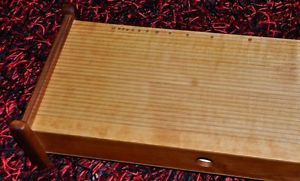
Monochord - Black Dot Music
Estimated price for orientation: 1 599 $
Category: Other String Instruments
Class:
Description Condition: Used: An item that has been used previously. The item may have some signs of cosmetic wear, but is fully operational and functions as intended. This item may be a floor model or store return that has been used. See the seller’s listing for full details and description of any imperfections. See all condition definitions- opens in a new window or tab ... Read moreabout the condition
The monochord can be used to illustrate the properties of musical and to illustrate regarding string length and tension: "essentially a tool for measuring musical intervals". For example, when a monochord's string is open it vibrates at a particular frequency and produces a pitch. When the length of the string is halved, and , it produces a pitch an higher and the string vibrates at twice the frequency of the original (2:1) (·). Half of this length will produce a pitch two octaves higher than the original—four times the initial frequency (4:1)—and so on. Standard diatonic (Ptolemy's Diatonic Ditonic) is easily derived starting from ratios, (n+1)/n, constructed from the first four counting numbers, the , measured out on a monochord.[] The mathematics involved include the , , and and .Several string "monochord""As the name implies, only one string is needed to do the experiments; but, since ancient times, several strings where used, all tuned in exact unison, each with a moveable bridge, so that various intervals can be compared to each other ." A "bichord instrument" is one, "having two strings in unison for each note [a ]," such as the . With two strings one can easily demonstrate how various musical sound. Both open strings are tuned to the same pitch, and then the movable bridge is put in a mathematical position on the second string to demonstrate, for instance, the (at 4/5th of the string length) (·) or the (at 5/6th of the string length) (·).
Description
| Condition: | Used: An item that has been used previously. The item may have some signs of cosmetic wear, but is fully operational and functions as intended. This item may be a floor model or store return that has been used. See the seller’s listing for full details and description of any imperfections. See all condition definitions- opens in a new window or tab ... Read moreabout the condition |
The monochord can be used to illustrate the properties of musical and to illustrate regarding string length and tension: "essentially a tool for measuring musical intervals". For example, when a monochord's string is open it vibrates at a particular frequency and produces a pitch. When the length of the string is halved, and , it produces a pitch an higher and the string vibrates at twice the frequency of the original (2:1) (·). Half of this length will produce a pitch two octaves higher than the original—four times the initial frequency (4:1)—and so on. Standard diatonic (Ptolemy's Diatonic Ditonic) is easily derived starting from ratios, (n+1)/n, constructed from the first four counting numbers, the , measured out on a monochord.[] The mathematics involved include the , , and and ."As the name implies, only one string is needed to do the experiments; but, since ancient times, several strings where used, all tuned in exact unison, each with a moveable bridge, so that various intervals can be compared to each other ." A "bichord instrument" is one, "having two strings in unison for each note [a ]," such as the . With two strings one can easily demonstrate how various musical sound. Both open strings are tuned to the same pitch, and then the movable bridge is put in a mathematical position on the second string to demonstrate, for instance, the (at 4/5th of the string length) (·) or the (at 5/6th of the string length) (·).
Several string "monochord"