Back to the main page Back to category Synthesizers
musical instrument details
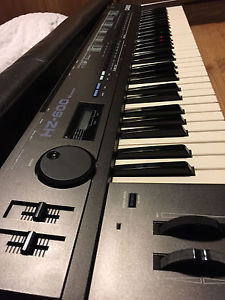
Casio Digital Analog Hybrid HZ 600 Synthesizer Excellent Condition Rare
Estimated price for orientation: 599 $
Category: Synthesizers
Class:
Description
Absolutley stunning example of an HZ 600 Digital-Analog Hybrid Synthesizer from Casio. This thing looks and sounds stunning. There are two barely visible marks - check the photos. Considering this synth is from 1987 and the condition, i'm pricing it like this, otherwise ill just hold on to it when it will be worth a lot more. There are 32 waveforms and that just about covers it. It can do alot with all those waveforms but as far as getting that 80s retro sound - this is it. It will be very well packaged and courier/insurance as always. These are extremely rare It has an aftermarket power supply specifically for the HZ 600. I have sold a lot of pro audio gear on here ...check my feedback for all the good info! International buyers are welcome but please bear in mind this will be through the Ebay Postage Programme so I can't give you an individual price - you will see it under your options i assume. Thanks for lookingHere's a cool video from someone with the synth - https://www.youtube.com/watch?v=CI6TGVuda7QFrom vintagesynthexplorer -
In 1987, Casio released a new Spectrum Dynamic synthesis on the market. In principle, the SD synthesizers are digital-analog hybrids with eight voices of polyphony. The first of SD instruments was a "professionally" looking bitimbral synthesizer HZ-600, which was followed by HT-3000, a home keyboard-like instrument with programmable automatic accompaniment, 61 standard-size keys and built-in loudspeakers, HT-700 with the same features like HT-3000 but with 49 small keys, and MT-600, a preset version of HT-700. All these instruments share identical sound engines. The only exception in the HT/HZ series is HT-6000 with more professional features, i.e. 8 independent filters, 64 waveforms, 4 oscillators per voice, ring modulation and velocity sensitive keyboard. The Spectrum Dynamic (SD) does mean that some of 32 digitally generated waves (for Upper voice) are evolving in the time. In the wave memory, there are also classical sawtooth, square and pulse waves, as well as white noise and combined waves. Each patch uses 1 oscillator only, and there is no possibility to tune the oscillator one octave lower or upper, and there is no sub-oscillator. One LFO is available, controlling vibrato only. You can adjust its speed, depth, waveform and delay. The signal goes through a VCF (NJM2090, low-pass 4 pole filter) with adjustable cut-off frequency, resonance (no self-oscillation is achievable) and its own ADSR envelope with adjustable depth. In single mode, only one filter over all eight voices is available, like on Korg Poly 800, but HZ-600 (and aforementioned HT-series instruments) have two filters - the another one is used for Lower tones. The DCA envelope (again ADSR with adjustable depth) controls not only the amplification of the patch, but also the behavior of SD waves. The patch stores setting of built-in chorus (off, slow weak, slow deep and fast weak) which have influence on both, Upper and Lower tones. In the instrument's memory, there are 20 preset tones, 20 internal tones, which can be re-written by the user, and up to 120 tones can be written on optional memory card RA-100. Lower tones have only 16 waves to select, vibrato settings are only on/off and Delay, while the instrument uses the vibrato setting of actually playing upper tone. Lower tones have their own VCF and DCA with identical possibilities like Upper tones. There are 10 Lower tones in ROM, 10 internal and up to 60 Lower tones can be written on the memory card. The instrument allows to adjust pitch-bend range (2, 3, and 5 semitones), transposition (+6 / -5 semitones), to deactivate the Auto Power Off function, and to control the simple MIDI implementation: The basic channel is adjustable between 1 and 15 (for Upper tone), the Lower tone always uses the following higher channel. HZ/HT instruments recognise note on/off, move of wheels (the Modulation must be switched on) and program change commands.
Description
Absolutley stunning example of an HZ 600 Digital-Analog Hybrid Synthesizer from Casio. This thing looks and sounds stunning. There are two barely visible marks - check the photos. Considering this synth is from 1987 and the condition, i'm pricing it like this, otherwise ill just hold on to it when it will be worth a lot more. There are 32 waveforms and that just about covers it. It can do alot with all those waveforms but as far as getting that 80s retro sound - this is it. It will be very well packaged and courier/insurance as always. These are extremely rare It has an aftermarket power supply specifically for the HZ 600. I have sold a lot of pro audio gear on here ...check my feedback for all the good info! International buyers are welcome but please bear in mind this will be through the Ebay Postage Programme so I can't give you an individual price - you will see it under your options i assume. Thanks for lookingHere's a cool video from someone with the synth - https://www.youtube.com/watch?v=CI6TGVuda7QFrom vintagesynthexplorer -
In 1987, Casio released a new Spectrum Dynamic synthesis on the market. In principle, the SD synthesizers are digital-analog hybrids with eight voices of polyphony. The first of SD instruments was a "professionally" looking bitimbral synthesizer HZ-600, which was followed by HT-3000, a home keyboard-like instrument with programmable automatic accompaniment, 61 standard-size keys and built-in loudspeakers, HT-700 with the same features like HT-3000 but with 49 small keys, and MT-600, a preset version of HT-700. All these instruments share identical sound engines. The only exception in the HT/HZ series is HT-6000 with more professional features, i.e. 8 independent filters, 64 waveforms, 4 oscillators per voice, ring modulation and velocity sensitive keyboard. The Spectrum Dynamic (SD) does mean that some of 32 digitally generated waves (for Upper voice) are evolving in the time. In the wave memory, there are also classical sawtooth, square and pulse waves, as well as white noise and combined waves. Each patch uses 1 oscillator only, and there is no possibility to tune the oscillator one octave lower or upper, and there is no sub-oscillator. One LFO is available, controlling vibrato only. You can adjust its speed, depth, waveform and delay. The signal goes through a VCF (NJM2090, low-pass 4 pole filter) with adjustable cut-off frequency, resonance (no self-oscillation is achievable) and its own ADSR envelope with adjustable depth. In single mode, only one filter over all eight voices is available, like on Korg Poly 800, but HZ-600 (and aforementioned HT-series instruments) have two filters - the another one is used for Lower tones. The DCA envelope (again ADSR with adjustable depth) controls not only the amplification of the patch, but also the behavior of SD waves. The patch stores setting of built-in chorus (off, slow weak, slow deep and fast weak) which have influence on both, Upper and Lower tones. In the instrument's memory, there are 20 preset tones, 20 internal tones, which can be re-written by the user, and up to 120 tones can be written on optional memory card RA-100. Lower tones have only 16 waves to select, vibrato settings are only on/off and Delay, while the instrument uses the vibrato setting of actually playing upper tone. Lower tones have their own VCF and DCA with identical possibilities like Upper tones. There are 10 Lower tones in ROM, 10 internal and up to 60 Lower tones can be written on the memory card. The instrument allows to adjust pitch-bend range (2, 3, and 5 semitones), transposition (+6 / -5 semitones), to deactivate the Auto Power Off function, and to control the simple MIDI implementation: The basic channel is adjustable between 1 and 15 (for Upper tone), the Lower tone always uses the following higher channel. HZ/HT instruments recognise note on/off, move of wheels (the Modulation must be switched on) and program change commands.
In 1987, Casio released a new Spectrum Dynamic synthesis on the market. In principle, the SD synthesizers are digital-analog hybrids with eight voices of polyphony. The first of SD instruments was a "professionally" looking bitimbral synthesizer HZ-600, which was followed by HT-3000, a home keyboard-like instrument with programmable automatic accompaniment, 61 standard-size keys and built-in loudspeakers, HT-700 with the same features like HT-3000 but with 49 small keys, and MT-600, a preset version of HT-700. All these instruments share identical sound engines. The only exception in the HT/HZ series is HT-6000 with more professional features, i.e. 8 independent filters, 64 waveforms, 4 oscillators per voice, ring modulation and velocity sensitive keyboard. The Spectrum Dynamic (SD) does mean that some of 32 digitally generated waves (for Upper voice) are evolving in the time. In the wave memory, there are also classical sawtooth, square and pulse waves, as well as white noise and combined waves. Each patch uses 1 oscillator only, and there is no possibility to tune the oscillator one octave lower or upper, and there is no sub-oscillator. One LFO is available, controlling vibrato only. You can adjust its speed, depth, waveform and delay. The signal goes through a VCF (NJM2090, low-pass 4 pole filter) with adjustable cut-off frequency, resonance (no self-oscillation is achievable) and its own ADSR envelope with adjustable depth. In single mode, only one filter over all eight voices is available, like on Korg Poly 800, but HZ-600 (and aforementioned HT-series instruments) have two filters - the another one is used for Lower tones. The DCA envelope (again ADSR with adjustable depth) controls not only the amplification of the patch, but also the behavior of SD waves. The patch stores setting of built-in chorus (off, slow weak, slow deep and fast weak) which have influence on both, Upper and Lower tones. In the instrument's memory, there are 20 preset tones, 20 internal tones, which can be re-written by the user, and up to 120 tones can be written on optional memory card RA-100. Lower tones have only 16 waves to select, vibrato settings are only on/off and Delay, while the instrument uses the vibrato setting of actually playing upper tone. Lower tones have their own VCF and DCA with identical possibilities like Upper tones. There are 10 Lower tones in ROM, 10 internal and up to 60 Lower tones can be written on the memory card. The instrument allows to adjust pitch-bend range (2, 3, and 5 semitones), transposition (+6 / -5 semitones), to deactivate the Auto Power Off function, and to control the simple MIDI implementation: The basic channel is adjustable between 1 and 15 (for Upper tone), the Lower tone always uses the following higher channel. HZ/HT instruments recognise note on/off, move of wheels (the Modulation must be switched on) and program change commands.