Back to the main page Back to category Roland Juno106 K
musical instrument details
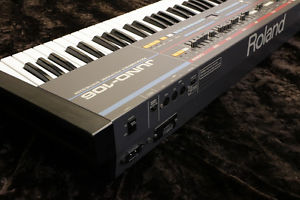
FREE SHIPPING Roland Juno-106 Polyphonic Analog Synthesizer made in Japan
Estimated price for orientation: 968 $
Category: Roland Juno106 K
Class:
Description Brand: Roland Model: Juno-106 Type: Keyboard Synthesizer Features: USB Compatible, Modulation Wheel Number of Keys: 61 Inputs / Outputs: MIDI (DIN) In MPN: Juno106 Country/Region of Manufacture: Japan UPC: 9786138714279
The JUNO-106 is a very common and widely used analog polysynth.
It continues to be one of the most popular analog synths due to its great sound and easy programmability. It was the next major incarnation of the JUNO-series, following the JUNO-60.
While it has virtually the same synth engine as the JUNO-60,
the 106 added extensive MIDI control making it one of Roland's first MIDI-equipped synthesizers. There was also increased patch memory storage, up to 128 patches instead of the 56 patches available in the JUNO-60. However, the JUNO-60 is often said to have a slight sonic edge over the more advanced 106.
The 60 had the ability to modulate oscillator pulse from its envelope and has a "punchier" sound quality.
The JUNO-106 is a six-voice polyphonic and programable analog synth with one digitally controlled oscillator (DCO) per voice.
While classic monophonic synths used two or three oscillators to create a fatter sound, the JUNO-106 uses built-in Chorus to fatten up its sound to dramatic effect.
The nature of its DCO meant it was stable and always in perfect tune but still warm and analog. There is an excellent 24dB/oct analog lowpass filter with plenty of resonance and self-oscillating possibilities and a non-resonant highpass filter.
The programable pitch/mod bender can be assigned to control the DCO pitch, VCF cutoff, and LFO amount all at once or individually.
The JUNO-106 was the first MIDI equipped JUNO and its implementation is quite good.
There are 16 MIDI channels available and MIDI SysEx data can be transmitted/received from all the sliders and buttons for total remote control
and sequencing capability. A switch on the back of the keyboard, next to the MIDI ports allows the user to switch between three types of MIDI modes:
Keyboard and Hold data only; Keyboard, Hold, Bender, Patch selection data;
or All data (including SysEx). Most users simply set it to MIDI Function mode 3 and forget it.
This synth is incredibly straightforward and very powerful.
It's SH-series derived panel layout is easy to understand and very hands-on.
Use it to generate lush pads, filter sweeps, and funky bass lines and leads. The JUNO-106 is an awesome learning tool for anyone new to analog synthesis,
as well as an electronic musician's dream for its warm analog sounds coupled with modern features like MIDI and memory - all at a very reasonable price.
And still the JUNO-106 has an even cheaper alter-ego in the form of the HS-60 - a hobbyist version with built-in speakers.
Description
| Brand: | Roland | Model: | Juno-106 |
| Type: | Keyboard Synthesizer | Features: | USB Compatible, Modulation Wheel |
| Number of Keys: | 61 | Inputs / Outputs: | MIDI (DIN) In |
| MPN: | Juno106 | Country/Region of Manufacture: | Japan |
| UPC: | 9786138714279 |
The JUNO-106 is a very common and widely used analog polysynth.
It continues to be one of the most popular analog synths due to its great sound and easy programmability. It was the next major incarnation of the JUNO-series, following the JUNO-60.
While it has virtually the same synth engine as the JUNO-60,
the 106 added extensive MIDI control making it one of Roland's first MIDI-equipped synthesizers. There was also increased patch memory storage, up to 128 patches instead of the 56 patches available in the JUNO-60. However, the JUNO-60 is often said to have a slight sonic edge over the more advanced 106.
The 60 had the ability to modulate oscillator pulse from its envelope and has a "punchier" sound quality.
The JUNO-106 is a six-voice polyphonic and programable analog synth with one digitally controlled oscillator (DCO) per voice.
While classic monophonic synths used two or three oscillators to create a fatter sound, the JUNO-106 uses built-in Chorus to fatten up its sound to dramatic effect.
The nature of its DCO meant it was stable and always in perfect tune but still warm and analog. There is an excellent 24dB/oct analog lowpass filter with plenty of resonance and self-oscillating possibilities and a non-resonant highpass filter.
The programable pitch/mod bender can be assigned to control the DCO pitch, VCF cutoff, and LFO amount all at once or individually.
The JUNO-106 was the first MIDI equipped JUNO and its implementation is quite good.
There are 16 MIDI channels available and MIDI SysEx data can be transmitted/received from all the sliders and buttons for total remote control
and sequencing capability. A switch on the back of the keyboard, next to the MIDI ports allows the user to switch between three types of MIDI modes:
Keyboard and Hold data only; Keyboard, Hold, Bender, Patch selection data;
or All data (including SysEx). Most users simply set it to MIDI Function mode 3 and forget it.
This synth is incredibly straightforward and very powerful.
It's SH-series derived panel layout is easy to understand and very hands-on.
Use it to generate lush pads, filter sweeps, and funky bass lines and leads. The JUNO-106 is an awesome learning tool for anyone new to analog synthesis,
as well as an electronic musician's dream for its warm analog sounds coupled with modern features like MIDI and memory - all at a very reasonable price.
And still the JUNO-106 has an even cheaper alter-ego in the form of the HS-60 - a hobbyist version with built-in speakers.
It continues to be one of the most popular analog synths due to its great sound and easy programmability. It was the next major incarnation of the JUNO-series, following the JUNO-60.
While it has virtually the same synth engine as the JUNO-60,
the 106 added extensive MIDI control making it one of Roland's first MIDI-equipped synthesizers. There was also increased patch memory storage, up to 128 patches instead of the 56 patches available in the JUNO-60. However, the JUNO-60 is often said to have a slight sonic edge over the more advanced 106.
The 60 had the ability to modulate oscillator pulse from its envelope and has a "punchier" sound quality.
The JUNO-106 is a six-voice polyphonic and programable analog synth with one digitally controlled oscillator (DCO) per voice.
While classic monophonic synths used two or three oscillators to create a fatter sound, the JUNO-106 uses built-in Chorus to fatten up its sound to dramatic effect.
The nature of its DCO meant it was stable and always in perfect tune but still warm and analog. There is an excellent 24dB/oct analog lowpass filter with plenty of resonance and self-oscillating possibilities and a non-resonant highpass filter.
The programable pitch/mod bender can be assigned to control the DCO pitch, VCF cutoff, and LFO amount all at once or individually.
The JUNO-106 was the first MIDI equipped JUNO and its implementation is quite good.
There are 16 MIDI channels available and MIDI SysEx data can be transmitted/received from all the sliders and buttons for total remote control
and sequencing capability. A switch on the back of the keyboard, next to the MIDI ports allows the user to switch between three types of MIDI modes:
Keyboard and Hold data only; Keyboard, Hold, Bender, Patch selection data;
or All data (including SysEx). Most users simply set it to MIDI Function mode 3 and forget it.
This synth is incredibly straightforward and very powerful.
It's SH-series derived panel layout is easy to understand and very hands-on.
Use it to generate lush pads, filter sweeps, and funky bass lines and leads. The JUNO-106 is an awesome learning tool for anyone new to analog synthesis,
as well as an electronic musician's dream for its warm analog sounds coupled with modern features like MIDI and memory - all at a very reasonable price.
And still the JUNO-106 has an even cheaper alter-ego in the form of the HS-60 - a hobbyist version with built-in speakers.