Back to the main page Back to category Gibson Acoustic
musical instrument details
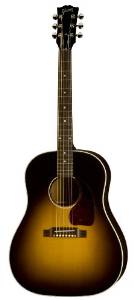
Gibson J-45 Standard Acoustic-Electric Guitar, Vintage Sunburst
Estimated price for orientation: 1 949 $
Category: Gibson Acoustic
Class:
Features Designed to benefit all musicians Crisp Bright tone Electric Guitar AA-grade Sitka spruce top Pattern-grade Honduras mahogany back and sides Mother-of-pearl. Description Product Description Product Description The J-45 has been Gibson’s top-selling acoustic guitar for years. Nicknamed “The Workhorse” and first introduced in 1942, Gibson’s most popular acoustic is now the icon of its round-shoulder, dreadnought line, world renowned for its full, balanced expression, warm bass, and excellent projection. Subtle changes to the bracing of its predecessor—the J-35—made Gibson’s J-45 one of most technically advanced guitars of its time. Amazon.com The J-45 has been Gibson's top-selling acoustic guitar for years. Nicknamed "The Workhorse" and first introduced in 1942, Gibson's most popular acoustic is now the icon of its round-shoulder, dreadnought line, world renowned for its full, balanced expression, warm bass, and excellent projection. Subtle changes to the bracing of its predecessor--the J-35--made Gibson's J-45 one of most technically advanced guitars of its time. The Workhorse.
Nickel Grover Rotomatic Tuners
Grover's original Rotomatic tuners are an engineering marvel, with abundant style and performance exactly suited for the J-45. With a gear ratio of 14:1, the Rotomatics deliver precision tuning in a durable housing that provides maximum protection for the gear and string post. All moving parts are cut for exact meshing, eliminating the possibility of slippage. A countersunk tension screw lets players regulate the tuning tension to any degree. A special lubricant inside the gear box provides smooth and accurate tuning stability. Body Tonewoods (back, sides and top)
The top of the J-45 is made from AA-grade Sitka spruce, while the back and sides are constructed from pattern grade Honduras mahogany, giving the J-45 its world renowned full, balanced expression, warm bass, and excellent projection. Selecting the right wood, and the formula to dry it out, are two of the most central procedures to Gibson's guitar-building process. Beginning with its first catalog in 1903, Gibson has assured its customers that every guitar would be built using woods with "the most durable, elastic, and sonorous qualities," and today's guitars from Gibson Acoustic are no different. Tapered dovetail neck joint allows the body and neck to become one solid piece of resonating wood. Features a a radiused, or "tuned" top. Body binding adds a subtle elegance. Pickguard
The pickguard for the J-45 is Gibson's standard plain tortoise tear drop shape, which has been used on the J-45 since its introduction in 1942. As with all of Gibson's pickguards, the coloring and binding are all done by hand. Rosette
A rosette is the beautiful, hand-crafted circle around the soundhole, and can be one of the most ornamental elements of any acoustic guitar. It is also one of the most subtle and complicated woodworking decorations on any acoustic guitar. The rosette on the J-45 is a simple single-ring rosette consisting of three-ply binding, adding a stylish, understated elegance to the J-45 Standard. Rosewood Fingerboard with Rolled Edges and Dot Inlays
The fingerboard of Gibson's J-45 is constructed from the highest grade rosewood on earth, which is personally inspected and qualified by Gibson's team of skilled experts before it enters the Gibson factories. The resilience of this durable wood makes the fingerboard extremely balanced and stable, and gives each chord and note unparalleled clarity and bite. The J-45's dot inlays are made of genuine mother of pearl, measuring approximately 1/4-inch in diameter, and are inserted into the fingerboard using a process that eliminates gaps. The fingerboard also sports a rolled edge--instead of the usual right angle where the fingerboard surface meets the neck, Gibson Acoustic's rolled edges are slightly beveled for an extremely smooth and comfortable feel, enhancing the playability of the J-45. L.R. Baggs Element Active Acoustic Pickup System
Gibson Acoustic's J-45 comes equipped with the popular Element Active Acoustic Pickup System from L.R. Baggs, which features a low-profile undersaddle element--or transducer--that's proven more stable and durable than many standard ribbon-type pickups. Combined with an onboard preamp with an unobtrusive volume control mounted just inside the soundhole, the Element delivers performance not previously attainable from an undersaddle pickup. Its sleek and effective design removes unnecessary internal components to enhance the coupling between the pickup and the guitar, and improve the sensitivity of the transducer for a robust, lively, and natural acoustic sound with excellent dynamics and delicate high end. The Element works with a standard 9V battery, which is housed inside the guitar in L.R. Bagg's new "Battery Bagg." Bracing
Every acoustic guitar made by Gibson features hand-scalloped, radiused top bracing inside the body, a feature normally found only in limited run, hand-made guitars. By scalloping each brace by hand, the natural sound of the acoustic is focused more toward the center of the body, enhancing the instrument's sound projection. The J-45 features a variation of Gibson's "X" bracing pattern situated behind the soundhole, with a set of tall and thin braces for the back, and scalloped tall and thin braces for the top. This legendary bracing design delivers a balanced expression, with punchy, deep lows, warm mids, and clear, crisp highs. When pushed for more volume, the J-45 projects a natural compression, which helps it blend nicely with any accompaniment. Tapered Dovetail Neck Joint
The dovetail neck joint is one of the oldest--and best--ways of securely joining the neck to the body of a guitar. It is also a complex and expensive neck joint to build, but the result is a tight, locking connection that supports the neck at the proper neck-pitch angle, allowing the body and neck to become one solid piece of resonating wood, with no metal to impede vibration. This process is done entirely by hand, requiring patience and sk
Features Designed to benefit all musicians Crisp Bright tone Electric Guitar AA-grade Sitka spruce top Pattern-grade Honduras mahogany back and sides Mother-of-pearl. Description Product Description Product Description The J-45 has been Gibson’s top-selling acoustic guitar for years. Nicknamed “The Workhorse” and first introduced in 1942, Gibson’s most popular acoustic is now the icon of its round-shoulder, dreadnought line, world renowned for its full, balanced expression, warm bass, and excellent projection. Subtle changes to the bracing of its predecessor—the J-35—made Gibson’s J-45 one of most technically advanced guitars of its time. Amazon.com The J-45 has been Gibson's top-selling acoustic guitar for years. Nicknamed "The Workhorse" and first introduced in 1942, Gibson's most popular acoustic is now the icon of its round-shoulder, dreadnought line, world renowned for its full, balanced expression, warm bass, and excellent projection. Subtle changes to the bracing of its predecessor--the J-35--made Gibson's J-45 one of most technically advanced guitars of its time. The Workhorse. Nickel Grover Rotomatic Tuners Grover's original Rotomatic tuners are an engineering marvel, with abundant style and performance exactly suited for the J-45. With a gear ratio of 14:1, the Rotomatics deliver precision tuning in a durable housing that provides maximum protection for the gear and string post. All moving parts are cut for exact meshing, eliminating the possibility of slippage. A countersunk tension screw lets players regulate the tuning tension to any degree. A special lubricant inside the gear box provides smooth and accurate tuning stability. Body Tonewoods (back, sides and top) The top of the J-45 is made from AA-grade Sitka spruce, while the back and sides are constructed from pattern grade Honduras mahogany, giving the J-45 its world renowned full, balanced expression, warm bass, and excellent projection. Selecting the right wood, and the formula to dry it out, are two of the most central procedures to Gibson's guitar-building process. Beginning with its first catalog in 1903, Gibson has assured its customers that every guitar would be built using woods with "the most durable, elastic, and sonorous qualities," and today's guitars from Gibson Acoustic are no different. Tapered dovetail neck joint allows the body and neck to become one solid piece of resonating wood. Features a a radiused, or "tuned" top. Body binding adds a subtle elegance. Pickguard The pickguard for the J-45 is Gibson's standard plain tortoise tear drop shape, which has been used on the J-45 since its introduction in 1942. As with all of Gibson's pickguards, the coloring and binding are all done by hand. Rosette A rosette is the beautiful, hand-crafted circle around the soundhole, and can be one of the most ornamental elements of any acoustic guitar. It is also one of the most subtle and complicated woodworking decorations on any acoustic guitar. The rosette on the J-45 is a simple single-ring rosette consisting of three-ply binding, adding a stylish, understated elegance to the J-45 Standard. Rosewood Fingerboard with Rolled Edges and Dot Inlays The fingerboard of Gibson's J-45 is constructed from the highest grade rosewood on earth, which is personally inspected and qualified by Gibson's team of skilled experts before it enters the Gibson factories. The resilience of this durable wood makes the fingerboard extremely balanced and stable, and gives each chord and note unparalleled clarity and bite. The J-45's dot inlays are made of genuine mother of pearl, measuring approximately 1/4-inch in diameter, and are inserted into the fingerboard using a process that eliminates gaps. The fingerboard also sports a rolled edge--instead of the usual right angle where the fingerboard surface meets the neck, Gibson Acoustic's rolled edges are slightly beveled for an extremely smooth and comfortable feel, enhancing the playability of the J-45. L.R. Baggs Element Active Acoustic Pickup System Gibson Acoustic's J-45 comes equipped with the popular Element Active Acoustic Pickup System from L.R. Baggs, which features a low-profile undersaddle element--or transducer--that's proven more stable and durable than many standard ribbon-type pickups. Combined with an onboard preamp with an unobtrusive volume control mounted just inside the soundhole, the Element delivers performance not previously attainable from an undersaddle pickup. Its sleek and effective design removes unnecessary internal components to enhance the coupling between the pickup and the guitar, and improve the sensitivity of the transducer for a robust, lively, and natural acoustic sound with excellent dynamics and delicate high end. The Element works with a standard 9V battery, which is housed inside the guitar in L.R. Bagg's new "Battery Bagg." Bracing Every acoustic guitar made by Gibson features hand-scalloped, radiused top bracing inside the body, a feature normally found only in limited run, hand-made guitars. By scalloping each brace by hand, the natural sound of the acoustic is focused more toward the center of the body, enhancing the instrument's sound projection. The J-45 features a variation of Gibson's "X" bracing pattern situated behind the soundhole, with a set of tall and thin braces for the back, and scalloped tall and thin braces for the top. This legendary bracing design delivers a balanced expression, with punchy, deep lows, warm mids, and clear, crisp highs. When pushed for more volume, the J-45 projects a natural compression, which helps it blend nicely with any accompaniment. Tapered Dovetail Neck Joint The dovetail neck joint is one of the oldest--and best--ways of securely joining the neck to the body of a guitar. It is also a complex and expensive neck joint to build, but the result is a tight, locking connection that supports the neck at the proper neck-pitch angle, allowing the body and neck to become one solid piece of resonating wood, with no metal to impede vibration. This process is done entirely by hand, requiring patience and sk