Back to the main page Back to category Banjos
musical instrument details
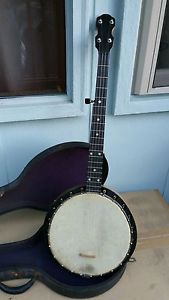
Antique banjo Jerome May Mayberger
Estimated price for orientation: 699 $
Category: Banjos
Class:
Description Brand: may maker Exact Year: pre 1800 Number of Strings: 5 Country/Region of Manufacture: United States
This is an banjo believed to be from late 1800, built by a man named Jerome Mayberger, who shortened his name to May.
On this banjo it is tagged ...Jerome May maker. Built in Stratford, Connecticut. The banjo appears to be all original and period correct, as does the case it is in. The original "clock key" head tuning tool is still I the case.
This us a real piece of Americana history.
Jerome May applied for patents on his banjo designs, for improving the over all sounds of the banjo.
Research his name for more information. This comes off a site called littlebearbanjoblog: Jerome Mayberger, a New Yorker, who later changed his name to Jerome May, built banjos in the 1860s and 1870s. His 1867 patent, intended to be an improvement on George Teed’s banjo, was designed to channel air through the resonator in unique ways, but what struck me was the unusual configuration for the resonator – the rim set into the “sound board” (resonator), and the neck was jointed to the resonator sidewall.
Description
| Brand: | may maker | Exact Year: | pre 1800 |
| Number of Strings: | 5 | Country/Region of Manufacture: | United States |
This is an banjo believed to be from late 1800, built by a man named Jerome Mayberger, who shortened his name to May.
On this banjo it is tagged ...Jerome May maker. Built in Stratford, Connecticut. The banjo appears to be all original and period correct, as does the case it is in. The original "clock key" head tuning tool is still I the case.
This us a real piece of Americana history.
Jerome May applied for patents on his banjo designs, for improving the over all sounds of the banjo.
Research his name for more information. This comes off a site called littlebearbanjoblog: Jerome Mayberger, a New Yorker, who later changed his name to Jerome May, built banjos in the 1860s and 1870s. His 1867 patent, intended to be an improvement on George Teed’s banjo, was designed to channel air through the resonator in unique ways, but what struck me was the unusual configuration for the resonator – the rim set into the “sound board” (resonator), and the neck was jointed to the resonator sidewall.
On this banjo it is tagged ...Jerome May maker. Built in Stratford, Connecticut. The banjo appears to be all original and period correct, as does the case it is in. The original "clock key" head tuning tool is still I the case.
This us a real piece of Americana history.
Jerome May applied for patents on his banjo designs, for improving the over all sounds of the banjo.
Research his name for more information. This comes off a site called littlebearbanjoblog: Jerome Mayberger, a New Yorker, who later changed his name to Jerome May, built banjos in the 1860s and 1870s. His 1867 patent, intended to be an improvement on George Teed’s banjo, was designed to channel air through the resonator in unique ways, but what struck me was the unusual configuration for the resonator – the rim set into the “sound board” (resonator), and the neck was jointed to the resonator sidewall.