Back to the main page Back to category French Horns
musical instrument details
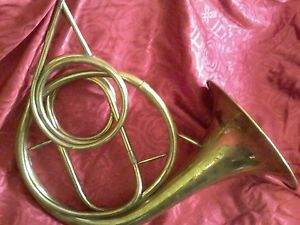
Natural French Horn, Goudon/Kalishens, crooks Bb alto to Bb basso. Superb!
Estimated price for orientation: 5 200 $
Category: French Horns
Class:
Description Brand: Goudon, imported by Kalishens Skill Level: expert, advanced, serious student Type: cor d'orchestre Country/Region of Manufacture: France Finish: Brass Model: natural horn Bell Material: enamel, gildong, and paint
This horn, almost certainly built by Goudon of Paris, but imported by Kalishens, New York, and bearing their brand, is built on a French pattern dating from the 1800s.
The "rebranding" of French instruments was commonplace at that time, and allowed a shop which had no master draftsman to offer a complete line of instruments. Several major French makers had not only "absorbed" other firms, and their brand names, but overtly advertized in their catalogues, the availability of unbranded instruments, for rebranding by putative importers.The design of this horn features a reduced size of coil, with the difference in length completed by a longer tuning slide crook, which could be changed out, and allowed the player to play at the various tunings used in the 19th century: A430, A438 (A440), A450. These Goudon horns are of such excellence, that they even seem to have their own natural horn subculture following, today! The condition, sound, intonation, and playability are absolutely superb! There are independent original crooks for Bb alto, A, and G, antique crooks from another set for F, E, Eb, D, and C, and a coupler from a third source for Bb basso. All play very well, and are well tuned to the horn. The bell interior is enameled, gilded, and painted. This treatment was not only festive, but it actually reduced the erosion of the bell metal, created by the hand technique of the player. In every way, this is a spectacular historical instrument, opined by many to be the equal of horns by Raoux, Courtois, and Dupre. There is no coeval case, but another from the 19th century, is available as a separate purchase, but the crooks will need a separate case. Most natural horn players today prefer a case of sturdy construction or a gig bag, with a crook case repurposed from a file case from an office supply store. Neither is there an original mouthpiece, but Moosewood and others make copies of historic cups with historic shanks that accept your preference of modern rim, the aspect of mouthpiece changes that is so disorienting. This is almost certainly a finer alternative than attempting to use one of the eccentric flat-rimmed historic models. Shipping, packing, and insurance are $68 within the continental US. Shipping to Europe is by the eBay shipping service. Historically Informed Performance has become very popular these days, and the music of 18th and 19th century European composers can, once again, be heard without a Wagnerian accent.
Description
| Brand: | Goudon, imported by Kalishens | Skill Level: | expert, advanced, serious student |
| Type: | cor d'orchestre | Country/Region of Manufacture: | France |
| Finish: | Brass | Model: | natural horn |
| Bell Material: | enamel, gildong, and paint |
This horn, almost certainly built by Goudon of Paris, but imported by Kalishens, New York, and bearing their brand, is built on a French pattern dating from the 1800s.
The "rebranding" of French instruments was commonplace at that time, and allowed a shop which had no master draftsman to offer a complete line of instruments. Several major French makers had not only "absorbed" other firms, and their brand names, but overtly advertized in their catalogues, the availability of unbranded instruments, for rebranding by putative importers.The design of this horn features a reduced size of coil, with the difference in length completed by a longer tuning slide crook, which could be changed out, and allowed the player to play at the various tunings used in the 19th century: A430, A438 (A440), A450. These Goudon horns are of such excellence, that they even seem to have their own natural horn subculture following, today! The condition, sound, intonation, and playability are absolutely superb! There are independent original crooks for Bb alto, A, and G, antique crooks from another set for F, E, Eb, D, and C, and a coupler from a third source for Bb basso. All play very well, and are well tuned to the horn. The bell interior is enameled, gilded, and painted. This treatment was not only festive, but it actually reduced the erosion of the bell metal, created by the hand technique of the player. In every way, this is a spectacular historical instrument, opined by many to be the equal of horns by Raoux, Courtois, and Dupre. There is no coeval case, but another from the 19th century, is available as a separate purchase, but the crooks will need a separate case. Most natural horn players today prefer a case of sturdy construction or a gig bag, with a crook case repurposed from a file case from an office supply store. Neither is there an original mouthpiece, but Moosewood and others make copies of historic cups with historic shanks that accept your preference of modern rim, the aspect of mouthpiece changes that is so disorienting. This is almost certainly a finer alternative than attempting to use one of the eccentric flat-rimmed historic models. Shipping, packing, and insurance are $68 within the continental US. Shipping to Europe is by the eBay shipping service. Historically Informed Performance has become very popular these days, and the music of 18th and 19th century European composers can, once again, be heard without a Wagnerian accent.
The "rebranding" of French instruments was commonplace at that time, and allowed a shop which had no master draftsman to offer a complete line of instruments. Several major French makers had not only "absorbed" other firms, and their brand names, but overtly advertized in their catalogues, the availability of unbranded instruments, for rebranding by putative importers.The design of this horn features a reduced size of coil, with the difference in length completed by a longer tuning slide crook, which could be changed out, and allowed the player to play at the various tunings used in the 19th century: A430, A438 (A440), A450. These Goudon horns are of such excellence, that they even seem to have their own natural horn subculture following, today! The condition, sound, intonation, and playability are absolutely superb! There are independent original crooks for Bb alto, A, and G, antique crooks from another set for F, E, Eb, D, and C, and a coupler from a third source for Bb basso. All play very well, and are well tuned to the horn. The bell interior is enameled, gilded, and painted. This treatment was not only festive, but it actually reduced the erosion of the bell metal, created by the hand technique of the player. In every way, this is a spectacular historical instrument, opined by many to be the equal of horns by Raoux, Courtois, and Dupre. There is no coeval case, but another from the 19th century, is available as a separate purchase, but the crooks will need a separate case. Most natural horn players today prefer a case of sturdy construction or a gig bag, with a crook case repurposed from a file case from an office supply store. Neither is there an original mouthpiece, but Moosewood and others make copies of historic cups with historic shanks that accept your preference of modern rim, the aspect of mouthpiece changes that is so disorienting. This is almost certainly a finer alternative than attempting to use one of the eccentric flat-rimmed historic models. Shipping, packing, and insurance are $68 within the continental US. Shipping to Europe is by the eBay shipping service. Historically Informed Performance has become very popular these days, and the music of 18th and 19th century European composers can, once again, be heard without a Wagnerian accent.