Back to the main page Back to category Other Musical Instruments
musical instrument details
Handcrafted, One Of A Kind Root End Shakuhachi-Jinashi, Flute/Samurai Mace EDC
Estimated price for orientation: 600 $
Category: Other Musical Instruments
Class:
Description Condition: New: A brand-new, unused, unopened, undamaged item in its original packaging (where packaging is applicable). Packaging should be the same as what is found in a retail store, unless the item is handmade or was packaged by the manufacturer in non-retail packaging, such as an unprinted box or plastic bag. See the seller's listing for full details. See all condition definitions- opens in a new window or tab ... Read moreabout the condition
I have been making custom flutes for the last two decades. This was a commissioned piece that was never paid for. It is one of a kind and one of the most unique and beautiful flutes in both design and tone that I have ever crafted. The shakuhachi is three tools in one: a beautiful flute, a meditation device, and a weapon. It’s also extremely portable and can legally be carried anywhere. For a martial artist, it doesn’t get much better than that. The bamboo flute was used by Japanese Buddhist monks of the Fuke Sect as a tool for meditation, suizen or “blowing zen”. But during the Edo Period (1603 – 1868), significant numbers of samurai found themselves without masters, ronin, and decided to become monks. They called themselves komuso, priests of nothingness. These ronin would often sell their swords in order to pay the fee to become a komuso monk, and would wander the country playing their flutes for money. Having no swords, the komuso changed the design of the bamboo flute to make it double as a weapon, cutting it from the root end of bamboo instead of from a thinner and weaker section. This led to a dense, solid, and heavy flute with an end that resembles a mace.
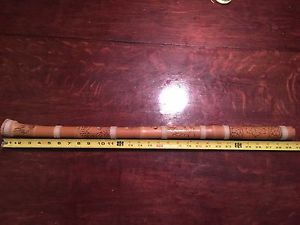
There are two radically different approaches used in making shakuhachi. The most common uses a highly-articulated bore that is fabricated inside the bamboo. It is shaped and fine tuned by hand. The second method used to make shakuhachi leaves the interior of the instrument as natural as possible. This style of shakuhachi is called called Jinashikan. Jinashikan are very difficult to produce. The natural hand-shaped bore of these instruments gives the maker much more control over tonal quality. The tone of jinashikan, or Jenashi is somewhat darker and more mellow than the brighter precision bore shakyhachi. Now a little bit about this particular instrument. The lowest note on this instrument is G# below C3 and the highest is A above C4. The carving was all done by hand. The upper section of the flute is inscribed with "Om Mani Padme Hum". Next is the the buddhist lotus blossom with eight petals in the center of which is the eight spoked wheel. Both signifying the Nobel Eightfold Path of buddhism. Below that is "Om Mani Padme Hum" again. The length of the flute has the sky dragon coiled around using the holes to climb. Each claw gripping a finger hole. There are four finger holes on the front of the flute with a hole in the back for the thumb as per traditional Shakuhachi. The hole position is standard except for the bottom most (where you place the pinky of your right hand). This hole is slightly offset to allow for more comfortable playing. The flute is signed and numbered 1 of 1.
I think I have gone into enough detail. Take a look at the pictures and if you have any questions feel free to contact me. Whoever wins the auction will pay the shipping. The additional cost in shipping is to cover insuring the package for its full value.
Description
| Condition: | New: A brand-new, unused, unopened, undamaged item in its original packaging (where packaging is applicable). Packaging should be the same as what is found in a retail store, unless the item is handmade or was packaged by the manufacturer in non-retail packaging, such as an unprinted box or plastic bag. See the seller's listing for full details. See all condition definitions- opens in a new window or tab ... Read moreabout the condition |
I have been making custom flutes for the last two decades. This was a commissioned piece that was never paid for. It is one of a kind and one of the most unique and beautiful flutes in both design and tone that I have ever crafted. The shakuhachi is three tools in one: a beautiful flute, a meditation device, and a weapon. It’s also extremely portable and can legally be carried anywhere. For a martial artist, it doesn’t get much better than that. The bamboo flute was used by Japanese Buddhist monks of the Fuke Sect as a tool for meditation, suizen or “blowing zen”. But during the Edo Period (1603 – 1868), significant numbers of samurai found themselves without masters, ronin, and decided to become monks. They called themselves komuso, priests of nothingness. These ronin would often sell their swords in order to pay the fee to become a komuso monk, and would wander the country playing their flutes for money. Having no swords, the komuso changed the design of the bamboo flute to make it double as a weapon, cutting it from the root end of bamboo instead of from a thinner and weaker section. This led to a dense, solid, and heavy flute with an end that resembles a mace.
There are two radically different approaches used in making shakuhachi. The most common uses a highly-articulated bore that is fabricated inside the bamboo. It is shaped and fine tuned by hand. The second method used to make shakuhachi leaves the interior of the instrument as natural as possible. This style of shakuhachi is called called Jinashikan. Jinashikan are very difficult to produce. The natural hand-shaped bore of these instruments gives the maker much more control over tonal quality. The tone of jinashikan, or Jenashi is somewhat darker and more mellow than the brighter precision bore shakyhachi. Now a little bit about this particular instrument. The lowest note on this instrument is G# below C3 and the highest is A above C4. The carving was all done by hand. The upper section of the flute is inscribed with "Om Mani Padme Hum". Next is the the buddhist lotus blossom with eight petals in the center of which is the eight spoked wheel. Both signifying the Nobel Eightfold Path of buddhism. Below that is "Om Mani Padme Hum" again. The length of the flute has the sky dragon coiled around using the holes to climb. Each claw gripping a finger hole. There are four finger holes on the front of the flute with a hole in the back for the thumb as per traditional Shakuhachi. The hole position is standard except for the bottom most (where you place the pinky of your right hand). This hole is slightly offset to allow for more comfortable playing. The flute is signed and numbered 1 of 1.
I think I have gone into enough detail. Take a look at the pictures and if you have any questions feel free to contact me. Whoever wins the auction will pay the shipping. The additional cost in shipping is to cover insuring the package for its full value.
There are two radically different approaches used in making shakuhachi. The most common uses a highly-articulated bore that is fabricated inside the bamboo. It is shaped and fine tuned by hand. The second method used to make shakuhachi leaves the interior of the instrument as natural as possible. This style of shakuhachi is called called Jinashikan. Jinashikan are very difficult to produce. The natural hand-shaped bore of these instruments gives the maker much more control over tonal quality. The tone of jinashikan, or Jenashi is somewhat darker and more mellow than the brighter precision bore shakyhachi. Now a little bit about this particular instrument. The lowest note on this instrument is G# below C3 and the highest is A above C4. The carving was all done by hand. The upper section of the flute is inscribed with "Om Mani Padme Hum". Next is the the buddhist lotus blossom with eight petals in the center of which is the eight spoked wheel. Both signifying the Nobel Eightfold Path of buddhism. Below that is "Om Mani Padme Hum" again. The length of the flute has the sky dragon coiled around using the holes to climb. Each claw gripping a finger hole. There are four finger holes on the front of the flute with a hole in the back for the thumb as per traditional Shakuhachi. The hole position is standard except for the bottom most (where you place the pinky of your right hand). This hole is slightly offset to allow for more comfortable playing. The flute is signed and numbered 1 of 1.
I think I have gone into enough detail. Take a look at the pictures and if you have any questions feel free to contact me. Whoever wins the auction will pay the shipping. The additional cost in shipping is to cover insuring the package for its full value.