Back to the main page Back to category Peavey 5150 EVH
musical instrument details
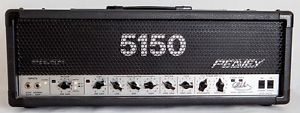
1992 ~ Peavey 5150 EVH Block Letter Amp Head
Estimated price for orientation: 800 $
Category: Peavey 5150 EVH
Class:
Description Condition: Used: An item that has been used previously. The item may have some signs of cosmetic wear, but is fully operational and functions as intended. This item may be a floor model or store return that has been used. See the seller’s listing for full details and description of any imperfections. See all condition definitions- opens in a new window or tab ... Read moreabout the condition Model: 5150 Number of Channels: 2 Amplifier Type: Head Country/Region of Manufacture: United States Brand: Peavey Type: Electric Guitar Amplifier Amplifier Technology: Vacuum Tube
Bought somewhere around 1994. Locally bought. Excellent condition head works great and fires right up. Used but loved. With minor signs of usage (see pictures) what you see is what you get. Selling off some of my surplus equipment that has not been used for a while. Mine works great and is plug and play. No footswitch included. I used a effects processor with a slant cab. Sold the cab so this is left. Minor signs of use and clean. Non Smoking environment in case you were wondering. Stored in dry environment. Cool write up. The Peavey 5150 is an all-tube guitar amplifier made by Peavey Electronics from 1992 on, initially as a signature model for Eddie Van Halen. Since Van Halen and Peavey parted ways in 2004, the name of the model was changed to Peavey 6505, with Van Halen taking the 5150 name for his company, EVH, to name his 5150 III amplifier. Thus, the 6505 was named in celebration of Peavey's 40th anniversary (1965--2005). Several aspects of the amplifier, likely responsible for its success, are its rigid construction and reliability, excellent frequency response (largely attributable to the vacuum tube amplification), and clarity with heavy gain; a feature generally synonymous with the amplifier image among its market demographic. While the product was engineered, designed around a centered PCB, an aspect sometimes considered "impure" among audiophiles, its cascading five preamps (four preamplifiers and one phase inverter) and four power tubes were exceptionally implemented in a simplistic manner, allowing individual components to carry themselves (such as exceptional transformer placement to ensure acoustical integrity ie. minimizing transconductance) in addition to commonizing the systems' ground by way of multilayer PCB, a large source of unwanted nuances at the least in most poorly grounded musical applications. The Peavey 5150 I shipped with four Ruby Tube 6L6 Power Tubes, and five 12AX7 Tubes in the preamplifier staging (with one as a phase inverter.) Despite its shared "plain" PCB, each component was generally high quality, allowing manufacturing ease while providing high quality tone at an affordable price. A defining attribute largely responsible for the 5150 sound is the fixed bias. Commonly described analog a car engine and its respective idle, the 5150 bias was set to a lower value (lower engine "idle") which resulted in the Power Tubes running at a lower energy commonly known as "cold-biased." While the electrical theory behind this can easily be examined and theoreticized, the 5150 and its configuration resulted in a more controllable gain setting (ie. having a more forgiving sonic range than similarly "hot-biased" configurations. This engineering choice set the 5150 up to intrinsically sound its best with minimal augmentation. Since tube-amps are still uncontested in music amplification as far as tonal quality is concerned, (see hard-clipping) the optimal setting for tubes are when they are pushed to natural distortion (ie. Increases in "volume" or Bells(dB).) Thus, by allowing such a heavy amount of gain to be applied without sacrificing tonal definition, the amplifier could then be pushed due to the "colder" biasing requiring more current, versus a "hotter" setting from the beginning (volume knob or potentiometer knob "value of 1.") While able to stand among modern technology as a relatively "simple" design, especially in comparison to boutique "hand-wired" variants, the reliability and era its inception welcomed helped verify its cultural significance in Hard Rock, later Metal, as a unique product with a unique tone. Both the 5150 and the 6505 are well known for its high gain overdrive channel, and has seen widespread use by rock, hardcore and metal guitarists. An early breakthrough was its use by Colin Richardson and Andy Sneap, two "seminal" British producers of heavy metal; especially Machine Head's Burn My Eyes (1994) helped the 5150 gain a reputation for its sound, which "defined a generation of guitar tone".[1] Other notable artists and producers to use the 5150/6505 include Jason Suecof, Matt Tuck and Dino Cazares
Description
| Condition: | Used: An item that has been used previously. The item may have some signs of cosmetic wear, but is fully operational and functions as intended. This item may be a floor model or store return that has been used. See the seller’s listing for full details and description of any imperfections. See all condition definitions- opens in a new window or tab ... Read moreabout the condition | Model: | 5150 |
| Number of Channels: | 2 | Amplifier Type: | Head |
| Country/Region of Manufacture: | United States | Brand: | Peavey |
| Type: | Electric Guitar Amplifier | Amplifier Technology: | Vacuum Tube |
Bought somewhere around 1994. Locally bought. Excellent condition head works great and fires right up. Used but loved. With minor signs of usage (see pictures) what you see is what you get. Selling off some of my surplus equipment that has not been used for a while. Mine works great and is plug and play. No footswitch included. I used a effects processor with a slant cab. Sold the cab so this is left. Minor signs of use and clean. Non Smoking environment in case you were wondering. Stored in dry environment. Cool write up. The Peavey 5150 is an all-tube guitar amplifier made by Peavey Electronics from 1992 on, initially as a signature model for Eddie Van Halen. Since Van Halen and Peavey parted ways in 2004, the name of the model was changed to Peavey 6505, with Van Halen taking the 5150 name for his company, EVH, to name his 5150 III amplifier. Thus, the 6505 was named in celebration of Peavey's 40th anniversary (1965--2005). Several aspects of the amplifier, likely responsible for its success, are its rigid construction and reliability, excellent frequency response (largely attributable to the vacuum tube amplification), and clarity with heavy gain; a feature generally synonymous with the amplifier image among its market demographic. While the product was engineered, designed around a centered PCB, an aspect sometimes considered "impure" among audiophiles, its cascading five preamps (four preamplifiers and one phase inverter) and four power tubes were exceptionally implemented in a simplistic manner, allowing individual components to carry themselves (such as exceptional transformer placement to ensure acoustical integrity ie. minimizing transconductance) in addition to commonizing the systems' ground by way of multilayer PCB, a large source of unwanted nuances at the least in most poorly grounded musical applications. The Peavey 5150 I shipped with four Ruby Tube 6L6 Power Tubes, and five 12AX7 Tubes in the preamplifier staging (with one as a phase inverter.) Despite its shared "plain" PCB, each component was generally high quality, allowing manufacturing ease while providing high quality tone at an affordable price. A defining attribute largely responsible for the 5150 sound is the fixed bias. Commonly described analog a car engine and its respective idle, the 5150 bias was set to a lower value (lower engine "idle") which resulted in the Power Tubes running at a lower energy commonly known as "cold-biased." While the electrical theory behind this can easily be examined and theoreticized, the 5150 and its configuration resulted in a more controllable gain setting (ie. having a more forgiving sonic range than similarly "hot-biased" configurations. This engineering choice set the 5150 up to intrinsically sound its best with minimal augmentation. Since tube-amps are still uncontested in music amplification as far as tonal quality is concerned, (see hard-clipping) the optimal setting for tubes are when they are pushed to natural distortion (ie. Increases in "volume" or Bells(dB).) Thus, by allowing such a heavy amount of gain to be applied without sacrificing tonal definition, the amplifier could then be pushed due to the "colder" biasing requiring more current, versus a "hotter" setting from the beginning (volume knob or potentiometer knob "value of 1.") While able to stand among modern technology as a relatively "simple" design, especially in comparison to boutique "hand-wired" variants, the reliability and era its inception welcomed helped verify its cultural significance in Hard Rock, later Metal, as a unique product with a unique tone. Both the 5150 and the 6505 are well known for its high gain overdrive channel, and has seen widespread use by rock, hardcore and metal guitarists. An early breakthrough was its use by Colin Richardson and Andy Sneap, two "seminal" British producers of heavy metal; especially Machine Head's Burn My Eyes (1994) helped the 5150 gain a reputation for its sound, which "defined a generation of guitar tone".[1] Other notable artists and producers to use the 5150/6505 include Jason Suecof, Matt Tuck and Dino Cazares