Back to the main page Back to category Microphones and Wireless Systems
musical instrument details
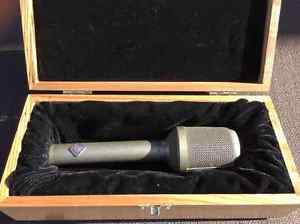
Vintage early 70's Neumann KM86 multi pattern condensor mic in wooden case
Estimated price for orientation: 1 250 $
Category: Microphones and Wireless Systems
Class:
Description Condition: Used: An item that has been used previously. The item may have some signs of cosmetic wear, but is fully operational and functions as intended. This item may be a floor model or store return that has been used. See the seller’s listing for full details and description of any imperfections. See all condition definitions- opens in a new window or tab ... Read moreabout the condition Brand: Neumann Type: Condenser Microphone
Amazing sounding KM86 from the 1970's I believe which is the 3 pattern mic in the KM seriesAuction is of the KM86 only and does not include the KM84'sbut does include the wooden box shown The -10db. pad works perfectly as do all the polar patterns and the selector switch The head comes off the body easily (as it's indeed to do) so not suited for mounting upside down like a U87 style can be Very low noise floor on this mic and it's not been used much over the past 10 years that I've had itNeumann KM 86 Multi-Pattern Condenser Microphone The KM 86 is a multipattern FET condenser microphone with two KK84 small-diaphragm Cardioid capsules mounted back-to-back. This mic was essentially a phantom-powered FET version of the KM 66 tube mic; both models contained a switch on the mic body allows selection of Cardioid, Omnidirectional, or figure-of-8 polar patterns. The use of two fixed-Cardioid capsules mounted back-to-back was a relatively recent innovation for Neumann. The idea was developed in the mid-1960s and first commercialized in the KM-66, released in 1966. Unlike large-diaphragm multipattern mics, which create switchable polar patterns by combining the output of two sides of a dual-diaphragm capsule in a variety of ways, the KM66, KM76, and KM86 utilize twin single-sided capsules developed for the fixed-Cardioid KM-84. The two capsules are mounted back-to-back, with 1cm of space between the diaphragms. Klaus Heyne The functional difference for generating figure eight with one capsule, a combined backplate and two diaphragms or two entirely separate cardioid capsules is two-fold. One, the physical distance, measured from diaphragm to diaphragm, is slightly bigger on the KM86 compared with, say, a U87. So there is some additional time delay involved. Two, each of the two cardioid capsules which form the figure eight on a KM86 is somewhat ‘purer’ in as much as the directional discrimination for each cardioid is derived from sound waves hitting the back plate (and then the inside of the diaphragm) directly, rather than traveling through another diaphragm, as in the case of combined backplate systems, like K67/K47, etc. The increase in space between the two diaphragms, as compared to a dual-diaphragm capsule, results in greater phase differences for low-frequency signals striking the two capsules; this in turn leads to an improvement in low-frequency response when the mic is in Figure-of-8 mode. Because the figure-8 performance of most dual-diaphragm capsules suffers in the low frequencies, the KM-86 and related microphones offer superior low-frequency reproduction. Neumann Polar diagrams of typical dual-diaphragm microphones indicate that the reverse attenuation of the cardioid pickup pattern decreases remarkably towards the low frequencies. When the two capsule halves are activated at the same time, the backside part adds a much higher share of the whole signal. This generates an narrower figure-8 pattern in the low frequencies and an uneven response due to changes in distance. In the KM 66, the cardioid and figure-8 patterns feature an accurate representation of low frequencies, even in such a case where the microphone is used at a greater distance from the sound source. The capsule assembly was shockmounted, to reduce mechanical noise. Over time, these rubber components can become brittle, reducing their effectiveness. The microphone’s name is descriptive: KM is for Kleine Mikrofon (“small microphone”). The digit 8 indicates the use of P48 phantom power. The digit 6 indicates a multipattern microphone. A second switch, on the rear of the microphone body, enabled a -10dB pad. The KM86 was available in two colors, with two possible output connectors, yielding four possible configurations: ▪ KM 86 - 3-pin Binder/Tuchel jack, silver/nickel finish, 175mm length ▪ KM 86 i - 3-pin XLR jack, silver/nickel finish, 185mm length ▪ KM 86 mt - 3-pin Binder/Tuchel jack, dark matte gray finish, 175mm length ▪ KM 86 i mt - 3-pin XLR jack, dark matte gray finish, 185mm length Like many of the Neumann microphones of its era, the KM86/KM86i could be modified for 50Ω output impedance, rather than the standard 200Ω. Mics configured for 50Ω from the factory were marked with a red dot next to the serial number. The KM86/KM86i specifications changed during its 18-year production run. For example, an early catalog specifies the sensitivity at 0.7mV/μb (7mV/Pa). But the user guide from 1980 specs the sensitivity at 9.5 mV/Pa. The KM86 microphone was discontinued in 1986. The Neumann KM 86 is also known as: KM86. The mic was released in 1968.
Description
| Condition: | Used: An item that has been used previously. The item may have some signs of cosmetic wear, but is fully operational and functions as intended. This item may be a floor model or store return that has been used. See the seller’s listing for full details and description of any imperfections. See all condition definitions- opens in a new window or tab ... Read moreabout the condition | Brand: | Neumann |
| Type: | Condenser Microphone |
Amazing sounding KM86 from the 1970's I believe which is the 3 pattern mic in the KM seriesAuction is of the KM86 only and does not include the KM84'sbut does include the wooden box shown The -10db. pad works perfectly as do all the polar patterns and the selector switch The head comes off the body easily (as it's indeed to do) so not suited for mounting upside down like a U87 style can be Very low noise floor on this mic and it's not been used much over the past 10 years that I've had it
Neumann KM 86 Multi-Pattern Condenser Microphone The KM 86 is a multipattern FET condenser microphone with two KK84 small-diaphragm Cardioid capsules mounted back-to-back. This mic was essentially a phantom-powered FET version of the KM 66 tube mic; both models contained a switch on the mic body allows selection of Cardioid, Omnidirectional, or figure-of-8 polar patterns. The use of two fixed-Cardioid capsules mounted back-to-back was a relatively recent innovation for Neumann. The idea was developed in the mid-1960s and first commercialized in the KM-66, released in 1966. Unlike large-diaphragm multipattern mics, which create switchable polar patterns by combining the output of two sides of a dual-diaphragm capsule in a variety of ways, the KM66, KM76, and KM86 utilize twin single-sided capsules developed for the fixed-Cardioid KM-84. The two capsules are mounted back-to-back, with 1cm of space between the diaphragms. Klaus Heyne The functional difference for generating figure eight with one capsule, a combined backplate and two diaphragms or two entirely separate cardioid capsules is two-fold. One, the physical distance, measured from diaphragm to diaphragm, is slightly bigger on the KM86 compared with, say, a U87. So there is some additional time delay involved. Two, each of the two cardioid capsules which form the figure eight on a KM86 is somewhat ‘purer’ in as much as the directional discrimination for each cardioid is derived from sound waves hitting the back plate (and then the inside of the diaphragm) directly, rather than traveling through another diaphragm, as in the case of combined backplate systems, like K67/K47, etc. The increase in space between the two diaphragms, as compared to a dual-diaphragm capsule, results in greater phase differences for low-frequency signals striking the two capsules; this in turn leads to an improvement in low-frequency response when the mic is in Figure-of-8 mode. Because the figure-8 performance of most dual-diaphragm capsules suffers in the low frequencies, the KM-86 and related microphones offer superior low-frequency reproduction. Neumann Polar diagrams of typical dual-diaphragm microphones indicate that the reverse attenuation of the cardioid pickup pattern decreases remarkably towards the low frequencies. When the two capsule halves are activated at the same time, the backside part adds a much higher share of the whole signal. This generates an narrower figure-8 pattern in the low frequencies and an uneven response due to changes in distance. In the KM 66, the cardioid and figure-8 patterns feature an accurate representation of low frequencies, even in such a case where the microphone is used at a greater distance from the sound source. The capsule assembly was shockmounted, to reduce mechanical noise. Over time, these rubber components can become brittle, reducing their effectiveness. The microphone’s name is descriptive: KM is for Kleine Mikrofon (“small microphone”). The digit 8 indicates the use of P48 phantom power. The digit 6 indicates a multipattern microphone. A second switch, on the rear of the microphone body, enabled a -10dB pad. The KM86 was available in two colors, with two possible output connectors, yielding four possible configurations: ▪ KM 86 - 3-pin Binder/Tuchel jack, silver/nickel finish, 175mm length ▪ KM 86 i - 3-pin XLR jack, silver/nickel finish, 185mm length ▪ KM 86 mt - 3-pin Binder/Tuchel jack, dark matte gray finish, 175mm length ▪ KM 86 i mt - 3-pin XLR jack, dark matte gray finish, 185mm length Like many of the Neumann microphones of its era, the KM86/KM86i could be modified for 50Ω output impedance, rather than the standard 200Ω. Mics configured for 50Ω from the factory were marked with a red dot next to the serial number. The KM86/KM86i specifications changed during its 18-year production run. For example, an early catalog specifies the sensitivity at 0.7mV/μb (7mV/Pa). But the user guide from 1980 specs the sensitivity at 9.5 mV/Pa. The KM86 microphone was discontinued in 1986. The Neumann KM 86 is also known as: KM86. The mic was released in 1968.