Back to the main page Back to category Yamaha Grand Con
musical instrument details
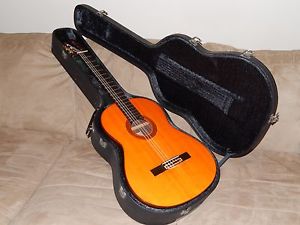
MADE IN 1969 YAMAHA GRAND CONCERT GC3 CLASSICAL GUITAR IN EXCELLENT CONDITION
Estimated price for orientation: 1 400 $
Category: Yamaha Grand Con
Class:
Description Brand: Yamaha Country/Region of Manufacture: Japan
Please read my 3 days return policy at the bottom of the page.************************************************************************* Yamaha GC3 1969 This guitar was made in 1969 by Yamaha Corporation. It was made by one of their best luthiers ever, Hiroshi Harada. Hiroshi Harada, along with Hideyuki Ezaki and Toshio Kato, was delegated in 1960s by Yamaha corp. to learn the art of guitar making directly from Spanish luthiers. Later on by the end on 1960’s and during 1970s these 3 luthiers revolutionized Yamaha’s classical guitar line and helped to establish this company as one of the best guitar making factory (Gakki) in the world. Guitar factory (Gakki) as company name can be quite misleading for many unaware players. These Japanese workshops were no different from any other luthier’s workshops. The difference was that instead of being led by one Master Luthier (owner) they employed a team of equally skilled luthiers, working together and supporting each other in order to produce a “perfect” product. These luthiers (often times not known by their individual name), represented their company (the label), were totally loyal to the bosses (owners) and had to put their egos aside. Only the best of the best were allowed to put their signatures on the labels.First Spanish blueprint classical Yamaha guitars were introduced in 1967. Top models line-up included GC3(Spruce/Indian Rosewood), GC5(Spruce/Brazilian Rosewood), GC7(Spruce/Brazilian Rosewood) and GC10(Spruce/Brazilian Rosewood)At the same time Yamaha introduced 3 superb flamenco models: GC5F, GC7F and GC10F. These guitars opened international markets for Yamaha corp. guitars. They were of absolutely highest imaginable grade of craftsmanship & materials and were also very expensive, not only to Japanese players. In fact these old Yamaha guitars made in late 1960s and in 1970s, on Japanese second hand market, reach similar prices as Masaru Kohno guitars made in the same period. This lineup remained unchanged only until 1970. Due to very rapid devaluation of Japanese currency, all these top models had added ornamental extras and were relabeled to higher numbers by 1971. For less fortunate guitar enthusiasts Yamaha introduced other lower grade models. Its price was 30 000 yen in 1969, a value equal to 7/8 of yearly salary of Japanese college graduate. Exactly the same grade guitar would be labelled as GC5 in 1971, as GC8 by 1973, as GC10 by 1975 and as GC15 by 1978.If this guitar was offered for sale in USA in 1969 it would priced at least $500. A purchase power of $1000 in 1969 equals to a purchase power of $5000 today.The back, sides & neck and headstock remain in truly excellent (practically mint) condition, which is quite rare in case of 46 years old instrument. On the bass side of the headstock there is tiny spot of missing finish, however covered by tuners. On the top there are few light dents, scratches and abrasions. None of them is deep nor could be described as serious. They are not visible from every angle and are best shown on picture 11. Some of these shallow scratches are simply not visible on the pictures. Ebony fingerboard is somewhat dry on the surface, but without any visible wear. This guitar doesn’t have any structural flaws. Original tuning machines were completely stuck and nonfunctional with cracked and/or missing buttons. They had to be replaced with new ones.This guitar plays easy and sounds fantastic. It is light and very responsive. It produces beautiful clean treble notes and deep resonant bass notes at pretty high volume. Real Honey !!! SPECIFICATIONS: GC3 Year(s) Sold: 1967-70 Top: Solid Yezo Spruce Shellac or lacquer Back / Sides: Solid Indian Rosewood Lacquer Neck: Honduras Mahogany Fingerboard: Ebony Bridge: Jacaranda Color(s): Natural String Length: 658mm Notes: Hand Crafted
Its action is set to 3.50 mm under E6 and 3.00 mm under E1. This guitar will be shipped in used Takabe Hard Shell Case in very good condition. To Australia it will be shipped in brand new Hard Polyfoam Case.Real Value of Japanese Vintage GuitarsThe key to understand value of vintage Japanese guitars is to acknowledge galloping devaluation of Japanese yen in 1960s & 1970s. This devaluation was somewhat slower in 1980s. The best measure of this devaluation is Starting Yearly Salary of Japanese College Graduate (SYSJCG).SYSJCG in 1965 was 19 600 yen, in 1969 – 34 600 yen, in 1970 39 200 yen, in 1972 – 62 300 yen, in 1975 79 200 yen, in 1977 121 200 and in 1980 - 163 000 yen. During 1960s and most of 1970s model numbers of Japanese guitars were strictly interconnected with their prices in Japanese yen. In late 1970s and during following decades model numbers were no longer strictly associated with their prices. Many Japanese guitar makers introduced model names instead of model numbers. Others were still using model numbers with addition of letter abbreviations or other symbols. The best and only logical approach while evaluating real value (real grade) of vintage Japanese guitar is to compare its price in Japanese yen with SYSJCG during the year guitar was made. Any guitar priced 100 000 in 1970 (labelled usually as No10) would be priced 200 000 yen in 1975 (relabeled to No20 or 2000), 300 000 yen in 1977 (labelled as No3, No30 or 3000). Starting in 1977 Masaru Kohno introduced his model No50 priced at 500 000 (skipping theoretical model 40). Soon other famous Japanese luthiers did the same. By 1983 Kohno started using model names instead numbers and was raising their prices as he was pleased. Naturally soon other Master luthiers did the same. Knowing all of that, you can bet on that Masaru Kohno No50 made in 1982 is practically the same quality as Kohno No15 made in 1972, or Kohno no20 made in 1975 or Kohno No30 made in 1977. I know it for a fact.The lowest grade models currently made by Matsuoka workshop are M75 and MH75. They are commonly considered as “beginner guitars”. Matsuoka model M30 made in 1973 is simply far, far better instrument. It is naturally better than model M50 made in 1977, model 80 made in 1982 or model M100 made in 1990. At present, the highest grade Matsuoka models are M300 and MH300. They absolutely stand no chance in competition with model M150 made in 1975… or model M200 made in 1977.It is very important to mention that if modern era luthiers are using 40 years old woods to make a classical guitar, its price is at least $8000.ReturnsIf you are not happy with your purchase you may return the guitar for a full refund. The cost of return shipping will not be refunded.All you need to do is to:1. Notify me within 2 days after delivery2. Pack guitar the same way I do it, using the same box and materials3. Ship it back to me no later than on 3rd day after delivery Another words I expect this “trail” period to occur within +/- 3 days. Naturally if you expect to receive a full refund, guitar has to be returned in the same condition as I ship it to you. VictorP.s. If you'd like to check my other posted on E-bay guitars click on the links below:
Description
| Brand: | Yamaha | Country/Region of Manufacture: | Japan |
Please read my 3 days return policy at the bottom of the page.************************************************************************* Yamaha GC3 1969 This guitar was made in 1969 by Yamaha Corporation. It was made by one of their best luthiers ever, Hiroshi Harada. Hiroshi Harada, along with Hideyuki Ezaki and Toshio Kato, was delegated in 1960s by Yamaha corp. to learn the art of guitar making directly from Spanish luthiers. Later on by the end on 1960’s and during 1970s these 3 luthiers revolutionized Yamaha’s classical guitar line and helped to establish this company as one of the best guitar making factory (Gakki) in the world. Guitar factory (Gakki) as company name can be quite misleading for many unaware players. These Japanese workshops were no different from any other luthier’s workshops. The difference was that instead of being led by one Master Luthier (owner) they employed a team of equally skilled luthiers, working together and supporting each other in order to produce a “perfect” product. These luthiers (often times not known by their individual name), represented their company (the label), were totally loyal to the bosses (owners) and had to put their egos aside. Only the best of the best were allowed to put their signatures on the labels.First Spanish blueprint classical Yamaha guitars were introduced in 1967. Top models line-up included GC3(Spruce/Indian Rosewood), GC5(Spruce/Brazilian Rosewood), GC7(Spruce/Brazilian Rosewood) and GC10(Spruce/Brazilian Rosewood)At the same time Yamaha introduced 3 superb flamenco models: GC5F, GC7F and GC10F. These guitars opened international markets for Yamaha corp. guitars. They were of absolutely highest imaginable grade of craftsmanship & materials and were also very expensive, not only to Japanese players. In fact these old Yamaha guitars made in late 1960s and in 1970s, on Japanese second hand market, reach similar prices as Masaru Kohno guitars made in the same period. This lineup remained unchanged only until 1970. Due to very rapid devaluation of Japanese currency, all these top models had added ornamental extras and were relabeled to higher numbers by 1971. For less fortunate guitar enthusiasts Yamaha introduced other lower grade models. Its price was 30 000 yen in 1969, a value equal to 7/8 of yearly salary of Japanese college graduate. Exactly the same grade guitar would be labelled as GC5 in 1971, as GC8 by 1973, as GC10 by 1975 and as GC15 by 1978.If this guitar was offered for sale in USA in 1969 it would priced at least $500. A purchase power of $1000 in 1969 equals to a purchase power of $5000 today.The back, sides & neck and headstock remain in truly excellent (practically mint) condition, which is quite rare in case of 46 years old instrument. On the bass side of the headstock there is tiny spot of missing finish, however covered by tuners. On the top there are few light dents, scratches and abrasions. None of them is deep nor could be described as serious. They are not visible from every angle and are best shown on picture 11. Some of these shallow scratches are simply not visible on the pictures. Ebony fingerboard is somewhat dry on the surface, but without any visible wear. This guitar doesn’t have any structural flaws. Original tuning machines were completely stuck and nonfunctional with cracked and/or missing buttons. They had to be replaced with new ones.This guitar plays easy and sounds fantastic. It is light and very responsive. It produces beautiful clean treble notes and deep resonant bass notes at pretty high volume. Real Honey !!!
Its action is set to 3.50 mm under E6 and 3.00 mm under E1. This guitar will be shipped in used Takabe Hard Shell Case in very good condition. To Australia it will be shipped in brand new Hard Polyfoam Case.Real Value of Japanese Vintage GuitarsThe key to understand value of vintage Japanese guitars is to acknowledge galloping devaluation of Japanese yen in 1960s & 1970s. This devaluation was somewhat slower in 1980s. The best measure of this devaluation is Starting Yearly Salary of Japanese College Graduate (SYSJCG).SYSJCG in 1965 was 19 600 yen, in 1969 – 34 600 yen, in 1970 39 200 yen, in 1972 – 62 300 yen, in 1975 79 200 yen, in 1977 121 200 and in 1980 - 163 000 yen. During 1960s and most of 1970s model numbers of Japanese guitars were strictly interconnected with their prices in Japanese yen. In late 1970s and during following decades model numbers were no longer strictly associated with their prices. Many Japanese guitar makers introduced model names instead of model numbers. Others were still using model numbers with addition of letter abbreviations or other symbols. The best and only logical approach while evaluating real value (real grade) of vintage Japanese guitar is to compare its price in Japanese yen with SYSJCG during the year guitar was made. Any guitar priced 100 000 in 1970 (labelled usually as No10) would be priced 200 000 yen in 1975 (relabeled to No20 or 2000), 300 000 yen in 1977 (labelled as No3, No30 or 3000). Starting in 1977 Masaru Kohno introduced his model No50 priced at 500 000 (skipping theoretical model 40). Soon other famous Japanese luthiers did the same. By 1983 Kohno started using model names instead numbers and was raising their prices as he was pleased. Naturally soon other Master luthiers did the same. Knowing all of that, you can bet on that Masaru Kohno No50 made in 1982 is practically the same quality as Kohno No15 made in 1972, or Kohno no20 made in 1975 or Kohno No30 made in 1977. I know it for a fact.The lowest grade models currently made by Matsuoka workshop are M75 and MH75. They are commonly considered as “beginner guitars”. Matsuoka model M30 made in 1973 is simply far, far better instrument. It is naturally better than model M50 made in 1977, model 80 made in 1982 or model M100 made in 1990. At present, the highest grade Matsuoka models are M300 and MH300. They absolutely stand no chance in competition with model M150 made in 1975… or model M200 made in 1977.It is very important to mention that if modern era luthiers are using 40 years old woods to make a classical guitar, its price is at least $8000.ReturnsIf you are not happy with your purchase you may return the guitar for a full refund. The cost of return shipping will not be refunded.All you need to do is to:1. Notify me within 2 days after delivery2. Pack guitar the same way I do it, using the same box and materials3. Ship it back to me no later than on 3rd day after delivery Another words I expect this “trail” period to occur within +/- 3 days. Naturally if you expect to receive a full refund, guitar has to be returned in the same condition as I ship it to you. VictorP.s. If you'd like to check my other posted on E-bay guitars click on the links below:
| SPECIFICATIONS: | GC3 | |
| Year(s) Sold: | 1967-70 | |
| Top: | Solid Yezo Spruce | Shellac or lacquer |
| Back / Sides: | Solid Indian Rosewood | Lacquer |
| Neck: | Honduras Mahogany | |
| Fingerboard: | Ebony | |
| Bridge: | Jacaranda | |
| Color(s): | Natural | |
| String Length: | 658mm | |
| Notes: | Hand Crafted |