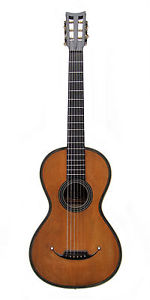
| (On behalf of a customer, I sell this)Romantic guitar by François Roudhloff, Mirecourt c. 1825/1830A very nice guitar by one of the most important French makers of the Romantic period. Contrary to the common myth, François Roudhloff (1781-1849) was neither associated to a (purely fictitious) Parisian maker by the name of Mauchand, nor was he based in Paris. The denomination "Roudhloff AND Mauchand" for a Roudhloff-guitar of any kind is therefore totally misleading. The confusion around F. Roudhloff is partly due to the fact that in 1811, he married Anne Charlotte Mauchant, a sister of the Mauchant Brothers, who were guitar-makers, too (see one of my other sales). F. Roudhloff simply adopted the spelling "Mauchand" when writing his wife's last name, while her brothers stuck to "Mauchant".
Also, it was a customary business strategy for Mirecourt-based makers like F. Roudhloff to add the mention "à Paris" to their brand-marked name. A habit which was abandoned by the likes of Roudhloff, Marchal, Petitjean and others only around 1825; after that, it was either dropped or replaced by the accurate statement "à Mirecourt".The head of this guitar is NOT original, but was altered probably 10 to 20 years after the instrument's construction, maybe on behalf of the London and Dublin based dealer Butler, whose label the guitar bears (in addition to several original brand marks). Although Butler is believed to have established in Dublin in 1826, very little is known about him - for instance, his name is missing from the excellent book "The Music Trade in Georgian England" (ed. by Michael Kessler). But whether or not the head was changed in Butler's shop, it was certainly changed in Britain as early as around 1835/45, period of making of the excellent English machines it carries. Considering that this type of machines is similar to those used by D. & A. Roudhloff (who were F. Roudhloff's nephews), it might be tempting to believe this could be an original equipment. Well… it is not (trust me on that). Still, it is a period "improvement", and historically significant enough to leave it be - although I for one would be very tempted to bring the guitar back to its original state.Though not one of F. Roudhloff's best guitars, this is still a very nice one, and in good condition, too. In addition to the head, there is also a small, yet notable alteration of the original bridge, certainly made to improve the intonation with nylon strings (which is excellent, as a matter of fact). For the rest, the soundboard varnish shows some wear, playing marks and one long scratch on the bass side (please do not even think of having the soundboard revarnished); there are also three marks of formerly installed non-original dot inlays on the side of the neck (the spaces have been filed and blackened). Some minor traces of repairs inside the body, too.Playability is excellent, but the string spacings on the right hand side are quite small (see list below), so this is definitely a guitar for a nail-player, NOT a flesh-player. The sound is very good, though slightly below the quality of the best F. Roudhloffs. In my opinion, this instrument is best suited for French solo or (guitar-)duo repertoire, like (late) Sor, Molino, de Fossa or Lhoyer, but not so much for Song accompaniment or duo with pianoforte. Total length (end-button not included): 930 mm
Length of body (on the back): 452 mm
Max. width of the body: 298 mm
Max. depth of the body: 86 mm
Vibrating string length: 649 mm
Width of the neck at the upper nut: 46 mm
Width of the neck at the neck to body-junction: 56,5 mm
Distance between 1st and 6th string at the upper nut: 37,5 mm
Distance between 1st and 6th string at the bridge: 55,5 mm
Weigth (strung): c. 1020 g
General remarks:1) Unless otherwise stated, guitars offered for sale via my eBay shop are not delivered with a hard case. There are two reasons for that: the first is that when I have a case made to measure, the result - depending on which manufacturer and options I choose - may not necessarily match the wishes of the guitar's future owner. So I prefer to leave this up to him or her. More importantly - and contrary to what most people think - as far as shipping is concerned, a hard case is your guitar's worst enemy. I am very careful and meticulous when packaging guitars, applying the idea that the guitar should simply be sealed and padded by a huge (!) amount of quality bubble-wrap, and put inside a very large and strong cardbox. The result is a light packaging, which absorbs all shocks to the outside before they can cause any damage to the instrument. I have shipped many guitars all over the planet this way and never have had any damage - but on the other side, I have seen guitars shipped inside their hard cases literally destroyed during the voyage.2) I am responsible for the quality of packaging, but not for delays in the delivery schedule due to customs services in your country or any case of force majeure. Also, please keep in mind that any shipping option taken against my explicit advice involves your responsibility. Shipping is free inside Europe, to North-America and to Japan, for any other locations please check back with me.3) Prices are non-negotiable, but I am interested in taking in payment European 18th and 19th century guitars in medium to bad condition. Check back if you have anything to propose.4) Any questions or concerns, feel free to ask.PLEASE CHECK MY OTHER ITEMS, TOO...
|