Back to the main page Back to category Live and Studio Mixers
musical instrument details
mixer
Estimated price for orientation: 1 600 $
Category: Live and Studio Mixers
Class:
Description
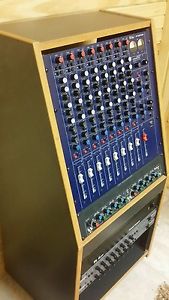
8 channel tube mixer with seperate power supply installed in a wooden roll around rack. Has some scratches and one tube needs to be replaced but still works.Sweet and thick eq with seperate outs fir every channel. No digital I/o card installed. Designed primarily for tracking, TL Audio's M3 tube mixer works well in a number of applications, but it excels as a front end to DAWs and other digital recorders. If you are a serious recordist looking to add tube warmth and color to your digital tracks, then your search may be over. Following in the footsteps of the acclaimed VTC tube console, the M3 TubeTracker delivers much of its larger sibling's sonic mojo in a smaller, less-expensive package.
This 8×2 mic/line mixer employs a hybrid tube/solid-state topology with balanced internal buses. The fan-cooled outboard PSU occupies two rackspaces and connects to the mixer via a 10-foot cable, providing 200 volts to its five 12AX7/ECC83 tubes — one for every two mic pre's and one in the stereo mix bus. (Because the 12AX7 is a dual-triode tube that contains two independent tube stages, it can be used in 2-channel preamps simultaneously.) The 28.6-pound M3 occupies 10 rackspaces, but comes with a wood-laminated particleboard surround for tabletop use.
In keeping with the “tracking” part of its name, the M3 has direct channel outs (post-fader, +4/-10 switchable) but no dedicated tape-return inputs. Balanced ¼-inch line inputs can be used as tape returns, but feed the same gain-control section as the mic pre's — selected via a mic/line switch — and are affected by the phase-reverse switch in the shared signal path. Each channel's gain pot has a +16 to +60dB range with a center detente for 0dB line; a drive LED indicates when the tube is overdriven.
Each channel's 4-band EQ has ±15 dB of boost/cut, fixed high- (12kHz) and low- (80Hz) shelving filters, and two sweepable mid-bands covering 500 to 18kHz and 50 to 2kHz (both with 0.7 Q). Also standard are a 90Hz HP filter, hardwired EQ bypass, two aux sends (one with pre-/post-fade switch), pan pot, mute and PFL switches, and 100mm fader. The EQ, mute and PFL switches have accompanying LEDs, and there's a peak LED on each channel.
The master section has two illuminated VU meters, global phantom-power switch, master aux-send level pots (with up to 15 dB of gain and PFL switches), master aux-return level pots (with balance pots and PFL switches), master PFL-balance pot, master output-level pot (switchable stereo bus/2-track return) and headphone out.
All connections are on the rear (except headphones), with XLR mic and ¼-inch TRS line inputs on each channel, along with TRS inserts and ¼-inch (post-fader) direct outs that are +4 and -10dB switchable. The two aux sends, two stereo aux returns and stereo 2-track return are balanced ¼-inch connectors, all with +4/-10 switches — a nice touch. The main stereo outs are XLR, while the stereo-monitor outs are balanced TRS. Calibration trim pots are provided for each channel and the master outs. To use multiple M3s, two 15-pin D-sub connectors link the PFL, aux and stereo buses, with the M3 at the end of the chain serving as the master-output source.
Description
8 channel tube mixer with seperate power supply installed in a wooden roll around rack. Has some scratches and one tube needs to be replaced but still works.Sweet and thick eq with seperate outs fir every channel. No digital I/o card installed. Designed primarily for tracking, TL Audio's M3 tube mixer works well in a number of applications, but it excels as a front end to DAWs and other digital recorders. If you are a serious recordist looking to add tube warmth and color to your digital tracks, then your search may be over. Following in the footsteps of the acclaimed VTC tube console, the M3 TubeTracker delivers much of its larger sibling's sonic mojo in a smaller, less-expensive package.
This 8×2 mic/line mixer employs a hybrid tube/solid-state topology with balanced internal buses. The fan-cooled outboard PSU occupies two rackspaces and connects to the mixer via a 10-foot cable, providing 200 volts to its five 12AX7/ECC83 tubes — one for every two mic pre's and one in the stereo mix bus. (Because the 12AX7 is a dual-triode tube that contains two independent tube stages, it can be used in 2-channel preamps simultaneously.) The 28.6-pound M3 occupies 10 rackspaces, but comes with a wood-laminated particleboard surround for tabletop use.
In keeping with the “tracking” part of its name, the M3 has direct channel outs (post-fader, +4/-10 switchable) but no dedicated tape-return inputs. Balanced ¼-inch line inputs can be used as tape returns, but feed the same gain-control section as the mic pre's — selected via a mic/line switch — and are affected by the phase-reverse switch in the shared signal path. Each channel's gain pot has a +16 to +60dB range with a center detente for 0dB line; a drive LED indicates when the tube is overdriven.
Each channel's 4-band EQ has ±15 dB of boost/cut, fixed high- (12kHz) and low- (80Hz) shelving filters, and two sweepable mid-bands covering 500 to 18kHz and 50 to 2kHz (both with 0.7 Q). Also standard are a 90Hz HP filter, hardwired EQ bypass, two aux sends (one with pre-/post-fade switch), pan pot, mute and PFL switches, and 100mm fader. The EQ, mute and PFL switches have accompanying LEDs, and there's a peak LED on each channel.
The master section has two illuminated VU meters, global phantom-power switch, master aux-send level pots (with up to 15 dB of gain and PFL switches), master aux-return level pots (with balance pots and PFL switches), master PFL-balance pot, master output-level pot (switchable stereo bus/2-track return) and headphone out.
All connections are on the rear (except headphones), with XLR mic and ¼-inch TRS line inputs on each channel, along with TRS inserts and ¼-inch (post-fader) direct outs that are +4 and -10dB switchable. The two aux sends, two stereo aux returns and stereo 2-track return are balanced ¼-inch connectors, all with +4/-10 switches — a nice touch. The main stereo outs are XLR, while the stereo-monitor outs are balanced TRS. Calibration trim pots are provided for each channel and the master outs. To use multiple M3s, two 15-pin D-sub connectors link the PFL, aux and stereo buses, with the M3 at the end of the chain serving as the master-output source.
This 8×2 mic/line mixer employs a hybrid tube/solid-state topology with balanced internal buses. The fan-cooled outboard PSU occupies two rackspaces and connects to the mixer via a 10-foot cable, providing 200 volts to its five 12AX7/ECC83 tubes — one for every two mic pre's and one in the stereo mix bus. (Because the 12AX7 is a dual-triode tube that contains two independent tube stages, it can be used in 2-channel preamps simultaneously.) The 28.6-pound M3 occupies 10 rackspaces, but comes with a wood-laminated particleboard surround for tabletop use.
In keeping with the “tracking” part of its name, the M3 has direct channel outs (post-fader, +4/-10 switchable) but no dedicated tape-return inputs. Balanced ¼-inch line inputs can be used as tape returns, but feed the same gain-control section as the mic pre's — selected via a mic/line switch — and are affected by the phase-reverse switch in the shared signal path. Each channel's gain pot has a +16 to +60dB range with a center detente for 0dB line; a drive LED indicates when the tube is overdriven.
Each channel's 4-band EQ has ±15 dB of boost/cut, fixed high- (12kHz) and low- (80Hz) shelving filters, and two sweepable mid-bands covering 500 to 18kHz and 50 to 2kHz (both with 0.7 Q). Also standard are a 90Hz HP filter, hardwired EQ bypass, two aux sends (one with pre-/post-fade switch), pan pot, mute and PFL switches, and 100mm fader. The EQ, mute and PFL switches have accompanying LEDs, and there's a peak LED on each channel.
The master section has two illuminated VU meters, global phantom-power switch, master aux-send level pots (with up to 15 dB of gain and PFL switches), master aux-return level pots (with balance pots and PFL switches), master PFL-balance pot, master output-level pot (switchable stereo bus/2-track return) and headphone out.
All connections are on the rear (except headphones), with XLR mic and ¼-inch TRS line inputs on each channel, along with TRS inserts and ¼-inch (post-fader) direct outs that are +4 and -10dB switchable. The two aux sends, two stereo aux returns and stereo 2-track return are balanced ¼-inch connectors, all with +4/-10 switches — a nice touch. The main stereo outs are XLR, while the stereo-monitor outs are balanced TRS. Calibration trim pots are provided for each channel and the master outs. To use multiple M3s, two 15-pin D-sub connectors link the PFL, aux and stereo buses, with the M3 at the end of the chain serving as the master-output source.