Back to the main page Back to category Preamps and Channel Strips
musical instrument details
CAPI VP28 Mic Pre w/ Litz Output Transformer and 2520 Opamps
Estimated price for orientation: 515 $
Category: Preamps and Channel Strips
Class:
Description Condition: New: A brand-new, unused, unopened, undamaged item in its original packaging (where packaging is applicable). Packaging should be the same as what is found in a retail store, unless the item is handmade or was packaged by the manufacturer in non-retail packaging, such as an unprinted box or plastic bag. See the seller's listing for full details. See all condition definitions- opens in a new window or tab ... Read moreabout the condition Brand: CAPI Model: VP28 Number of Channels: 1 Country/Region of Manufacture: United States Type: Microphone Preamp
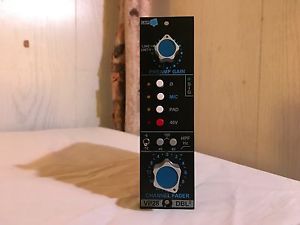
I have completed building and testing a brand new pair of fantastic API style mic preamps from renowned circuit designer Jeff Steiger. These are available individually.Two fresh ones are available at the moment but if you need more I can build to order. These are decked out with GAR2520 opamps in every position, the most true to API style as well as the winner of various opamp shootouts in our studio.These truly give the API style punch that we love. Our studio has had a pair for a year (not these as they are brand new) and found them to be the absolute best guitar pre we've ever heard. Vocals and bass come across thick and warm. Kick and Snare punch is also unreal, going through two transformers really adds a weight I haven't heard in another pre, tube or solid state. I have used them to warm up overly digital sounding samples, keyboards, buss processing as well as putting in my master buss. They are truly fantastic in every way. The line switch makes along with the output attenuator makes it very easy to use as an outboard color and mojo box. These also have the very special Litz transformers, a little bit about them: "The 2623-1-L is a custom made audio output transformer. The 2623-1-L has been designed to replicate the transformers found in the vintage API recording consoles from the 1970's. This transformer was used in the "preamp out" and the "direct out" positions of the vintage consoles. It was also used in the ACA summing amplifiers (PCB mount version, 2623-4), Echo send modules, Master Cue modules, some of the 500 series modules and of course the talkback mic pre amp! To my knowledge, a Litz wire version of the 2623-1 has never been realized. As for other Litz wire output transformers, the Litz wire version of the 2503 has occasionally been referred to as the "preferred" sounding version of this popular quadfilar transformer. Litz wire is a type of cable made up of multiple strands of wires electrically insulated from one another and twisted together in a prescribed pattern. It has been said that winding with Litz wire produces a more uniform high frequency response but we have also noticed the bottom end seems to be a little "bigger" and "deeper". Please feel free to email with any questions, I've spent many hours recording and mixing with VP28s and have hand built more to spread the API style tone around Austin. Thanks for your interest!------------From the designer:Circuit Design and Topology: The preamp or 1st stage is nearly identical to the VP26 with a few exceptions. The original Mute switch has been replaced with a Mic switch. When engaged the module is in Mic mode. This is the same mic preamp circuit as a VP26, up to the t-pad. When disengaged, the preamp is in Line mode. This switch basically inserts a U-pad at the module's input changing the input Z to 10k along with dropping the level by 35dB. The signal still follows the same path as a mic signal so you get the benefit of the EA2622 input transformer in Line mode. The preamp section has the typical VP26 spec, 60dB of gain. The other main switches are Polarity flip, Pad which is the typical -20dB mic input pad and of course 48V for phantom. All four main switches have their own LED. The only red LED on the faceplate is for phantom. Easy to spot from a distance.Our electrons leave the "VP26 section" and would typically go thru the t-pad and then out. Since there is no t-pad attenuator on the VP28, the signal heads to a stepped "Channel Fader". This 12 position Grayhill switch emulates the full throw fader from the console. There is 12dB of gain "in hand" at the fader giving us a total of 72dB for mic gain. After the fader we have a two pushbutton HP filter array, implemented the same way as the console and as in the VC528. Left switch in, 40Hz, right switch in 80Hz, both in is 160Hz. I also carried over the -6dB/-12dB per octave switch from the VC528. Then we are off to the 2nd 2520 gain stage and the 2nd and final EA2623-1. From the fader to the output is more or less the same signal path used in the VC528. So, the VP28 is a complete VP26 preamp with the 2nd half of the VC528 following the HPF from the 553F. A mouthful indeed. I have chosen to only offer the stepped gain version for the VP28. The biggest reason is the definitive Unity Gain setting when in Line mode. The front panel artwork is designed around this and changing to a pot would though it out the window. The lowest preamp gain step is 4dB and the remaining steps are in 3dB increments. The fader is in 2dB boost increments and 4dB cut increments. Doing the math, there are a number of positions where the overall gain will be the same, but the gain staging is completely different. Each one will sound slightly different. Many tonal options to be found here. Last thought, I fully believe that "less is more" does not apply to discrete electronics and great transformers. "More is more" and is typically better to my ears.
Description
| Condition: | New: A brand-new, unused, unopened, undamaged item in its original packaging (where packaging is applicable). Packaging should be the same as what is found in a retail store, unless the item is handmade or was packaged by the manufacturer in non-retail packaging, such as an unprinted box or plastic bag. See the seller's listing for full details. See all condition definitions- opens in a new window or tab ... Read moreabout the condition | Brand: | CAPI |
| Model: | VP28 | Number of Channels: | 1 |
| Country/Region of Manufacture: | United States | Type: | Microphone Preamp |
I have completed building and testing a brand new pair of fantastic API style mic preamps from renowned circuit designer Jeff Steiger. These are available individually.Two fresh ones are available at the moment but if you need more I can build to order. These are decked out with GAR2520 opamps in every position, the most true to API style as well as the winner of various opamp shootouts in our studio.These truly give the API style punch that we love. Our studio has had a pair for a year (not these as they are brand new) and found them to be the absolute best guitar pre we've ever heard. Vocals and bass come across thick and warm. Kick and Snare punch is also unreal, going through two transformers really adds a weight I haven't heard in another pre, tube or solid state. I have used them to warm up overly digital sounding samples, keyboards, buss processing as well as putting in my master buss. They are truly fantastic in every way. The line switch makes along with the output attenuator makes it very easy to use as an outboard color and mojo box. These also have the very special Litz transformers, a little bit about them: "The 2623-1-L is a custom made audio output transformer. The 2623-1-L has been designed to replicate the transformers found in the vintage API recording consoles from the 1970's. This transformer was used in the "preamp out" and the "direct out" positions of the vintage consoles. It was also used in the ACA summing amplifiers (PCB mount version, 2623-4), Echo send modules, Master Cue modules, some of the 500 series modules and of course the talkback mic pre amp! To my knowledge, a Litz wire version of the 2623-1 has never been realized. As for other Litz wire output transformers, the Litz wire version of the 2503 has occasionally been referred to as the "preferred" sounding version of this popular quadfilar transformer. Litz wire is a type of cable made up of multiple strands of wires electrically insulated from one another and twisted together in a prescribed pattern. It has been said that winding with Litz wire produces a more uniform high frequency response but we have also noticed the bottom end seems to be a little "bigger" and "deeper". Please feel free to email with any questions, I've spent many hours recording and mixing with VP28s and have hand built more to spread the API style tone around Austin. Thanks for your interest!------------From the designer:Circuit Design and Topology: The preamp or 1st stage is nearly identical to the VP26 with a few exceptions. The original Mute switch has been replaced with a Mic switch. When engaged the module is in Mic mode. This is the same mic preamp circuit as a VP26, up to the t-pad. When disengaged, the preamp is in Line mode. This switch basically inserts a U-pad at the module's input changing the input Z to 10k along with dropping the level by 35dB. The signal still follows the same path as a mic signal so you get the benefit of the EA2622 input transformer in Line mode. The preamp section has the typical VP26 spec, 60dB of gain. The other main switches are Polarity flip, Pad which is the typical -20dB mic input pad and of course 48V for phantom. All four main switches have their own LED. The only red LED on the faceplate is for phantom. Easy to spot from a distance.Our electrons leave the "VP26 section" and would typically go thru the t-pad and then out. Since there is no t-pad attenuator on the VP28, the signal heads to a stepped "Channel Fader". This 12 position Grayhill switch emulates the full throw fader from the console. There is 12dB of gain "in hand" at the fader giving us a total of 72dB for mic gain. After the fader we have a two pushbutton HP filter array, implemented the same way as the console and as in the VC528. Left switch in, 40Hz, right switch in 80Hz, both in is 160Hz. I also carried over the -6dB/-12dB per octave switch from the VC528. Then we are off to the 2nd 2520 gain stage and the 2nd and final EA2623-1. From the fader to the output is more or less the same signal path used in the VC528. So, the VP28 is a complete VP26 preamp with the 2nd half of the VC528 following the HPF from the 553F. A mouthful indeed. I have chosen to only offer the stepped gain version for the VP28. The biggest reason is the definitive Unity Gain setting when in Line mode. The front panel artwork is designed around this and changing to a pot would though it out the window. The lowest preamp gain step is 4dB and the remaining steps are in 3dB increments. The fader is in 2dB boost increments and 4dB cut increments. Doing the math, there are a number of positions where the overall gain will be the same, but the gain staging is completely different. Each one will sound slightly different. Many tonal options to be found here. Last thought, I fully believe that "less is more" does not apply to discrete electronics and great transformers. "More is more" and is typically better to my ears.