Back to the main page Back to category Classical Guitars
musical instrument details
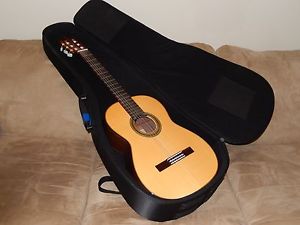
WONDERFUL R.MATSUOKA MH100 HAUSER STYLE CLASSICAL GUITAR IN NEAR MINT CONDITION
Estimated price for orientation: 1 200 $
Category: Classical Guitars
Class:
Description Brand: R.Matsuoka Country/Region of Manufacture: Japan MPN: 209003 UPC: Does not apply
At first glance it gives an impression of being a brand new instrument. At very close inspection (while flipping guitar towards the light) one may see few microscopic marks on its top, couple on its back and few along its edges. When I say "microscopic" I mean it. Regarding the sound this guitar is very competitive to much more expensive instruments, made by much more famous guitar makers. The guitar has very unique & sweet sound, with clear trebles and deep basses, with great sustain and decent volume. It is definitely comparable with many guitar models available on US market in price range $2500 - $3000.All Ryoji Matsuoka models, including lower numbers, are high quality guitars with very good volume and very clean and balanced notes. The fact that the lower models have laminated back & sides is truly of very minor importance. These laminates are made the way that is very hard to distinguish them from solid plates by naked eye and they do exactly the same job. The most important part of Matsuoka guitars is his original bracing of the soundboard which greatly enhances the volume and the sound quality.Antonio Torres, The Father of Modern Era Classical Guitar, has made a great sounding guitar with cardboard back and sides just to prove their relative irrelevance as the factor influencing overall sound quality of the guitar. Description* Ryoji Matsuoka MH100* Herman Houser style body and headstock* High Grade Solid Spruce Top with original Matsuoka bracing (bracing on this guitar resembles a lattice bracing)* “Wonder Rose” Indian Rosewood Doubleplate for back and sidesCalling this construction "laminates" would actually be very incorrect and quite misleading. This genuine Japanese invention has really nothing in common with modern era cheap particle-board laminates. This construction is nothing but 2 solid wood plates glued together, hence in fact nothing but reinforced solid woods. Such plates perform no different from solid woods, while don't crack as easily, are much easier to work with, and allow for much lower prices of these instruments. Such guitars have always been and still are a true blessing for all guitar enthusiasts with limited funds.This laminated “Wonder Rose” rosewood has undergone a special chemical treatment leading to much stronger bonds between wood cells and as the result it has the same properties as solid rosewood AA grade. At the same time this laminated rosewood is more resistant to cracking, less expensive an easier to work with. The same guitar with solid rosewood AA grade would cost at least twice that much, but sounding exactly the same. Ryoji Matsuoka’s business philosophy has always been to make high grade guitars that could be sold at moderate prices. For that Ryoji has always been highly respected among not only Japanese guitar students. Solid Rosewood grade AA is hard to find and used by guitar makers to build their most expensive "top of the line" models. * Mahogany neck* Ebonized Indian Rosewood for Fretboard* Bone nut and saddles* Nut width: 52mm* Scale: 650 mm* Gold hardwareIts action has been adjusted to 3.5mm under E6 and 3.0 mm under E1. Guitar is equipped with new thick padded semi-hard case.Ryoji Matsuoka was well known Japanese guitar maker who has been producing guitars in Nagoya, Japan since the 1960s. Nagoya is Japan’s 4th largest city and a major industrial port city located on the main island of Honshu in Aichi prefecture. The Nagoya/Aichi/Kani area (Kani is the prefecture next to Aichee) is one of Japan’s major musical instrument making centers. The city and the outlying areas have a long classical guitar making history with many small shops producing guitars. Major guitar and violin makers include Matsumoku Industrial, Suzuki, Takaharu, Sada Yairi, Kazuo Yairi (Kani), Daion, Yamaki, Ibanez/Hoshino, and Ryoji Matsuoka. Additionally, there are numerous small guitar shops and factories that contract to larger firms, such as Yamaha in Hamamatsu.
The Ryoji Matsuoka guitar works was a small scale guitar manufacturer with less than 15 employees. For a few years during the 1960s and early 1970s, Matsuoka produced the higher end Aria guitar models for Shiro Arai, founder of Aria . These Aria models either have Ryoji Matsuoka's name on the label or are marked RM with a red stamp on the neck block. Matsuoka also made some models for Ibanez, including a few steel string flatop and archtop models.
During the early 1970s, Matsuoka produced Fleta, Hauser, Kohno and Rubio. The copies of Kohno guitars with 2 ebony strips in the necks and higher grade spruce tops were made in much greater numbers than copies of other luthiers. They were also sold at higher price.From 1975 to 1980 the company produced their own line of guitars: the concert, artist and artisan series.
The Concert series includes the M20 (laminated spruce top, nato neck), M30 (solid spruce top, mahogany neck), M40 (solid spruce top, mahogany neck). All 3 models have laminated rosewood back and sides and rosewood fingerboards.
The Artist Series includes the M50 and M60. These guitars have better quality spruce tops and were made in several versions. Some of them, less expensive versions, were made with laminated Indian Rosewood or laminated Jacaranda back and sides, ebony fingerboards and plain neck. On the other end of the spectrum there were also all solid versions with Solid Indian rosewood or solid Jacaranda back and sides, with one or double Ebony reinforcement in the neck.
The Old World Artisan Series includes the M70 and M80, made with all solid woods and one-piece mahogany necks.
During the 1980s and early 1990s, Matsuoka models included the M50, M60, M70, M80, M100, M150, M200, and M300 with Ramirez style headstock and models MH100, MH150, MH200, MH300 with Hauzer style headstock. All of them were made with solid Spruce tops. M50, M60, M70 were made either with laminated back and sides or as all solid guitars. All other models were all solid wood guitars.In the late 1990-ties models M65 and M75 with Cedar tops were added to the production line mostly with laminated back and sides.To make matters little more complicated, by the end of 1990-ties some Spruce top models were also made with Cedar top without any change on the label. So we can for example encounter model M60 with either Spruce or Cedar top. Most likely each guitar was sold with attached precise specification. Since early 1990-ties Matsuoka has also been making guitars for Aranjuez label (launched by Juan Orozco) and lower priced cosmetic copies of a Mathias Dammann classical guitars (they were not exact copies). The top Aranjuez model M720 has been made in cooperation with Kohno/Sakurai workshop. Masaru Kohno and later Masaki Sakurai were making tops with their superb bracing, while Ryoji Matsuoka was responsible for all other parts and final assembly. This cooperation continues until today between Toshiaki Matsuoka and Masaki Sakurai. These M720 guitars with Matsuka and Sakurai labels offer exceptional quality of sound at moderate price. They are sold at Guitar Salon International in Santa Monica, CA for $2700.ReturnsIf you are not happy with your purchase you may return the guitar for a full refund less any shipping charges.All you need to do is to:1. Notify me within 2 days after delivery2. Pack guitar the same way I do it, using the same box and materials3. Ship it back to me no later than on 3rd day after delivery Another words I expect this “trail” period to occur within +/- 3 days. Naturally if you expect to receive a full refund, guitar has to be returned in the same condition as I ship it to you. VictorP.s. If you'd like to check my other posted on E-bay guitars click on the links below:
Description
| Brand: | R.Matsuoka | Country/Region of Manufacture: | Japan |
| MPN: | 209003 | UPC: | Does not apply |
At first glance it gives an impression of being a brand new instrument. At very close inspection (while flipping guitar towards the light) one may see few microscopic marks on its top, couple on its back and few along its edges. When I say "microscopic" I mean it.
Regarding the sound this guitar is very competitive to much more expensive instruments, made by much more famous guitar makers. The guitar has very unique & sweet sound, with clear trebles and deep basses, with great sustain and decent volume. It is definitely comparable with many guitar models available on US market in price range $2500 - $3000.All Ryoji Matsuoka models, including lower numbers, are high quality guitars with very good volume and very clean and balanced notes. The fact that the lower models have laminated back & sides is truly of very minor importance. These laminates are made the way that is very hard to distinguish them from solid plates by naked eye and they do exactly the same job. The most important part of Matsuoka guitars is his original bracing of the soundboard which greatly enhances the volume and the sound quality.Antonio Torres, The Father of Modern Era Classical Guitar, has made a great sounding guitar with cardboard back and sides just to prove their relative irrelevance as the factor influencing overall sound quality of the guitar. Description* Ryoji Matsuoka MH100* Herman Houser style body and headstock* High Grade Solid Spruce Top with original Matsuoka bracing (bracing on this guitar resembles a lattice bracing)* “Wonder Rose” Indian Rosewood Doubleplate for back and sidesCalling this construction "laminates" would actually be very incorrect and quite misleading. This genuine Japanese invention has really nothing in common with modern era cheap particle-board laminates. This construction is nothing but 2 solid wood plates glued together, hence in fact nothing but reinforced solid woods. Such plates perform no different from solid woods, while don't crack as easily, are much easier to work with, and allow for much lower prices of these instruments. Such guitars have always been and still are a true blessing for all guitar enthusiasts with limited funds.This laminated “Wonder Rose” rosewood has undergone a special chemical treatment leading to much stronger bonds between wood cells and as the result it has the same properties as solid rosewood AA grade. At the same time this laminated rosewood is more resistant to cracking, less expensive an easier to work with. The same guitar with solid rosewood AA grade would cost at least twice that much, but sounding exactly the same. Ryoji Matsuoka’s business philosophy has always been to make high grade guitars that could be sold at moderate prices. For that Ryoji has always been highly respected among not only Japanese guitar students. Solid Rosewood grade AA is hard to find and used by guitar makers to build their most expensive "top of the line" models. * Mahogany neck* Ebonized Indian Rosewood for Fretboard* Bone nut and saddles* Nut width: 52mm* Scale: 650 mm* Gold hardwareIts action has been adjusted to 3.5mm under E6 and 3.0 mm under E1. Guitar is equipped with new thick padded semi-hard case.Ryoji Matsuoka was well known Japanese guitar maker who has been producing guitars in Nagoya, Japan since the 1960s. Nagoya is Japan’s 4th largest city and a major industrial port city located on the main island of Honshu in Aichi prefecture. The Nagoya/Aichi/Kani area (Kani is the prefecture next to Aichee) is one of Japan’s major musical instrument making centers. The city and the outlying areas have a long classical guitar making history with many small shops producing guitars. Major guitar and violin makers include Matsumoku Industrial, Suzuki, Takaharu, Sada Yairi, Kazuo Yairi (Kani), Daion, Yamaki, Ibanez/Hoshino, and Ryoji Matsuoka. Additionally, there are numerous small guitar shops and factories that contract to larger firms, such as Yamaha in Hamamatsu.
The Ryoji Matsuoka guitar works was a small scale guitar manufacturer with less than 15 employees. For a few years during the 1960s and early 1970s, Matsuoka produced the higher end Aria guitar models for Shiro Arai, founder of Aria . These Aria models either have Ryoji Matsuoka's name on the label or are marked RM with a red stamp on the neck block. Matsuoka also made some models for Ibanez, including a few steel string flatop and archtop models.
During the early 1970s, Matsuoka produced Fleta, Hauser, Kohno and Rubio. The copies of Kohno guitars with 2 ebony strips in the necks and higher grade spruce tops were made in much greater numbers than copies of other luthiers. They were also sold at higher price.From 1975 to 1980 the company produced their own line of guitars: the concert, artist and artisan series.
The Concert series includes the M20 (laminated spruce top, nato neck), M30 (solid spruce top, mahogany neck), M40 (solid spruce top, mahogany neck). All 3 models have laminated rosewood back and sides and rosewood fingerboards.
The Artist Series includes the M50 and M60. These guitars have better quality spruce tops and were made in several versions. Some of them, less expensive versions, were made with laminated Indian Rosewood or laminated Jacaranda back and sides, ebony fingerboards and plain neck. On the other end of the spectrum there were also all solid versions with Solid Indian rosewood or solid Jacaranda back and sides, with one or double Ebony reinforcement in the neck.
The Old World Artisan Series includes the M70 and M80, made with all solid woods and one-piece mahogany necks.
During the 1980s and early 1990s, Matsuoka models included the M50, M60, M70, M80, M100, M150, M200, and M300 with Ramirez style headstock and models MH100, MH150, MH200, MH300 with Hauzer style headstock. All of them were made with solid Spruce tops. M50, M60, M70 were made either with laminated back and sides or as all solid guitars. All other models were all solid wood guitars.In the late 1990-ties models M65 and M75 with Cedar tops were added to the production line mostly with laminated back and sides.To make matters little more complicated, by the end of 1990-ties some Spruce top models were also made with Cedar top without any change on the label. So we can for example encounter model M60 with either Spruce or Cedar top. Most likely each guitar was sold with attached precise specification. Since early 1990-ties Matsuoka has also been making guitars for Aranjuez label (launched by Juan Orozco) and lower priced cosmetic copies of a Mathias Dammann classical guitars (they were not exact copies). The top Aranjuez model M720 has been made in cooperation with Kohno/Sakurai workshop. Masaru Kohno and later Masaki Sakurai were making tops with their superb bracing, while Ryoji Matsuoka was responsible for all other parts and final assembly. This cooperation continues until today between Toshiaki Matsuoka and Masaki Sakurai. These M720 guitars with Matsuka and Sakurai labels offer exceptional quality of sound at moderate price. They are sold at Guitar Salon International in Santa Monica, CA for $2700.ReturnsIf you are not happy with your purchase you may return the guitar for a full refund less any shipping charges.All you need to do is to:1. Notify me within 2 days after delivery2. Pack guitar the same way I do it, using the same box and materials3. Ship it back to me no later than on 3rd day after delivery Another words I expect this “trail” period to occur within +/- 3 days. Naturally if you expect to receive a full refund, guitar has to be returned in the same condition as I ship it to you. VictorP.s. If you'd like to check my other posted on E-bay guitars click on the links below:
The Ryoji Matsuoka guitar works was a small scale guitar manufacturer with less than 15 employees. For a few years during the 1960s and early 1970s, Matsuoka produced the higher end Aria guitar models for Shiro Arai, founder of Aria . These Aria models either have Ryoji Matsuoka's name on the label or are marked RM with a red stamp on the neck block. Matsuoka also made some models for Ibanez, including a few steel string flatop and archtop models.
During the early 1970s, Matsuoka produced Fleta, Hauser, Kohno and Rubio. The copies of Kohno guitars with 2 ebony strips in the necks and higher grade spruce tops were made in much greater numbers than copies of other luthiers. They were also sold at higher price.From 1975 to 1980 the company produced their own line of guitars: the concert, artist and artisan series.
The Concert series includes the M20 (laminated spruce top, nato neck), M30 (solid spruce top, mahogany neck), M40 (solid spruce top, mahogany neck). All 3 models have laminated rosewood back and sides and rosewood fingerboards.
The Artist Series includes the M50 and M60. These guitars have better quality spruce tops and were made in several versions. Some of them, less expensive versions, were made with laminated Indian Rosewood or laminated Jacaranda back and sides, ebony fingerboards and plain neck. On the other end of the spectrum there were also all solid versions with Solid Indian rosewood or solid Jacaranda back and sides, with one or double Ebony reinforcement in the neck.
The Old World Artisan Series includes the M70 and M80, made with all solid woods and one-piece mahogany necks.
During the 1980s and early 1990s, Matsuoka models included the M50, M60, M70, M80, M100, M150, M200, and M300 with Ramirez style headstock and models MH100, MH150, MH200, MH300 with Hauzer style headstock. All of them were made with solid Spruce tops. M50, M60, M70 were made either with laminated back and sides or as all solid guitars. All other models were all solid wood guitars.In the late 1990-ties models M65 and M75 with Cedar tops were added to the production line mostly with laminated back and sides.To make matters little more complicated, by the end of 1990-ties some Spruce top models were also made with Cedar top without any change on the label. So we can for example encounter model M60 with either Spruce or Cedar top. Most likely each guitar was sold with attached precise specification. Since early 1990-ties Matsuoka has also been making guitars for Aranjuez label (launched by Juan Orozco) and lower priced cosmetic copies of a Mathias Dammann classical guitars (they were not exact copies). The top Aranjuez model M720 has been made in cooperation with Kohno/Sakurai workshop. Masaru Kohno and later Masaki Sakurai were making tops with their superb bracing, while Ryoji Matsuoka was responsible for all other parts and final assembly. This cooperation continues until today between Toshiaki Matsuoka and Masaki Sakurai. These M720 guitars with Matsuka and Sakurai labels offer exceptional quality of sound at moderate price. They are sold at Guitar Salon International in Santa Monica, CA for $2700.ReturnsIf you are not happy with your purchase you may return the guitar for a full refund less any shipping charges.All you need to do is to:1. Notify me within 2 days after delivery2. Pack guitar the same way I do it, using the same box and materials3. Ship it back to me no later than on 3rd day after delivery Another words I expect this “trail” period to occur within +/- 3 days. Naturally if you expect to receive a full refund, guitar has to be returned in the same condition as I ship it to you. VictorP.s. If you'd like to check my other posted on E-bay guitars click on the links below: