Back to the main page Back to category Microphones and Wireless Systems
musical instrument details
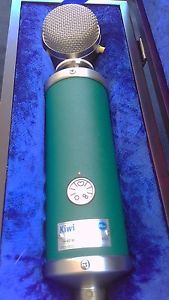
Blue Kiwi Multi-Pattern Microphone
Estimated price for orientation: 1 550 $
Category: Microphones and Wireless Systems
Class:
Description
The Kiwi Multi-Pattern Condenser Microphone from Blue is a large diaphragm condenser microphone that features a multi-pattern, dual single back plate variation of Blue's B6 capsule. It has 9 selectable polar patterns including cardioid, omnidirectional, figure 8 with 6 intermediate variations. The Kiwi has a transformerless design to provide a clean audio path and features no pads or filters between the capsule and mic circuit. It is designed to provide a modern vocal sound, but can be used on a variety of sources including acoustic guitar, piano, percussion, and brass and woodwind instruments. The S3 shockmount is included along with a cherrywood storage box. The polar pattern of the Kiwi is controlled by a rotary switch on the rear of the microphone. Positions are marked for omni at the anticlockwise end, figure of eight at the clockwise end, and cardioid in the middle. There are also three intermediate positions between the cardioid and each end, so there is a high degree of precision and variation available here, with three subcardioid and three hypercardioid patterns in addition to the primary trio. As with most multi-pattern mics, the frequency response varies slightly with different settings, as a result of combining the two capsule outputs The Kiwi was designed for recording vocals, but its very wide frequency response and smooth larger-than-life sound make it ideal for all manner of acoustic instruments and percussion. You'll need a pop shield for recording vocals, which may detract from the Kiwi's good looks, so (for those with bottomless pockets!) BLUE offer a very expensive pop shield as an optional extra. It has a retro look which complements the mic itself. The handbook provides a lot of very practical advice on positioning the microphone for recording voices, acoustic guitars, piano, woodwind, brass, drums, and percussion. I tried it on a variety of sources, but mainly voices and a saxophone — and it was never less than sublime
Description