Back to the main page Back to category Vintage Pro Audio Equipment
musical instrument details
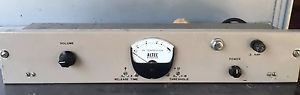
Vintage Altec Tube Compressor 436c Rare Brown Face
Estimated price for orientation: 771 $
Category: Vintage Pro Audio Equipment
Class:
Description
This is an Altec piece that I recently retrieved from storage. The face plate isn't perfect as shown in pictures. Also, it will need to be electronically refurbished. Pretty easy,as it is basic circuit. Yes, I have only been an eBay buyer, I am a composer studio guy who has some limited things to sell, so I am not an eBay business. However...You can bid with confidence I will ship fast, and pics are accurate. So.... When I had a studio, we had refurbished quite a few of these a awesome Ampex compressors, including doing the Beatles mod, and the amazing mic pres to use in our studer/ neve room. This was one of the extra units that the tech never got around to working on, so it's been I storage for the last 20 plus years A bit of info. The 436 series of compressors were all-valve, vari-mu designs, meaning that the amount of compression taking place depends on the level of the signal that is fed in. Early Altecs were inexpensive and basic; the original 436A model had fixed parameters and no user controls whatsoever. 1958 saw the release of the 436B, which featured an input gain control, then, a few years later, the 436C included threshold and release-time controls. The Altec 436Bs that EMI bought in 1959 (three years before The Beatles’ first sessions) were heavily modified to include an output attenuator and ‘recovery’ switch, which controlled the compression release-time. A unique feature of EMI’s six-position recovery switch was the Hold setting, which prevented a compressed signal from returning to its original level when in use. The EMI-modified Altecs were often used to process bass guitar because the Fairchild 660’s response times were simply too fast for bass duties. Beatles engineer Geoff Emerick always used them to compress Paul McCartney’s bass – either his famous Hofner violin bass or a Rickenbacker 4001S – and would sometimes compress the sound two or three times to create the punchy bass sound heard on albums such as Revolver and, especially, Sgt. Pepper. When the group set up their own Apple recording studio during the ill-fated Let It Be sessions, EMI lent them two Altecs Surprising how incredibly similar the Altec 436b and the Universal Audio 175 schematics are. The 175 contains almost the entire 436b circuit. Tubes: 6AL5, 6CG7, 6BC8 There were at least three versions of the 436, which were designated A, B and C. The “A” version had only a volume control. The “C” version added threshold and release (variable from .3 to 1.3 seconds at 63% recovery). Attack was fixed at 50 ms. "this unit will also operate as a straight high quality line amplifier when the 6AL5 tube is removed from it's socket." - Which bypasses the compressor.
Description
This is an Altec piece that I recently retrieved from storage. The face plate isn't perfect as shown in pictures. Also, it will need to be electronically refurbished. Pretty easy,as it is basic circuit. Yes, I have only been an eBay buyer, I am a composer studio guy who has some limited things to sell, so I am not an eBay business. However...You can bid with confidence I will ship fast, and pics are accurate. So.... When I had a studio, we had refurbished quite a few of these a awesome Ampex compressors, including doing the Beatles mod, and the amazing mic pres to use in our studer/ neve room. This was one of the extra units that the tech never got around to working on, so it's been I storage for the last 20 plus years A bit of info. The 436 series of compressors were all-valve, vari-mu designs, meaning that the amount of compression taking place depends on the level of the signal that is fed in. Early Altecs were inexpensive and basic; the original 436A model had fixed parameters and no user controls whatsoever. 1958 saw the release of the 436B, which featured an input gain control, then, a few years later, the 436C included threshold and release-time controls. The Altec 436Bs that EMI bought in 1959 (three years before The Beatles’ first sessions) were heavily modified to include an output attenuator and ‘recovery’ switch, which controlled the compression release-time. A unique feature of EMI’s six-position recovery switch was the Hold setting, which prevented a compressed signal from returning to its original level when in use. The EMI-modified Altecs were often used to process bass guitar because the Fairchild 660’s response times were simply too fast for bass duties. Beatles engineer Geoff Emerick always used them to compress Paul McCartney’s bass – either his famous Hofner violin bass or a Rickenbacker 4001S – and would sometimes compress the sound two or three times to create the punchy bass sound heard on albums such as Revolver and, especially, Sgt. Pepper. When the group set up their own Apple recording studio during the ill-fated Let It Be sessions, EMI lent them two Altecs Surprising how incredibly similar the Altec 436b and the Universal Audio 175 schematics are. The 175 contains almost the entire 436b circuit. Tubes: 6AL5, 6CG7, 6BC8 There were at least three versions of the 436, which were designated A, B and C. The “A” version had only a volume control. The “C” version added threshold and release (variable from .3 to 1.3 seconds at 63% recovery). Attack was fixed at 50 ms. "this unit will also operate as a straight high quality line amplifier when the 6AL5 tube is removed from it's socket." - Which bypasses the compressor.