Back to the main page Back to category Didgeridoos
musical instrument details
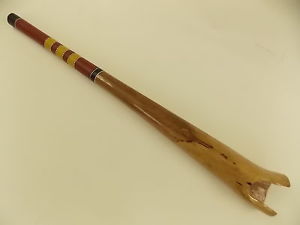
Termite eaten woolybut eucalyptus painted by Paul Hay .6
Estimated price for orientation: 550 $
Category: Didgeridoos
Class:
Description Condition: New: A brand-new, unused, unopened, undamaged item in its original packaging (where packaging is applicable). Packaging should be the same as what is found in a retail store, unless the item is handmade or was packaged by the manufacturer in non-retail packaging, such as an unprinted box or plastic bag. See the seller's listing for full details. See all condition definitions- opens in a new window or tab ... Read moreabout the condition Brand: didge tall paul
Product DescriptionTight at the top with a sharp taper and large bell giving this didge high backpressure and very loud and powerful volume although definitely not losing any clarity of sound as the frequencies are very clean and crisp.As a contemporary performer I would love to perform with the didge with a fast powerful rhythm but it has also been tested by one of the best traditional players in the UK who rates it very highly indeed.Wood; woolybut eucalyptus
Note; G
Toot; G
length; 1385mm
Mouth; 29mm
Bell; 160mmArtist profilePaul Hay has been playing didgeridoo for many years and is very well known within the didgeridoo community ,he is considered to be one of the best players in the UK using traditional techniques. His artwork on didgeridoos is not meant to be a copy of aboriginal Australian art as it has no imagery but with the use of colour and patterns shows appreciation for aboriginal art.This is Woolly butt eucalyptus harvested in the Northern Territory’s near Darwin Australia. It was eating out by termites and then shaped by hand with long chisels.The name Wooly butt comes from the woolly substance that grows around the base( butt ) of the tree which deters small woodland creatures from eating the bark.
Description
| Condition: | New: A brand-new, unused, unopened, undamaged item in its original packaging (where packaging is applicable). Packaging should be the same as what is found in a retail store, unless the item is handmade or was packaged by the manufacturer in non-retail packaging, such as an unprinted box or plastic bag. See the seller's listing for full details. See all condition definitions- opens in a new window or tab ... Read moreabout the condition | Brand: | didge tall paul |
Product DescriptionTight at the top with a sharp taper and large bell giving this didge high backpressure and very loud and powerful volume although definitely not losing any clarity of sound as the frequencies are very clean and crisp.As a contemporary performer I would love to perform with the didge with a fast powerful rhythm but it has also been tested by one of the best traditional players in the UK who rates it very highly indeed.Wood; woolybut eucalyptus
Note; G
Toot; G
length; 1385mm
Mouth; 29mm
Bell; 160mmArtist profilePaul Hay has been playing didgeridoo for many years and is very well known within the didgeridoo community ,he is considered to be one of the best players in the UK using traditional techniques. His artwork on didgeridoos is not meant to be a copy of aboriginal Australian art as it has no imagery but with the use of colour and patterns shows appreciation for aboriginal art.This is Woolly butt eucalyptus harvested in the Northern Territory’s near Darwin Australia. It was eating out by termites and then shaped by hand with long chisels.The name Wooly butt comes from the woolly substance that grows around the base( butt ) of the tree which deters small woodland creatures from eating the bark.
Note; G
Toot; G
length; 1385mm
Mouth; 29mm
Bell; 160mmArtist profilePaul Hay has been playing didgeridoo for many years and is very well known within the didgeridoo community ,he is considered to be one of the best players in the UK using traditional techniques. His artwork on didgeridoos is not meant to be a copy of aboriginal Australian art as it has no imagery but with the use of colour and patterns shows appreciation for aboriginal art.This is Woolly butt eucalyptus harvested in the Northern Territory’s near Darwin Australia. It was eating out by termites and then shaped by hand with long chisels.The name Wooly butt comes from the woolly substance that grows around the base( butt ) of the tree which deters small woodland creatures from eating the bark.