Back to the main page Back to category Software Loops and Samples
musical instrument details
Eventide Omnipressor + Blackhole + 2016 Stereo Room Bundle eDelivery JRR Shop
Estimated price for orientation: 547 $
Category: Software Loops and Samples
Class:
Description Condition: New: A brand-new, unused, unopened, undamaged item in its original packaging (where packaging is applicable). Packaging should be the same as what is found in a retail store, unless the item is handmade or was packaged by the manufacturer in non-retail packaging, such as an unprinted box or plastic bag. See the seller's listing for full details. See all condition definitions- opens in a new window or tab ... Read moreabout the condition Type: Virtual Processor Model: omnipressorblackhole2016stereoroombundle Platform: Mac, Windows MPN: omnipressorblackhole2016stereoroombundle Brand: Eventide UPC: Does Not Apply
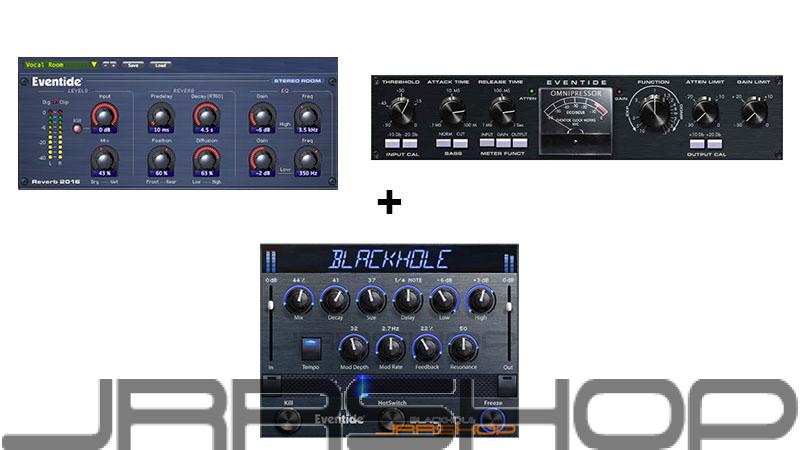
Introduced in 1971, the Omnipressor rack unit was widely used on hit records throughout the last four decades. One of our first customers was a young Brian May, lead guitarist of Queen. With the Omnipressor in his rig, his sound was never the same again. A double-knee compressor/limiter, the Omnipressor has the unique ability of simultaneously compressing and expanding audio; it is capable of extreme compression, limiting, expanding, and dynamic reversal. Now, this software plug-in of the Omnipressor is available for the first time for Pro Tools AAX, VST for PC, and AU. “Omnipressor is one of the most unique and creative "character" compressors I own. It makes drums pump, snares crack and kicks in your face.” -Brian Montgomery (Engineer – Paul McCartney, The Mars Volta) “The Omnipressor is one of the most unique compressors every built. For years I've been trying to get other normal compressors to emulate the backwards compression effects that only this unit can create. This is a long overdue plug for many drum and vocal special effects.” -Joe Chiccarelli (Engineer/Producer – U2, White Stripes, Elton John) “A very unusual design, it can perform compression and expansion simultaneously, enabling it to produce dramatic dynamic effects that most other compressors can’t replicate. It is also capable of seriously heavy-handed processing, making it attractive for use in parallel compression scenarios.” -Paul White, Sound on Sound Blackhole E-Mail Delivery!! (iLok 2 USB Key required!) Blackhole is a massive reverberator that has evolved over the years by pulling in mass quantities of time and energy (of the development persuasion, of course). In its earliest incarnation – first in the DSP4000 and later in the H8000 flagship processors - it was regarded, by some, as a secret weapon. Recently it was tuned, expanded and enhanced and then unleashed in the Eventide Space stompbox. Now, it's available as a Native plug-in. Blackhole may not be your first choice to simulate an enclosure on the surface of the earth but, if you’re at all interested in ‘sculpting sound', Blackhole just might pull you in. From our vantage point, its possibilities appear to be endless but, of course, we can’t see beyond its event horizon. THE LEGENDARY REVERB ALGORITHM OF EVENTIDE'S SP2016 Long used as an essential reverb for mixing hit records, the Eventide SP2016, while long discontinued, is still in use in places like Ocean Way. Now, the top favorite reverb algorithm from this sought after hardware box is now available for Pro Tools AAX, VST for PC, and AU. Features -Natural and distinctive; unique sound
-Simple, intuitive parametric controls
-Complex early reflections
-Smooth decay tail
-Novel Position control for precise room placement
-Decay control sets the reverb time
-Predelay adds a delay before the reverb
-Diffusion alters the character of the space
-EQ block: corner frequency and gain controls
-Input gain control for precise level matching
-Kill button for quick effect audition Creating a reverb algorithm is part art and part science. The science bit is all about the naturalness of the sound - whether the simulation convincingly conveys the "feel" of a real room. Some digital reverbs don't have the horsepower to run a sufficiently complex program to achieve "naturalness." Without enough processing power the effect will suffer from low echo density or unnatural density growth with time or comb filter effects, etc. As Einstein is alleged to have said "things should be as simple as possible, but no simpler." This principle certainly applies to reverb algorithms. The art of reverb algorithm design begins with simulating a 'room' that actually sounds good. Needless to say, rooms exist in the real world that sound awful. The structure of the reverb algorithm combined with the choices of delay lengths, interconnects, filter placement, early reflections, etc. all contribute to the overall sound. The final element of the art of reverb design is the designer's choice of the ways in which, and the extent to which, the artist/engineer/producer is permitted to modify the effect. What are the
Description
| Condition: | New: A brand-new, unused, unopened, undamaged item in its original packaging (where packaging is applicable). Packaging should be the same as what is found in a retail store, unless the item is handmade or was packaged by the manufacturer in non-retail packaging, such as an unprinted box or plastic bag. See the seller's listing for full details. See all condition definitions- opens in a new window or tab ... Read moreabout the condition | Type: | Virtual Processor |
| Model: | omnipressorblackhole2016stereoroombundle | Platform: | Mac, Windows |
| MPN: | omnipressorblackhole2016stereoroombundle | Brand: | Eventide |
| UPC: | Does Not Apply |
Introduced in 1971, the Omnipressor rack unit was widely used on hit records throughout the last four decades. One of our first customers was a young Brian May, lead guitarist of Queen. With the Omnipressor in his rig, his sound was never the same again. A double-knee compressor/limiter, the Omnipressor has the unique ability of simultaneously compressing and expanding audio; it is capable of extreme compression, limiting, expanding, and dynamic reversal. Now, this software plug-in of the Omnipressor is available for the first time for Pro Tools AAX, VST for PC, and AU. “Omnipressor is one of the most unique and creative "character" compressors I own. It makes drums pump, snares crack and kicks in your face.” -Brian Montgomery (Engineer – Paul McCartney, The Mars Volta) “The Omnipressor is one of the most unique compressors every built. For years I've been trying to get other normal compressors to emulate the backwards compression effects that only this unit can create. This is a long overdue plug for many drum and vocal special effects.” -Joe Chiccarelli (Engineer/Producer – U2, White Stripes, Elton John) “A very unusual design, it can perform compression and expansion simultaneously, enabling it to produce dramatic dynamic effects that most other compressors can’t replicate. It is also capable of seriously heavy-handed processing, making it attractive for use in parallel compression scenarios.” -Paul White, Sound on Sound Blackhole E-Mail Delivery!! (iLok 2 USB Key required!) Blackhole is a massive reverberator that has evolved over the years by pulling in mass quantities of time and energy (of the development persuasion, of course). In its earliest incarnation – first in the DSP4000 and later in the H8000 flagship processors - it was regarded, by some, as a secret weapon. Recently it was tuned, expanded and enhanced and then unleashed in the Eventide Space stompbox. Now, it's available as a Native plug-in. Blackhole may not be your first choice to simulate an enclosure on the surface of the earth but, if you’re at all interested in ‘sculpting sound', Blackhole just might pull you in. From our vantage point, its possibilities appear to be endless but, of course, we can’t see beyond its event horizon.
THE LEGENDARY REVERB ALGORITHM OF EVENTIDE'S SP2016
Long used as an essential reverb for mixing hit records, the Eventide SP2016, while long discontinued, is still in use in places like Ocean Way. Now, the top favorite reverb algorithm from this sought after hardware box is now available for Pro Tools AAX, VST for PC, and AU.
Features -Natural and distinctive; unique sound
-Simple, intuitive parametric controls
-Complex early reflections
-Smooth decay tail
-Novel Position control for precise room placement
-Decay control sets the reverb time
-Predelay adds a delay before the reverb
-Diffusion alters the character of the space
-EQ block: corner frequency and gain controls
-Input gain control for precise level matching
-Kill button for quick effect audition Creating a reverb algorithm is part art and part science. The science bit is all about the naturalness of the sound - whether the simulation convincingly conveys the "feel" of a real room. Some digital reverbs don't have the horsepower to run a sufficiently complex program to achieve "naturalness." Without enough processing power the effect will suffer from low echo density or unnatural density growth with time or comb filter effects, etc. As Einstein is alleged to have said "things should be as simple as possible, but no simpler." This principle certainly applies to reverb algorithms. The art of reverb algorithm design begins with simulating a 'room' that actually sounds good. Needless to say, rooms exist in the real world that sound awful. The structure of the reverb algorithm combined with the choices of delay lengths, interconnects, filter placement, early reflections, etc. all contribute to the overall sound. The final element of the art of reverb design is the designer's choice of the ways in which, and the extent to which, the artist/engineer/producer is permitted to modify the effect. What are the
-Simple, intuitive parametric controls
-Complex early reflections
-Smooth decay tail
-Novel Position control for precise room placement
-Decay control sets the reverb time
-Predelay adds a delay before the reverb
-Diffusion alters the character of the space
-EQ block: corner frequency and gain controls
-Input gain control for precise level matching
-Kill button for quick effect audition Creating a reverb algorithm is part art and part science. The science bit is all about the naturalness of the sound - whether the simulation convincingly conveys the "feel" of a real room. Some digital reverbs don't have the horsepower to run a sufficiently complex program to achieve "naturalness." Without enough processing power the effect will suffer from low echo density or unnatural density growth with time or comb filter effects, etc. As Einstein is alleged to have said "things should be as simple as possible, but no simpler." This principle certainly applies to reverb algorithms. The art of reverb algorithm design begins with simulating a 'room' that actually sounds good. Needless to say, rooms exist in the real world that sound awful. The structure of the reverb algorithm combined with the choices of delay lengths, interconnects, filter placement, early reflections, etc. all contribute to the overall sound. The final element of the art of reverb design is the designer's choice of the ways in which, and the extent to which, the artist/engineer/producer is permitted to modify the effect. What are the