Back to the main page Back to category Audio or MIDI Interfaces
musical instrument details
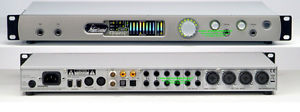
Prism Sound Orpheus F-wire/T-bolt Audio Interface w/ 12 DAs (4) MicPres!
Estimated price for orientation: 2 245 $
Category: Audio or MIDI Interfaces
Class:
Description Interface Type: FireWire Interface, Thunderbolt Interface Max. Sampling Rate: 192 kHz Mic/Line Input: (4) MicPres Max. Number of Channels: 8 AD / 8 DA Brand: Prism Sound Suited For: Mastering Quality Model: Orpheus Features: Phantom Power MPN: Does Not Apply Country/Region of Manufacture: United Kingdom Additional Inputs/Outputs: Analog In, Analog Out UPC: Does not apply
For computers without FireWire, equipped computers via a third party Thunderbolt to FireWire adaptor. Orpheus has line, microphone and instrument inputs, selectable RIAA Equalization for turntables, a built-in premium-quality monitoring mixer for each output providing for performer fold-back and surround monitoring, concurrent ADAT and switchable S/PDIF or AES3 digital I/O plus support for outboard MIDI devices. Microphone inputs include MS matrix processing. High-performance digital sampling-rate conversion (SRC) is available for digital inputs or outputs. Dual headphone outputs are provided each with its own volume control, both monitoring the same headphone feed. Signal Path Eight analogue input channels and up to 10 digital input channels are available as inputs for your audio workstation software through the host computer's audio driver. Similarly, eight analogue output channels, up to 10 digital output channels and stereo headphone outputs can play 20 different channels. For low-latency fold-back or monitoring to headphones or main outputs, each output pair (1-2, 3-4 etc or the headphone output) can optionally be driven from the built-in DSP mixer with an individual local mix of any selection of inputs through the controller applet. All analogue inputs are electronically balanced with automatic unbalanced operation. Analogue outputs are electronically balanced with 'bootstrapping', i.e. level is maintained if one leg is grounded. Windows (ALL) AND MAC OS Orpheus is easy to connect to your computer and to your outboard gear. For Windows ( XP – Windows 10 ) users ASIO and WDM drivers are provided, while for Mac OS X 10.4 or later, Orpheus interfaces directly to Core Audio. For both Mac and PC platforms, there is a controller application to configure the unit and control its built-in mixer and other functions. Aside from the monitor and headphone level controls, everything else is operated solely from the Orpheus controller application. The controller software opens on-screen as a separate panel alongside your existing editing software. Flexible INs AND OUTs Orpheus provides a highly integrated solution with instrument and microphone inputs, and line outputs that could be used for stereo or multi-channel monitoring and/or fold-back to performers. Orpheus offers eight analogue recording channels, eight monitoring outputs, stereo digital input and output on a phono connector plus concurrent optical digital I/O ports that can interface to S/PDIF or ADAT data formats, giving Orpheus a maximum capability of 18 concurrent input and output channels plus stereo headphones. Orpheus' eight analogue inputs support various capabilities. Orpheus has four really good mic amps with software-controlled gain in 1dB steps, individually-switchable phantom power - and very low noise and distortion. These inputs are auto-sensing, and support microphone and line input, with digitally-controlled mic gain in excess of 60dB. Two of these inputs also support direct injection (DI) instrument connections with quarter-inch jacks on the front panel. RIAA Equalization can be selected in the controller applet on channels 1 & 2 so that turntables can be connected for archiving or sampling applications. By selecting the input type (Mic or DI) , low- or high-impedance cartridges can be loaded with suitable termination impedances. All analogue inputs have individually-selectable Prism Sound "Overkillers" built in, just as on the higher-priced ADA-8XR, to catch those fast transients. The Overkiller threshold automatically follows the operating line-up level selection (+4dBu or -10dBV). Overkillers are ideal for percussive sounds, particularly drums, where headroom can be a problem. The co-axial digital I/O port can be switched in the Orpheus controller applet between S/PDIF and AES3 formats. This control changes the operating voltage and the Channel Status format and is complemented by two in-line adaptor leads that provide external XLR connections for AES3 devices. Other connections include MIDI in and out and wordclock sync I/O. Orpheus can also operate in a stand-alone mode using its ADAT or co-axial digital I/O connections. Once set up using the Orpheus controller applet, the unit can be disconnected from the host computer and used independently. Orpheus will retain its settings when powered down so even if it is switched off, Orpheus can be re-powered and stand-alone operation can continue with the automatically-stored settings.
Description
| Interface Type: | FireWire Interface, Thunderbolt Interface | Max. Sampling Rate: | 192 kHz |
| Mic/Line Input: | (4) MicPres | Max. Number of Channels: | 8 AD / 8 DA |
| Brand: | Prism Sound | Suited For: | Mastering Quality |
| Model: | Orpheus | Features: | Phantom Power |
| MPN: | Does Not Apply | Country/Region of Manufacture: | United Kingdom |
| Additional Inputs/Outputs: | Analog In, Analog Out | UPC: | Does not apply |
For computers without FireWire, equipped computers via a third party Thunderbolt to FireWire adaptor. Orpheus has line, microphone and instrument inputs, selectable RIAA Equalization for turntables, a built-in premium-quality monitoring mixer for each output providing for performer fold-back and surround monitoring, concurrent ADAT and switchable S/PDIF or AES3 digital I/O plus support for outboard MIDI devices. Microphone inputs include MS matrix processing. High-performance digital sampling-rate conversion (SRC) is available for digital inputs or outputs. Dual headphone outputs are provided each with its own volume control, both monitoring the same headphone feed. Signal Path Eight analogue input channels and up to 10 digital input channels are available as inputs for your audio workstation software through the host computer's audio driver. Similarly, eight analogue output channels, up to 10 digital output channels and stereo headphone outputs can play 20 different channels. For low-latency fold-back or monitoring to headphones or main outputs, each output pair (1-2, 3-4 etc or the headphone output) can optionally be driven from the built-in DSP mixer with an individual local mix of any selection of inputs through the controller applet. All analogue inputs are electronically balanced with automatic unbalanced operation. Analogue outputs are electronically balanced with 'bootstrapping', i.e. level is maintained if one leg is grounded. Windows (ALL) AND MAC OS Orpheus is easy to connect to your computer and to your outboard gear. For Windows ( XP – Windows 10 ) users ASIO and WDM drivers are provided, while for Mac OS X 10.4 or later, Orpheus interfaces directly to Core Audio. For both Mac and PC platforms, there is a controller application to configure the unit and control its built-in mixer and other functions. Aside from the monitor and headphone level controls, everything else is operated solely from the Orpheus controller application. The controller software opens on-screen as a separate panel alongside your existing editing software. Flexible INs AND OUTs Orpheus provides a highly integrated solution with instrument and microphone inputs, and line outputs that could be used for stereo or multi-channel monitoring and/or fold-back to performers. Orpheus offers eight analogue recording channels, eight monitoring outputs, stereo digital input and output on a phono connector plus concurrent optical digital I/O ports that can interface to S/PDIF or ADAT data formats, giving Orpheus a maximum capability of 18 concurrent input and output channels plus stereo headphones. Orpheus' eight analogue inputs support various capabilities. Orpheus has four really good mic amps with software-controlled gain in 1dB steps, individually-switchable phantom power - and very low noise and distortion. These inputs are auto-sensing, and support microphone and line input, with digitally-controlled mic gain in excess of 60dB. Two of these inputs also support direct injection (DI) instrument connections with quarter-inch jacks on the front panel. RIAA Equalization can be selected in the controller applet on channels 1 & 2 so that turntables can be connected for archiving or sampling applications. By selecting the input type (Mic or DI) , low- or high-impedance cartridges can be loaded with suitable termination impedances. All analogue inputs have individually-selectable Prism Sound "Overkillers" built in, just as on the higher-priced ADA-8XR, to catch those fast transients. The Overkiller threshold automatically follows the operating line-up level selection (+4dBu or -10dBV). Overkillers are ideal for percussive sounds, particularly drums, where headroom can be a problem. The co-axial digital I/O port can be switched in the Orpheus controller applet between S/PDIF and AES3 formats. This control changes the operating voltage and the Channel Status format and is complemented by two in-line adaptor leads that provide external XLR connections for AES3 devices. Other connections include MIDI in and out and wordclock sync I/O. Orpheus can also operate in a stand-alone mode using its ADAT or co-axial digital I/O connections. Once set up using the Orpheus controller applet, the unit can be disconnected from the host computer and used independently. Orpheus will retain its settings when powered down so even if it is switched off, Orpheus can be re-powered and stand-alone operation can continue with the automatically-stored settings.