Back to the main page Back to category Mounts and Assembly Hardware
musical instrument details
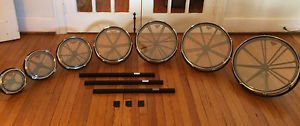
Remo Rototoms (Roto Toms) – full set (6/8/10/12/14/16/18), freshly refurbished
Estimated price for orientation: 800 $
Category: Mounts and Assembly Hardware
Class:
Description Brand: Remo Model: Rototoms Instrument: Rototoms
*Please read my notes below before buying* Shipping:
I’ve set the shipping cost at $100, but that’s a shot-in-the-dark guess. It certainly won’t be cheap to package all this metal securely and ship it, and I can imagine many different ways of doing it; I just can’t calculate it accurately before it’s actually done. So, after you make the purchase, you and I will discuss shipping to make sure it’s done exactly how you want it done. If the cost is more than $100, I’ll require that amount in a separate payment before I ship; if the cost is less than $100, I’ll refund that amount through PayPal.Pricing:
For a while, I’ve been monitoring the sale prices of used Rototoms, both individually and as sets. When the time came to set my price, I averaged all the past prices and their sum was $865. A few days ago, a full set of Rototoms was auctioned here (item #232230707775 in “sold listings”) and the final price was $860. It was good to know that my previous estimates were accurate.
My Rototom set is not a turnkey solution – you will have to figure out your own way to mount them and supply that gear yourself, even if you use the rails provided – but this isn't a disadvantage. In their original configuration, Rototoms always ended up set very high, much higher than anyone normally would mount standard tom toms (e.g. that weird, high-school-ish, above-the-hi-hat kind of way). It really is the best thing to do to devise an alternate way to mount them. (I’ve done some thinking about this over time and will be glad to help you with some ideas/links if you want.)
Because setting them up will require some effort on your part, but taking into account my own work to make them look good *and* the inclusion of a complete set of brand new Remo Emperors, I’ve arrived at a total price of $800. (If you want to think about it a different way, you can be paying $700 for the drums and $100 for $125 worth of heads.) In my opinion, these drums and hardware look much better than those that sold earlier.About the drums:
I bought these Rototoms from their original buyer a few years ago but only ever used one or two at at time; the others always were stored at home in a cool, dry area. When I received them, it was clear that they hadn’t been cared for in the best way: the paint on the spoked frames and rails was worn/chipped in many spots, and there were spots of oxidation on the rims, tension rods, and carriage bolts. Despite that, they all could be assembled completely and functioned as they should.I had great plans to use them in a Bozzio/Bruford kind of setup but never got around to it; it wouldn’t have been the most appropriate choice to use such a progressive setup in the style of music I found myself playing at the time. Recently, I decided to sell them and set about refurbishing them.Regarding the spoked frames and rails: I began by brushing/scraping everything by hand and smoothing things out with steel wool. I chose to paint these parts in satin black; on the range of paint sheen, satin is at the midpoint between flat and gloss (photo 8). (I was inspired by the new style of wheels that you see on some modern cars: they’re sleek and stealthy but not gaudy or fussy. Personally, I’m not a fan of high-gloss paints, especially on musical instruments.) I took care to apply it evenly, and they all turned out looking great (photos 2, 3).
Regarding the Remo logos at the hubs of the spoked frames: Some were relatively intact and some were flaking off. They all were made with *extremely* thin film that was very easily peeled away with the slightest scrape (photo 12). I tried to save them by lightly covering them as I painted, but they couldn’t withstand the slightest bit of stress. Instead of just leaving the remaining scraps, I peeled them all off and painted over the hubs; I think the resulting cleanliness and consistency was the best choice. I was able to save the logos on the rails, however (photo 5).
Regarding the chrome and steel parts: I gave them a similar course of brushing and steel wool-ing. I soaked some of the rods and bolts in white vinegar, a proven “home method” to remove rust. (I stayed away from chemical solutions; I didn’t think they were necessary.) After polishing with the finest-grade steel wool, all the rims shine nicely, but there still are rough spots on some of them (photo 10). I considered touching them up with auto paint but I thought that was going too far; doing so only would achieve a lateral move in their appearance. From a few feet away, you can’t really see the blemishes (photo 4). I polished *every* tension rod and carriage bolt by hand, but there remain some spots and indications of age (photos 9, 10). Not every part is pristine, but the parts that aren’t excellent still are in good shape.I put a lot of time and care into making these drums look as nice as possible, and as you can see, they look pretty great. They’re not perfect, however; I don’t think it would be reasonable to expect perfection from a bunch of old metal parts! But I put the kind of effort into refurbishing them that I would have expended for myself, and I’m kind of a stickler. I would be proud to keep and play these drums if I had a good use for them.
Description
| Brand: | Remo | Model: | Rototoms |
| Instrument: | Rototoms |
*Please read my notes below before buying* Shipping:
I’ve set the shipping cost at $100, but that’s a shot-in-the-dark guess. It certainly won’t be cheap to package all this metal securely and ship it, and I can imagine many different ways of doing it; I just can’t calculate it accurately before it’s actually done. So, after you make the purchase, you and I will discuss shipping to make sure it’s done exactly how you want it done. If the cost is more than $100, I’ll require that amount in a separate payment before I ship; if the cost is less than $100, I’ll refund that amount through PayPal.Pricing:
For a while, I’ve been monitoring the sale prices of used Rototoms, both individually and as sets. When the time came to set my price, I averaged all the past prices and their sum was $865. A few days ago, a full set of Rototoms was auctioned here (item #232230707775 in “sold listings”) and the final price was $860. It was good to know that my previous estimates were accurate.
My Rototom set is not a turnkey solution – you will have to figure out your own way to mount them and supply that gear yourself, even if you use the rails provided – but this isn't a disadvantage. In their original configuration, Rototoms always ended up set very high, much higher than anyone normally would mount standard tom toms (e.g. that weird, high-school-ish, above-the-hi-hat kind of way). It really is the best thing to do to devise an alternate way to mount them. (I’ve done some thinking about this over time and will be glad to help you with some ideas/links if you want.)
Because setting them up will require some effort on your part, but taking into account my own work to make them look good *and* the inclusion of a complete set of brand new Remo Emperors, I’ve arrived at a total price of $800. (If you want to think about it a different way, you can be paying $700 for the drums and $100 for $125 worth of heads.) In my opinion, these drums and hardware look much better than those that sold earlier.About the drums:
I bought these Rototoms from their original buyer a few years ago but only ever used one or two at at time; the others always were stored at home in a cool, dry area. When I received them, it was clear that they hadn’t been cared for in the best way: the paint on the spoked frames and rails was worn/chipped in many spots, and there were spots of oxidation on the rims, tension rods, and carriage bolts. Despite that, they all could be assembled completely and functioned as they should.I had great plans to use them in a Bozzio/Bruford kind of setup but never got around to it; it wouldn’t have been the most appropriate choice to use such a progressive setup in the style of music I found myself playing at the time. Recently, I decided to sell them and set about refurbishing them.Regarding the spoked frames and rails: I began by brushing/scraping everything by hand and smoothing things out with steel wool. I chose to paint these parts in satin black; on the range of paint sheen, satin is at the midpoint between flat and gloss (photo 8). (I was inspired by the new style of wheels that you see on some modern cars: they’re sleek and stealthy but not gaudy or fussy. Personally, I’m not a fan of high-gloss paints, especially on musical instruments.) I took care to apply it evenly, and they all turned out looking great (photos 2, 3).
Regarding the Remo logos at the hubs of the spoked frames: Some were relatively intact and some were flaking off. They all were made with *extremely* thin film that was very easily peeled away with the slightest scrape (photo 12). I tried to save them by lightly covering them as I painted, but they couldn’t withstand the slightest bit of stress. Instead of just leaving the remaining scraps, I peeled them all off and painted over the hubs; I think the resulting cleanliness and consistency was the best choice. I was able to save the logos on the rails, however (photo 5).
Regarding the chrome and steel parts: I gave them a similar course of brushing and steel wool-ing. I soaked some of the rods and bolts in white vinegar, a proven “home method” to remove rust. (I stayed away from chemical solutions; I didn’t think they were necessary.) After polishing with the finest-grade steel wool, all the rims shine nicely, but there still are rough spots on some of them (photo 10). I considered touching them up with auto paint but I thought that was going too far; doing so only would achieve a lateral move in their appearance. From a few feet away, you can’t really see the blemishes (photo 4). I polished *every* tension rod and carriage bolt by hand, but there remain some spots and indications of age (photos 9, 10). Not every part is pristine, but the parts that aren’t excellent still are in good shape.I put a lot of time and care into making these drums look as nice as possible, and as you can see, they look pretty great. They’re not perfect, however; I don’t think it would be reasonable to expect perfection from a bunch of old metal parts! But I put the kind of effort into refurbishing them that I would have expended for myself, and I’m kind of a stickler. I would be proud to keep and play these drums if I had a good use for them.
I’ve set the shipping cost at $100, but that’s a shot-in-the-dark guess. It certainly won’t be cheap to package all this metal securely and ship it, and I can imagine many different ways of doing it; I just can’t calculate it accurately before it’s actually done. So, after you make the purchase, you and I will discuss shipping to make sure it’s done exactly how you want it done. If the cost is more than $100, I’ll require that amount in a separate payment before I ship; if the cost is less than $100, I’ll refund that amount through PayPal.Pricing:
For a while, I’ve been monitoring the sale prices of used Rototoms, both individually and as sets. When the time came to set my price, I averaged all the past prices and their sum was $865. A few days ago, a full set of Rototoms was auctioned here (item #232230707775 in “sold listings”) and the final price was $860. It was good to know that my previous estimates were accurate.
My Rototom set is not a turnkey solution – you will have to figure out your own way to mount them and supply that gear yourself, even if you use the rails provided – but this isn't a disadvantage. In their original configuration, Rototoms always ended up set very high, much higher than anyone normally would mount standard tom toms (e.g. that weird, high-school-ish, above-the-hi-hat kind of way). It really is the best thing to do to devise an alternate way to mount them. (I’ve done some thinking about this over time and will be glad to help you with some ideas/links if you want.)
Because setting them up will require some effort on your part, but taking into account my own work to make them look good *and* the inclusion of a complete set of brand new Remo Emperors, I’ve arrived at a total price of $800. (If you want to think about it a different way, you can be paying $700 for the drums and $100 for $125 worth of heads.) In my opinion, these drums and hardware look much better than those that sold earlier.About the drums:
I bought these Rototoms from their original buyer a few years ago but only ever used one or two at at time; the others always were stored at home in a cool, dry area. When I received them, it was clear that they hadn’t been cared for in the best way: the paint on the spoked frames and rails was worn/chipped in many spots, and there were spots of oxidation on the rims, tension rods, and carriage bolts. Despite that, they all could be assembled completely and functioned as they should.I had great plans to use them in a Bozzio/Bruford kind of setup but never got around to it; it wouldn’t have been the most appropriate choice to use such a progressive setup in the style of music I found myself playing at the time. Recently, I decided to sell them and set about refurbishing them.Regarding the spoked frames and rails: I began by brushing/scraping everything by hand and smoothing things out with steel wool. I chose to paint these parts in satin black; on the range of paint sheen, satin is at the midpoint between flat and gloss (photo 8). (I was inspired by the new style of wheels that you see on some modern cars: they’re sleek and stealthy but not gaudy or fussy. Personally, I’m not a fan of high-gloss paints, especially on musical instruments.) I took care to apply it evenly, and they all turned out looking great (photos 2, 3).
Regarding the Remo logos at the hubs of the spoked frames: Some were relatively intact and some were flaking off. They all were made with *extremely* thin film that was very easily peeled away with the slightest scrape (photo 12). I tried to save them by lightly covering them as I painted, but they couldn’t withstand the slightest bit of stress. Instead of just leaving the remaining scraps, I peeled them all off and painted over the hubs; I think the resulting cleanliness and consistency was the best choice. I was able to save the logos on the rails, however (photo 5).
Regarding the chrome and steel parts: I gave them a similar course of brushing and steel wool-ing. I soaked some of the rods and bolts in white vinegar, a proven “home method” to remove rust. (I stayed away from chemical solutions; I didn’t think they were necessary.) After polishing with the finest-grade steel wool, all the rims shine nicely, but there still are rough spots on some of them (photo 10). I considered touching them up with auto paint but I thought that was going too far; doing so only would achieve a lateral move in their appearance. From a few feet away, you can’t really see the blemishes (photo 4). I polished *every* tension rod and carriage bolt by hand, but there remain some spots and indications of age (photos 9, 10). Not every part is pristine, but the parts that aren’t excellent still are in good shape.I put a lot of time and care into making these drums look as nice as possible, and as you can see, they look pretty great. They’re not perfect, however; I don’t think it would be reasonable to expect perfection from a bunch of old metal parts! But I put the kind of effort into refurbishing them that I would have expended for myself, and I’m kind of a stickler. I would be proud to keep and play these drums if I had a good use for them.