Back to the main page Back to category Fuzz
musical instrument details
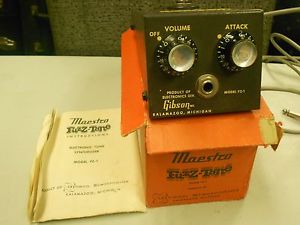
Maestro Fuzz Tone,FZ-1 FIRST ISSUE, One owner, 1962, in BOX
Estimated price for orientation: 1 995 $
Category: Fuzz
Class:
Description Condition: Used: An item that has been used previously. The item may have some signs of cosmetic wear, but is fully operational and functions as intended. This item may be a floor model or store return that has been used. See the seller’s listing for full details and description of any imperfections. See all condition definitions- opens in a new window or tab ... Read moreabout the condition Brand: Maestro
The unit offered here is a one owner bought new in 1962. It is in excellent working condition with the exception of a jumper wire to by-pass the on-off pot. It is on as soon as you plug in and hit the switch. I do not know if the pot is defective or it's something else. If the buyer wants, I will have my tech repair it so it is in perfect working order when it arrives. OR, you can do the repairs yourself or just use it as it is working now. As you see in the photos, it comes with the original box and wiring diagram/information sheet. This is a early model #2198. Free shipping in USA.Here is some background history about this model effect.The Maestro FZ-1 Fuzz-Tone was the first distortion device to become widely available on the market for electric guitars and basses, although there had been other prototype devices made. It was designed and manufactured by . The Maestro FZ-1 (along with its almost identical update the FZ-1a) achieved a peak of popularity in the 1960s. The device was used by in the Rolling Stones' 1965 hit "" and became a favorite of many and acts of the time. Gibson re-issued the FZ-1a in the 1990s, but later discontinued the model. introduced the Maestro FZ-1 Fuzz-Tone in 1962, the first commercially available fuzzbox to gain widespread acceptance. It was the most popular device of its kind for several years. It became a favorite of many garage rock and psychedelic bands.The Maestro FZ-1 sported a three circuit with RCA 2N270 devices, powered by two 1.5-volt batteries, and a lead cable to connect it to an instrument (bass as it was originally intended, or guitar). Germanium devices are temperature sensitive, and the effect responds to the incoming signal's amplitude (volume) consistently. Upon release, Gibson/Maestro made a demonstration disc available, featuring sound samples of the different settings of the pedal and guitar combination, emphasising the "brass-like" quality of certain tones.
Description
| Condition: | Used: An item that has been used previously. The item may have some signs of cosmetic wear, but is fully operational and functions as intended. This item may be a floor model or store return that has been used. See the seller’s listing for full details and description of any imperfections. See all condition definitions- opens in a new window or tab ... Read moreabout the condition | Brand: | Maestro |
The unit offered here is a one owner bought new in 1962. It is in excellent working condition with the exception of a jumper wire to by-pass the on-off pot. It is on as soon as you plug in and hit the switch. I do not know if the pot is defective or it's something else. If the buyer wants, I will have my tech repair it so it is in perfect working order when it arrives. OR, you can do the repairs yourself or just use it as it is working now. As you see in the photos, it comes with the original box and wiring diagram/information sheet. This is a early model #2198. Free shipping in USA.Here is some background history about this model effect.The Maestro FZ-1 Fuzz-Tone was the first distortion device to become widely available on the market for electric guitars and basses, although there had been other prototype devices made. It was designed and manufactured by . The Maestro FZ-1 (along with its almost identical update the FZ-1a) achieved a peak of popularity in the 1960s. The device was used by in the Rolling Stones' 1965 hit "" and became a favorite of many and acts of the time. Gibson re-issued the FZ-1a in the 1990s, but later discontinued the model. introduced the Maestro FZ-1 Fuzz-Tone in 1962, the first commercially available fuzzbox to gain widespread acceptance. It was the most popular device of its kind for several years. It became a favorite of many garage rock and psychedelic bands.The Maestro FZ-1 sported a three circuit with RCA 2N270 devices, powered by two 1.5-volt batteries, and a lead cable to connect it to an instrument (bass as it was originally intended, or guitar). Germanium devices are temperature sensitive, and the effect responds to the incoming signal's amplitude (volume) consistently. Upon release, Gibson/Maestro made a demonstration disc available, featuring sound samples of the different settings of the pedal and guitar combination, emphasising the "brass-like" quality of certain tones.