Back to the main page Back to category Other Circus and Carnival
musical instrument details
North Tonawanda BARREL ORGAN (Fairground Band Wurlitzer Limonaire Gavioli Steam)
Estimated price for orientation: 5 000 $
Category: Other Circus and Carnival
Class:
Description Country/Region of Manufacture: United States
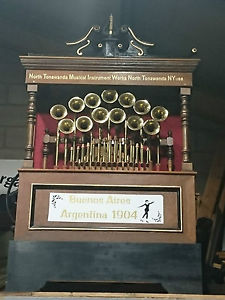
North Tonawanda TRUMPET 'MILITARY BAND' ORGAN Barrel-playing Mechanical Musical InstrumentCirca 1900, this very rare 44-key trumpet ‘Military Band’ organ remains very original, right down to its operation on barrel; almost all of the few surviving de Kleist North Tonawanda Barrel Organ Factory / Musical Instrument Works organs have been converted to rolls! Indeed it is probably the only example of a de Kleist organ in Europe to still retain its barrel (Eugene de Kleist having been an employee of Limonaire Freres prior to starting out on his own). It is also possibly the last survivor of this model to retain its barrel, and thus now unique. As an early North Tonawanda instrument, the organ mechanism is effectively a Limonaire in design and probably manufacturer, fitted in an American oak case (see ‘Manufacturer’s History’ section of this description).UPDATE 8th March - Here's a video I've just made of it playing (although the bass trombones were turned off as I've not yet had chance to reset the reeds):History of this InstrumentThought to date somewhere between 1893 and 1908, the organ was supplied by de Kleist to a Roller Skating rink in America. With 13 brass trumpets and wooden bass trombones playing on their own counter-notes to the usual flue bass, accompaniment and 14-note melody sections, along with bright brass piccolos and vibrate violin pipes, the music happily carried across the noise of hundreds of wooden roller skate wheels circulating around it.By the 1920s the organ was replaced, and was exported to Argentina where it was put back to work in Buenos Aires. During this time, it was repaired and maintained by the La Salvia family organ company, who also re-pinned the barrel with 8 fresh upbeat tunes (the family are still involved with organs today, and have a collection of instruments in Buenos Aires used for educational purposes).With interest in mechanical music resurging in the UK during the 1960s, the organ was purchased in non-playing order and imported by an English collector. When he passed away, it found its way to a junk shop, where via a serendipitous route it was spotted and purchased by the late Bob Minnie, a well-known mechanical music enthusiast and restorer. Bob undertook a complete restoration, replacing split windchest boards and ducting, and fully re-leathering the action and bellows.Bob sold the organ to a steam and vehicle collector in Cheshire, who after mounting in an old catering trailer, briefly exhibited the organ at a rally or two. I purchased the complete outfit circa 2003 and took the organ out of the trailer, where it has remained in my private collection since, spending most of that time in between two Gaviolis. Manufacturer’s HistoryIn 1892 the US Government imposed high import tariffs on imported street and fairground organs from Europe. At the time, French company Gavioli had established an office in North America, but this tax deterred other European organ manufacturers from doing the same. This starved American fairground ride manufacturers of high quality instruments needed to attract fair goers. The following year, William Herschell, son of carousel builder Allan Herschell, travelled to London to meet former Limonaire Frères employee Eugene de Kleist. Backed by the Herschell family, de Kleist set up band organ production in the US by building a factory on the outskirts of New York, founding the North Tonawanda Barrel Organ Factory. As components were not subject to the import tariffs, many of the company’s early organs had Limonaire parts. The company later expanded its product range by also building automatic pianos (which were also sold through a deal with WurliTzer). In 1906 the company was incorporated as the North Tonawanda Musical Instrument Works, and moved to a larger purpose-built factory in this famous instrument-producing town.The InstrumentThe organ remains in good playing order from its barrel. Despite being due a tuning and some fettling once the weather settles down, it sounds amazing, with a such a rich tone coming from the brass resonator trumpets. It is operated either by hand-turning the flywheel, or electrically with a 110V drive motor. The rear panel door requires replacement cloth, otherwise the oak finished casework remains in sound order with a lovely patina. The top pediment is missing a small piece of one corner, but this is easily repaired. Considering its age, it is in remarkably good condition; aside from the piccolo pipes which may have been partly remade, all the remaining pipework would appear original. Under bottom of the case are all the flue bass / accompaniment / helper pipes (stopped). With the red front fascia panel removed, one can see some of the violin and cello pipes normally hidden from view. Also the bass trombones, which like the trumpets, have original wooden boots, but square instead of round (two of these need the reeds resetting in order to play - I've not had chance to sort this yet). The trumpet reeds are all bright and with new tuning wires which makes life easy. Some of the pipes have had labels stuck on (not by me!) which ideally want cleaning off with label remover.I will add more photos to this description shortly. Included with the organ is a North Tonawanda Music Instruments Works reprinted catalogue (when I've found it!), plus the display boards from when it was trailer mounted.One option for the future owner could be to add a non-intrusive MIDI player system, particularly given that the scale is virtually the same as Wurlitzer rolls, of which numeral scanned MIDI files are readily available from the internet (indeed I can give the winning bidder a disc of these that will work with this scale, having correct 14-note counter-melody for the brass trumpets). Being on bellows, one could also make an interesting exhibit by driving with a steam engine!Approximate SizesWidth: 44 inches excluding wheel and case handles (52 inches overall) Height: 61 inches to top of case, or 75 inches high overall to top of pediment Depth: 30 inches (case base, excluding wheel) Terms of SaleSeveral other interests mean I have to rotate my collection of 'cool things' once in a while; I will be sad to see this go, but hope it can find an appreciative home. I have started this auction at the bargain price of £5000 - you will not find an equivalent antique organ in original playing order for such a low amount, and I hope bidding far exceeds this!The organ is located in my workshops near Ludlow (Shropshire), England. The winning bidder is to pay cash on collection, or via bank transfer beforehand. It’s heavy, but I have a fork lift so can load the organ onto a trailer, flatbed, or into a van.Whilst I’d prefer the buyer to collect in person, for international bidders I would be open to working with a shipping agent, but you must make the arrangements (I can happily recommend a company that I have successfully used to import instruments from the US). The organ is sold strictly ‘as seen’. Viewing by potential bidders is welcome prior to the end of the auction. Feel free to ask any questions, and good luck if you join the bidding!
Description
| Country/Region of Manufacture: | United States |
North Tonawanda TRUMPET 'MILITARY BAND' ORGAN Barrel-playing Mechanical Musical InstrumentCirca 1900, this very rare 44-key trumpet ‘Military Band’ organ remains very original, right down to its operation on barrel; almost all of the few surviving de Kleist North Tonawanda Barrel Organ Factory / Musical Instrument Works organs have been converted to rolls! Indeed it is probably the only example of a de Kleist organ in Europe to still retain its barrel (Eugene de Kleist having been an employee of Limonaire Freres prior to starting out on his own). It is also possibly the last survivor of this model to retain its barrel, and thus now unique. As an early North Tonawanda instrument, the organ mechanism is effectively a Limonaire in design and probably manufacturer, fitted in an American oak case (see ‘Manufacturer’s History’ section of this description).UPDATE 8th March - Here's a video I've just made of it playing (although the bass trombones were turned off as I've not yet had chance to reset the reeds):
History of this InstrumentThought to date somewhere between 1893 and 1908, the organ was supplied by de Kleist to a Roller Skating rink in America. With 13 brass trumpets and wooden bass trombones playing on their own counter-notes to the usual flue bass, accompaniment and 14-note melody sections, along with bright brass piccolos and vibrate violin pipes, the music happily carried across the noise of hundreds of wooden roller skate wheels circulating around it.By the 1920s the organ was replaced, and was exported to Argentina where it was put back to work in Buenos Aires. During this time, it was repaired and maintained by the La Salvia family organ company, who also re-pinned the barrel with 8 fresh upbeat tunes (the family are still involved with organs today, and have a collection of instruments in Buenos Aires used for educational purposes).With interest in mechanical music resurging in the UK during the 1960s, the organ was purchased in non-playing order and imported by an English collector. When he passed away, it found its way to a junk shop, where via a serendipitous route it was spotted and purchased by the late Bob Minnie, a well-known mechanical music enthusiast and restorer. Bob undertook a complete restoration, replacing split windchest boards and ducting, and fully re-leathering the action and bellows.Bob sold the organ to a steam and vehicle collector in Cheshire, who after mounting in an old catering trailer, briefly exhibited the organ at a rally or two. I purchased the complete outfit circa 2003 and took the organ out of the trailer, where it has remained in my private collection since, spending most of that time in between two Gaviolis. Manufacturer’s HistoryIn 1892 the US Government imposed high import tariffs on imported street and fairground organs from Europe. At the time, French company Gavioli had established an office in North America, but this tax deterred other European organ manufacturers from doing the same. This starved American fairground ride manufacturers of high quality instruments needed to attract fair goers. The following year, William Herschell, son of carousel builder Allan Herschell, travelled to London to meet former Limonaire Frères employee Eugene de Kleist. Backed by the Herschell family, de Kleist set up band organ production in the US by building a factory on the outskirts of New York, founding the North Tonawanda Barrel Organ Factory. As components were not subject to the import tariffs, many of the company’s early organs had Limonaire parts. The company later expanded its product range by also building automatic pianos (which were also sold through a deal with WurliTzer). In 1906 the company was incorporated as the North Tonawanda Musical Instrument Works, and moved to a larger purpose-built factory in this famous instrument-producing town.The InstrumentThe organ remains in good playing order from its barrel. Despite being due a tuning and some fettling once the weather settles down, it sounds amazing, with a such a rich tone coming from the brass resonator trumpets. It is operated either by hand-turning the flywheel, or electrically with a 110V drive motor. The rear panel door requires replacement cloth, otherwise the oak finished casework remains in sound order with a lovely patina. The top pediment is missing a small piece of one corner, but this is easily repaired. Considering its age, it is in remarkably good condition; aside from the piccolo pipes which may have been partly remade, all the remaining pipework would appear original. Under bottom of the case are all the flue bass / accompaniment / helper pipes (stopped). With the red front fascia panel removed, one can see some of the violin and cello pipes normally hidden from view. Also the bass trombones, which like the trumpets, have original wooden boots, but square instead of round (two of these need the reeds resetting in order to play - I've not had chance to sort this yet). The trumpet reeds are all bright and with new tuning wires which makes life easy. Some of the pipes have had labels stuck on (not by me!) which ideally want cleaning off with label remover.I will add more photos to this description shortly. Included with the organ is a North Tonawanda Music Instruments Works reprinted catalogue (when I've found it!), plus the display boards from when it was trailer mounted.One option for the future owner could be to add a non-intrusive MIDI player system, particularly given that the scale is virtually the same as Wurlitzer rolls, of which numeral scanned MIDI files are readily available from the internet (indeed I can give the winning bidder a disc of these that will work with this scale, having correct 14-note counter-melody for the brass trumpets). Being on bellows, one could also make an interesting exhibit by driving with a steam engine!
Approximate SizesWidth: 44 inches excluding wheel and case handles (52 inches overall) Height: 61 inches to top of case, or 75 inches high overall to top of pediment Depth: 30 inches (case base, excluding wheel)
Terms of SaleSeveral other interests mean I have to rotate my collection of 'cool things' once in a while; I will be sad to see this go, but hope it can find an appreciative home. I have started this auction at the bargain price of £5000 - you will not find an equivalent antique organ in original playing order for such a low amount, and I hope bidding far exceeds this!The organ is located in my workshops near Ludlow (Shropshire), England. The winning bidder is to pay cash on collection, or via bank transfer beforehand. It’s heavy, but I have a fork lift so can load the organ onto a trailer, flatbed, or into a van.Whilst I’d prefer the buyer to collect in person, for international bidders I would be open to working with a shipping agent, but you must make the arrangements (I can happily recommend a company that I have successfully used to import instruments from the US). The organ is sold strictly ‘as seen’. Viewing by potential bidders is welcome prior to the end of the auction. Feel free to ask any questions, and good luck if you join the bidding!