Back to the main page Back to category Electric Guitars
musical instrument details
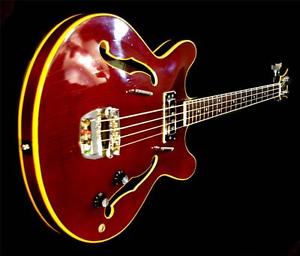
STANDEL HARPTONE BASS GUITAR, MODEL 400C. 1968. CHERRY. EXTREMELY RARE. VINTAGE.
Estimated price for orientation: 3 795 $
Category: Electric Guitars
Class:
Description Condition: Used: An item that has been used previously. The item may have some signs of cosmetic wear, but is fully operational and functions as intended. This item may be a floor model or store return that has been used. See the seller’s listing for full details and description of any imperfections. See all condition definitions- opens in a new window or tab ... Read moreabout the condition
Description STANDELBASSGUITAR MODEL 400-C1968SAM KOONTZ"HARPTONE"STANDELSN: 1054L-3AEXTREMELY RARE!NOTE: PLEASE LOOK AT OUR OTHER AUCTIONS FOR MORE GREAT GUITARS. THE INFORMATION BELOW REFERS TO SAM KOONTZ AND HIS BUILDING OF HARPTONE, STANDEL, AND KOONTZ GUITARS. THIS IS AN EXTREMELY RARE BASS GUITAR BUILT BY SAM KOONTZ AT HARPTONE. STANDEL GUITARS BUILT BY HARPTONE BY SAM KOONTZ. Number two on my list of most undervalued "vintage custom" guitars. My current collection of guitars and amplifiers now totals over 1500+ pieces. Within that collection are several brands of guitars that I consider to be unfairly ignored and undervalued as collectible instruments. These include Veillette Citron, Standel, Lado, and others that I believe will soon attain the status of "collector guitars" and their increased value will be reflected in higher prices that they rightly deserve. The creation of the "collectible" guitar market initially came as the result of "word of mouth", magazine columns, and a lot of hype. The internet has now helped to bring needed attention to those luthiers who created guitars instead of just assembling or building them. Many of these luthiers must be considered as gifted artists and should be equally honored for their artistic skills as well as their resulting products. Also, with the buyer's ability to find a guitar online and buy it immediately, along with the seller's ability to immediately offer a guitar to millions of people throughout the world (thanks ebay), it does not take long for a demand trend (quite deserving in this case) to quickly outstrip the existing supply, e.g., Standel (HARPTONE), as a company only built a total of 300 pieces and the majority of those were guitars according to available information. In a "new" open world that honestly recognizes the inherent value of a handmade guitar as a piece of "performance art", i.e., it plays as good as it looks so every time it is played, it becomes a single piece art show as well. And even though I am guilty of buying many "new guitars" built by "new luthiers", I sometimes wonder if that is dishonoring those small shop luthiers who paved the way for these new builders to be able to gain access to a product market that was so dominated by the two major mass builders in the 1960's-70's as to make any attempt to introduce real "handbuilt" guitars into the market almost certainly doomed to fail. In 1970, STANDEL retreated to its amplifier business while HARPTONE continued to build mostly guitar cases but was later sold but not before they succeeded in building one of a kind quality instruments that will become true "collectibles". And Sam Koontz went home to Linden, NJ where he hand built some of the finest jazz acoustic electric guitars I have ever seen that now command individual prices upward to $50,000.00. And those guitars reflected the influence of Sam's earlier work with HARPTONE (Standel). If you have not played a STANDEL (HARPTONE), you have missed a marvelous experience. They are solid strong guitars with incredible tones coming from its custom DEARMOND/ROWE pickups (DeArmond pickups of the 1950s and '60s are revered and collected around the world because they reflect the era of discovery when electric guitar was experimental and new.) And they are beautiful and stylish. The finishes are true vintage in color and texture. They have aged beautifully with the usual checking. ABOUT THIS GUITAR. ABOUT SAM KOONTZ, HARPTONE, AND STANDEL. FROM ONLINE PUBLIC SOURCE: "Sam Koontz was a guitar builder who was decades ahead of his time. Regrettably, he died while young but his instruments, in extremely short supply, have become legendary". Harptone Guitars are SAM KOONTZ GUITARS. Standel guitars are Harptone Guitars and are therefore SAM KOONTZ GUITARS. Standel labels applied to SAM KOONTZ guitars does not take away their originality, beauty, craftsmanship, tone, and their place in AMERICAN GUITAR LEGEND. Sam Koontz, who hand built his first classical guitar in 1959, deserves to be called a LEGEND. Some have described him as "being ahead of his time" and "a true innovator". Those accolades are certainly true but more than that, he was a MASTER CRAFTSMAN who honestly practiced his art with true dedication to designing and building guitars that would be "musical instruments played by musicians to create music." For that reason, every guitar designed and built by Sam Koontz, under the brand names of HARPTONE, STANDEL, and KOONTZ is a masterpiece. And for that reason, I have actively sought out and purchased these brands of guitars for my personal collection. From the first one I bought to the last I bought, EVERYONE OF THEM IS A MASTERPIECE in its own way. None of them are "mass produced". More about that later. Koontz, who lived in Linden, N.J., was surrounded by the great NYC luthiers such as D'angelico. In fact the headstock of his guitars (Harptone, Standel, Koontz) all featured a "crown" shape in acknowledgment of Koontz's love for the D'angelico style. These design influences of his "physical place in NJ" were assimilated into his guitar art. Historically, Sam Koontz was best known as a "designer and builder of guitars" for HARPTONE Guitar Company (and also designed and built some of the manufacturing equipment used by HARPTONE to build guitars). The Harptone Manufacturing Corporation was founded in 1893 in the USA, as a maker of musical instrument cases and accessories. In 1924, Harptone began the production and distribution of guitars, banjos, mandolins and tiples and continued until 1942. During the war years though, all musical instrument making was discontinued and production diverted to the war effort. In 1966 after extensive market research Harptone decided to resume guitar manufacturing. They aimed to produce professional grade American made guitars at attractive prices. They produced Acoustic and semi hollow bodied guitars and bases until 1975 under Luthier Sam Koontz. Their manufacturing facility was located at127 South 15th Street Newark, New Jersey in the United States.Many players and collectors, including me, have often described the early Koontz guitars, branded HARPTONE and STANDEL, as "being kinda GUILDish". For good reason. I consider GUILD to be another underrated and undervalued guitar brand. GUILD guitars are absolutely some of the best guitars ever built. And so are SAM KOONTZ guitars whether they are branded HARPTONE, STANDEL, or KOONTZ. But perhaps this "GUILDish" look and feel came directly from the craftsman who Koontz had hired to build the HARPTONE, i.e., STANDEL, guitars away from their former jobs building guitars for GUILD. Same GUILD builders but in a different building with different brand names.Some other collectors refer to them as "should have been a Gibson" because many of us consider them to be a better ES-335, a better ED.....-you get the idea. Looks like a Gibson but that's it-because these guitars play better and sound better than comparable Gibsons in my collection. Sometime in the late 1960's, most likely in late 1967 or early 1968, Sam was approached by Bob Crooks from Standel about building some "HARPTONE" guitars but branded "STANDEL". This was after the tumultuous first guitar building attempt with Semie Mosely and Joe Hall out in California. I find it satisfying that a West Coast guy, Bob Crooks, came to the East Coast to get his guitars. And I also find it interesting that he trusted Sam Koontz enough to just take what Sam was making at HARPTONE and simply do a brand budging change. But also, it marked a shift in the character of the STANDEL guitar as Bob finally envisioned it. It was like a reversion back from the "modern" and "stylish" guitars being built in California to the "classic" and "enduring" East Coast acoustic electric pieces that were filtering out of the small luthier shops in the NYC area (think Gretsch). Ok, the HARPTONE morphed into the STANDEL-but all from the mind and hands of SAM KOONTZ. And they were built from the finest materials available (woods included maple & mahogany and pickups came from DeArmond-Rowe, etc) by talented luthiers well versed in the art of guitar making. So we pass through the first door leading to the final sanctum of sanctification of these guitars as VINTAGE COLLECTIBLE INSTRUMENTS.The next door is quantity. To really be blessed as a "RARE" VINTAGE COLLECTIBLE INSTRUMENT, there just can't be a lot of them around. Scarcity and sanctity go together. Again, this brand STANDEL (HARPTONE) passes through that door as well.According to the best documentable data available, ONLY ABOUT 300 of the HARPTONE/STANDEL guitars were built. And these were built between 1967 and 1969. NOTE: HARPTONE brand is really 1967 and into 1968 whereas STANDEL branding is 1968-69. Within this small quantity, there were twenty models listed in their catalog with the DELUXE ARTIST LINE (Models 1000 & 9xx) being the most elaborate and most expensive and most sparingly produced. Then followed by the DELUXE LINE (Models 5xx) and the STANDARD LINE (Models 6xx & 4xx). Thus the distribution of the production is spread widely over the numerous with some being extremely rare because only a few were ever produced. And the final door has been opened, and that is the encomium acknowledgement of these incredible guitars ascending to the level of adulation and recognition they deserve. This is in keeping with the assignment of fame to an instrument that is iconic by nature and form but not fully realized by the audience of "experts" until it's true nature is revealed. We are revealing now, in our opinion-supported by other collectors- that the HARPTONE/STANDEL guitars (bass and six string) are RARE VINTAGE COLLECTIBLE INSTRUMENTS and are in our opinion, overlooked to a fault which has thereby placed them in a vacuum from which we believe they should be freed. Are they as rare and valuable as the later KOONTZ guitars that were each handbuilt solely by Sam that featured the "trap doors" designed to control sound "F" hole door etc? No. Those guitars are extremely rare and extremely highly valued and priced as noted online:When Metuchen, NJ resident Howard Krive died in 2008 following a nearly year-long battle with cancer, he left quite a surprise for his surviving family members. His family and friends knew Krive as an avid guitar player and collector. But no one realized the extent of that collection. Because Krive’s family had very limited musical knowledge, they called on his friend and fellow musician Christopher Wylde to help them sort through the collection. As they began opening guitar cases, they uncovered a rare Koontz jazz guitar. And then another. And another. Thirty-one in all, each valued between twenty and fifty-thousand dollars. Sam Koontz, a Linden jazz guitar maker, only made approximately 200 hand-crafted guitars in his career, and 31 of them belonged to Howard Krive. The fine Koontz guitars are prized by discriminating jazz players, and because of extremely limited availability, command a hefty pricetag.It’s a story that might make William Shakespeare proud. “We’ve got passion, we’ve got love, we have beauty, we have death and we have suicide… it’s everything that Shakespeare would have written about,” said Christopher Wylde, who had been a professional musician in England before moving to Milltown 15 years ago. Wylde said many of the Koontz guitars could sell for $30,000 to $40,000, though there is one, described as “the cream of the crop,” which could go for as much as $50,000. As a lasting legacy and final tribute to both Koontz and Howard Krive, who amassed a very large collection of the guitars, the collection will be featured in a PBS documentary with noted player Bob Miles, host of “World of Guitar” and “Miles of Music.” The musical and entertaining program will allow viewers to fully understand and appreciate Koontz’s work, courtesy of Krive’s guitar collection. The documentary is expected to air in 2011. “I opened a case for a Sam Koontz guitar 31 times,” Wylde said. “It was just shocking to me. It is a story within itself. These are the moments in life that just take your breath away.” Wylde said it is different when talking about master guitar builders such as D’Angelico, D’Aquisto, W.E. Moll, Benedetto, Gibson and others. “D’Angelico and D’Aquisto guitars have global appeal and the 1,000-plus guitars have always been found for sale,” he said. “With Sam Koontz, he only made a little over 200 guitars before he committed suicide in 1981. So the 31 Koontz guitars were definitely a rare find.” “Just the design and craftsmanship, some with the scroll patterns on the guitars, are amazing,” he said. “Koontz would travel all the way to Germany and purchase the wood for his guitars.” ABOUT THIS HARPTONE /STANDEL BASS GUITAR: MODEL: 400-C (Cherry)DOUBLE ROUNDED CUTAWAY.SN: 1054L-3SBODY COLOR: CHERRY TRANSPARENTBODY: 16" x 1 3/4". TOP: Arched FLAME MAPLE (Veneer wood)BACK & SIDES: FLAME MAPLE.BODY features 5 ply binding.3 ply BOUND "F" Holes.NECK & HEAD BINDING.NECK: Very slim radiusFRETBOARD is ROSEWOOD with PEARL Inlays.FRETS: 20PICKUPS: ROWE/DEARMOND SINGLE Integrated with individually adjustable polepieces.TUNERS: Chrome.HEADSTOCK is "KOONTZ CROWN" with Pearl Inlay "STANDEL" logo.TONE & VOLUME KNOBS for pickup.BRIDGE: Adjustable Roller.CHROME PLATE Stop Tailpiece.OHSC.NOTE: The one piece shaping of the back of all Standel/ Harptone guitars reflects Sam's Archtops.SOUND: Compares to Epiphone Rivoli or Gibson Hollowbody bass but with more thump. ROWE/DEARMOND pickups have strong bass, full tone, and even a bit jangly. Just like a true 1960's guitar should sound.COSMETIC CONDITION IS GOOD. Has lots of finish checking, dings, scratches, and some dulling of the finish. Look at the photos to see more. This is a VINTAGE guitar that LOOKS VINTAGE. It has that warm and honest look of a true 44 year old guitar.ELECTRONICALLY AND MECHANICALLY, IT IS IN EXCELLENT CONDITION.About TUNE YOUR SOUND.More information about this guitar and others can be found at: tuneyoursound.comTYS is a joint venture between a couple of guitar collectors who both share a passion for rock and roll music and the instruments used to make that music. Fortunately the two of us have been able to afford to buy the best examples of these instruments we could find. Many are one off, celebrity owned, and unique. And yes, we own a lot of guitars-together we are closing in on the 2,000 mark. But we have decided it is time to share our the fruits of our passion with other likewise smitten players and collectors, so please keep checking our auctions for more unbelievable pieces.Beginning Fall, 2012, many of our instruments will be made available for rent in the USA and Europe. Please check our site for more information. GUARANTEE:BUYER HAS 48 HOURS TO HAVE THE INSTRUMENT INSPECTED BY A PROFESSIONAL GUITAR REPAIR PERSON OR LUTHIER. IF ANY DEFECTS ARE FOUND IN THE MECHANICAL OR ELECTRICAL CONDITION OF THE INSTRUMENT (NOT DISCLOSED IN THE AUCTION AD), BUYER WILL BE REQUIRED TO SHIP THE INSTRUMENT BACK TO US BY EXPRESS SHIPMENT USING THE ORIGINAL PACKING MATERIALS AND ANY ADDITIONAL PACKAGING TO INSURE ITS SAFE RETURN. IT MUST BE FULLY INSURED. BUYER PAYS ALL COST TO SHIP THE INSTRUMENT BACK TO US. WE WILL REPAIR THE INSTRUMENT WITHIN TEN DAYS OF RETURN RECEIPT AND SHIP IT BACK TO THE BUYER AT OUR EXPENSE. THIS ASSURANCE DOES NOT APPLY TO KNOBS, STRINGS, HARDWARE DISCOLORATION, STRAPS. CASES, OR ACCIDENTAL DAMAGE THAT MAY OCCUR AFTER RECEIPT BY BUYER. ALL INSTRUMENTS ARE FULLY PHOTOGRAPHED PRIOR TO SHIPMENT. IT IS THE BUYER’S RESPONSIBILITY TO NOTIFY SELLER IMMEDIATELY IF THE INSTRUMENT HAS INCURRED ANY DAMAGE DURING SHIPMENT. IN THE EVENT OF SUCH DAMAGE, PLEASE RETAIN ALL SHIPPING MATERIALS FOR INSPECTION.FULL DETAILS INCLUDED IN AD. BUYER HAS 48 HOURS TO HAVE THE INSTRUMENT INSPECTED BY A PROFESSIONAL GUITAR REPAIR PERSON OR LUTHIER. IF ANY DEFECTS ARE FOUND IN THE MECHANICAL OR ELECTRICAL CONDITION OF THE INSTRUMENT (NOT DISCLOSED IN THE AUCTION AD), BUYER WILL BE REQUIRED TO SHIP THE INSTRUMENT BACK TO US BY EXPRESS SHIPMENT USING THE ORIGINAL PACKING MATERIALS AND ANY ADDITIONAL PACKAGING TO INSURE ITS SAFE RETURN PLEASE READ BEFORE YOU BID.SHIPPING CHARGES. The charges listed in this ad are for the continental US only. Shipment outside that area is at actual cost and Buyer must pay all tariffs, duties, and other charges that may be levied on the item when it is imported into its final destination. And for foreign buyers, please request a quote for shipping cost before you bid. No surprises are always good. And please do not ask that we use a lower value for an export shipment. NOTE: NO THIRD PARTY SHIPMENTS-WE ONLY SHIP TO THE BUYER WHO PAYS FOR IT. How we indicate condition of guitar:Perhaps one of the most difficult aspects of selling guitars (and most collectibles) is the manner in which condition is determined and rated. We have chosen to stay away from the percentage scale and from the “MINT” down scale as well. They just cannot be quantified. We will use the definitions listed below, which are also subjective, but more general. Rating collectibles of any type is always subjective and to do attempt to do it on some objective checklist basis always seems to raise more questions than answered. We just want the Buyer to be pleased with her/his purchase and to not complain if there is a cat hair under the E string on the 5th fret.Our definitions used to describe condition of guitars:PRISTINE/EXCELLENT. Very little, if any, fret wear, neck wear, body wear, scratches, dings, or other cosmetic damage. Electronics work correctly. Hardware works correctly (tuners, tremolo systems, bridges, and tailpieces). Other accessories with the guitar, i.e., hang tags, tools, etc., will be noted in the ad. Pictures in ad, or as provided later, will take precedence over any written description.ks correctly (tuners, tremolo systems, bridges, and tailpieces). VERY GOOD. More wear and tear than EXCELENT but still in very good cosmetic condition. Again, the nicks, dings, etc will be described in the ad and shown in the pictures. Hardware works correctly (tuners, tremolo systems, bridges, and tailpieces). GOOD. Step down from very good.Other definitions we may use:NOS. New Old Stock. Speaks for itself but the condition will still be rated. PROTOS. These are usually one of a kind prototype instrument. DEMOS (Display): From NAMM etc. ONE OF A KIND. Only one like it.If you have any questions about the condition of a guitar that we are advertising for sale, please ask us before you bid and we will provide you with whatever information you require to make your decision about bidding on an item. BUT THE ULTIMATE GUARANTEE THAT WE WILL GIVE YOU ON ANY ITEM IS “YOU ARE BIDDING ON WHAT YOU SEE IN THE PICTURES AS TO COSMETIC CONDITION” AND WHAT IS LISTED IN THE AD AS TO ELECTRONIC CONDITION. FOR NOS GUITARS, PROTOS, AND DISPLAY GUITARS, THEY ARE SOLD IN “AS IS” CONDITION.Thank you.ONE LAST NOTE: We appreciate feedback about our offerings but please do not email us about our prices. WE DO NOT BELIEVE, AND HAVE NEVER TRUSTED, “BOOK VALUE” AS A MEASURE OF VALUE FOR A GUITAR (and most other things). Such a concept only works if you are selling in a mass market situation where one item is just like the next one off the line. NONE OF OUR GUITARS SOLD HERE REALLY CAN BE CALLED “MASS MARKET” PIECES. Each was purchased for a unique feature (appearance, sound, construction, craftsmanship, ownership, maker, etc) and therefore cannot be given a “book value”.NOTE: ABOUT PAYMENTS FOR THIS GUITAR. WE ARE FORCED BY EBAY TO USE PAYPAL AS A FORM OF PAYMENT. WE WILL DO THAT BUT ONLY FROM PAYPAL FUNDS AVAILABLE IN YOUR ACCOUNT OR BY ECHECK.
Description
| Condition: | Used: An item that has been used previously. The item may have some signs of cosmetic wear, but is fully operational and functions as intended. This item may be a floor model or store return that has been used. See the seller’s listing for full details and description of any imperfections. See all condition definitions- opens in a new window or tab ... Read moreabout the condition |
Description STANDELBASSGUITAR MODEL 400-C1968SAM KOONTZ"HARPTONE"STANDELSN: 1054L-3AEXTREMELY RARE!NOTE: PLEASE LOOK AT OUR OTHER AUCTIONS FOR MORE GREAT GUITARS. THE INFORMATION BELOW REFERS TO SAM KOONTZ AND HIS BUILDING OF HARPTONE, STANDEL, AND KOONTZ GUITARS. THIS IS AN EXTREMELY RARE BASS GUITAR BUILT BY SAM KOONTZ AT HARPTONE. STANDEL GUITARS BUILT BY HARPTONE BY SAM KOONTZ. Number two on my list of most undervalued "vintage custom" guitars. My current collection of guitars and amplifiers now totals over 1500+ pieces. Within that collection are several brands of guitars that I consider to be unfairly ignored and undervalued as collectible instruments. These include Veillette Citron, Standel, Lado, and others that I believe will soon attain the status of "collector guitars" and their increased value will be reflected in higher prices that they rightly deserve. The creation of the "collectible" guitar market initially came as the result of "word of mouth", magazine columns, and a lot of hype. The internet has now helped to bring needed attention to those luthiers who created guitars instead of just assembling or building them. Many of these luthiers must be considered as gifted artists and should be equally honored for their artistic skills as well as their resulting products. Also, with the buyer's ability to find a guitar online and buy it immediately, along with the seller's ability to immediately offer a guitar to millions of people throughout the world (thanks ebay), it does not take long for a demand trend (quite deserving in this case) to quickly outstrip the existing supply, e.g., Standel (HARPTONE), as a company only built a total of 300 pieces and the majority of those were guitars according to available information. In a "new" open world that honestly recognizes the inherent value of a handmade guitar as a piece of "performance art", i.e., it plays as good as it looks so every time it is played, it becomes a single piece art show as well. And even though I am guilty of buying many "new guitars" built by "new luthiers", I sometimes wonder if that is dishonoring those small shop luthiers who paved the way for these new builders to be able to gain access to a product market that was so dominated by the two major mass builders in the 1960's-70's as to make any attempt to introduce real "handbuilt" guitars into the market almost certainly doomed to fail. In 1970, STANDEL retreated to its amplifier business while HARPTONE continued to build mostly guitar cases but was later sold but not before they succeeded in building one of a kind quality instruments that will become true "collectibles". And Sam Koontz went home to Linden, NJ where he hand built some of the finest jazz acoustic electric guitars I have ever seen that now command individual prices upward to $50,000.00. And those guitars reflected the influence of Sam's earlier work with HARPTONE (Standel). If you have not played a STANDEL (HARPTONE), you have missed a marvelous experience. They are solid strong guitars with incredible tones coming from its custom DEARMOND/ROWE pickups (DeArmond pickups of the 1950s and '60s are revered and collected around the world because they reflect the era of discovery when electric guitar was experimental and new.) And they are beautiful and stylish. The finishes are true vintage in color and texture. They have aged beautifully with the usual checking. ABOUT THIS GUITAR. ABOUT SAM KOONTZ, HARPTONE, AND STANDEL. FROM ONLINE PUBLIC SOURCE: "Sam Koontz was a guitar builder who was decades ahead of his time. Regrettably, he died while young but his instruments, in extremely short supply, have become legendary". Harptone Guitars are SAM KOONTZ GUITARS. Standel guitars are Harptone Guitars and are therefore SAM KOONTZ GUITARS. Standel labels applied to SAM KOONTZ guitars does not take away their originality, beauty, craftsmanship, tone, and their place in AMERICAN GUITAR LEGEND. Sam Koontz, who hand built his first classical guitar in 1959, deserves to be called a LEGEND. Some have described him as "being ahead of his time" and "a true innovator". Those accolades are certainly true but more than that, he was a MASTER CRAFTSMAN who honestly practiced his art with true dedication to designing and building guitars that would be "musical instruments played by musicians to create music." For that reason, every guitar designed and built by Sam Koontz, under the brand names of HARPTONE, STANDEL, and KOONTZ is a masterpiece. And for that reason, I have actively sought out and purchased these brands of guitars for my personal collection. From the first one I bought to the last I bought, EVERYONE OF THEM IS A MASTERPIECE in its own way. None of them are "mass produced". More about that later. Koontz, who lived in Linden, N.J., was surrounded by the great NYC luthiers such as D'angelico. In fact the headstock of his guitars (Harptone, Standel, Koontz) all featured a "crown" shape in acknowledgment of Koontz's love for the D'angelico style. These design influences of his "physical place in NJ" were assimilated into his guitar art. Historically, Sam Koontz was best known as a "designer and builder of guitars" for HARPTONE Guitar Company (and also designed and built some of the manufacturing equipment used by HARPTONE to build guitars). The Harptone Manufacturing Corporation was founded in 1893 in the USA, as a maker of musical instrument cases and accessories. In 1924, Harptone began the production and distribution of guitars, banjos, mandolins and tiples and continued until 1942. During the war years though, all musical instrument making was discontinued and production diverted to the war effort. In 1966 after extensive market research Harptone decided to resume guitar manufacturing. They aimed to produce professional grade American made guitars at attractive prices. They produced Acoustic and semi hollow bodied guitars and bases until 1975 under Luthier Sam Koontz. Their manufacturing facility was located at127 South 15th Street Newark, New Jersey in the United States.Many players and collectors, including me, have often described the early Koontz guitars, branded HARPTONE and STANDEL, as "being kinda GUILDish". For good reason. I consider GUILD to be another underrated and undervalued guitar brand. GUILD guitars are absolutely some of the best guitars ever built. And so are SAM KOONTZ guitars whether they are branded HARPTONE, STANDEL, or KOONTZ. But perhaps this "GUILDish" look and feel came directly from the craftsman who Koontz had hired to build the HARPTONE, i.e., STANDEL, guitars away from their former jobs building guitars for GUILD. Same GUILD builders but in a different building with different brand names.Some other collectors refer to them as "should have been a Gibson" because many of us consider them to be a better ES-335, a better ED.....-you get the idea. Looks like a Gibson but that's it-because these guitars play better and sound better than comparable Gibsons in my collection. Sometime in the late 1960's, most likely in late 1967 or early 1968, Sam was approached by Bob Crooks from Standel about building some "HARPTONE" guitars but branded "STANDEL". This was after the tumultuous first guitar building attempt with Semie Mosely and Joe Hall out in California. I find it satisfying that a West Coast guy, Bob Crooks, came to the East Coast to get his guitars. And I also find it interesting that he trusted Sam Koontz enough to just take what Sam was making at HARPTONE and simply do a brand budging change. But also, it marked a shift in the character of the STANDEL guitar as Bob finally envisioned it. It was like a reversion back from the "modern" and "stylish" guitars being built in California to the "classic" and "enduring" East Coast acoustic electric pieces that were filtering out of the small luthier shops in the NYC area (think Gretsch). Ok, the HARPTONE morphed into the STANDEL-but all from the mind and hands of SAM KOONTZ. And they were built from the finest materials available (woods included maple & mahogany and pickups came from DeArmond-Rowe, etc) by talented luthiers well versed in the art of guitar making. So we pass through the first door leading to the final sanctum of sanctification of these guitars as VINTAGE COLLECTIBLE INSTRUMENTS.The next door is quantity. To really be blessed as a "RARE" VINTAGE COLLECTIBLE INSTRUMENT, there just can't be a lot of them around. Scarcity and sanctity go together. Again, this brand STANDEL (HARPTONE) passes through that door as well.According to the best documentable data available, ONLY ABOUT 300 of the HARPTONE/STANDEL guitars were built. And these were built between 1967 and 1969. NOTE: HARPTONE brand is really 1967 and into 1968 whereas STANDEL branding is 1968-69. Within this small quantity, there were twenty models listed in their catalog with the DELUXE ARTIST LINE (Models 1000 & 9xx) being the most elaborate and most expensive and most sparingly produced. Then followed by the DELUXE LINE (Models 5xx) and the STANDARD LINE (Models 6xx & 4xx). Thus the distribution of the production is spread widely over the numerous with some being extremely rare because only a few were ever produced. And the final door has been opened, and that is the encomium acknowledgement of these incredible guitars ascending to the level of adulation and recognition they deserve. This is in keeping with the assignment of fame to an instrument that is iconic by nature and form but not fully realized by the audience of "experts" until it's true nature is revealed. We are revealing now, in our opinion-supported by other collectors- that the HARPTONE/STANDEL guitars (bass and six string) are RARE VINTAGE COLLECTIBLE INSTRUMENTS and are in our opinion, overlooked to a fault which has thereby placed them in a vacuum from which we believe they should be freed. Are they as rare and valuable as the later KOONTZ guitars that were each handbuilt solely by Sam that featured the "trap doors" designed to control sound "F" hole door etc? No. Those guitars are extremely rare and extremely highly valued and priced as noted online:When Metuchen, NJ resident Howard Krive died in 2008 following a nearly year-long battle with cancer, he left quite a surprise for his surviving family members. His family and friends knew Krive as an avid guitar player and collector. But no one realized the extent of that collection. Because Krive’s family had very limited musical knowledge, they called on his friend and fellow musician Christopher Wylde to help them sort through the collection. As they began opening guitar cases, they uncovered a rare Koontz jazz guitar. And then another. And another. Thirty-one in all, each valued between twenty and fifty-thousand dollars. Sam Koontz, a Linden jazz guitar maker, only made approximately 200 hand-crafted guitars in his career, and 31 of them belonged to Howard Krive. The fine Koontz guitars are prized by discriminating jazz players, and because of extremely limited availability, command a hefty pricetag.It’s a story that might make William Shakespeare proud. “We’ve got passion, we’ve got love, we have beauty, we have death and we have suicide… it’s everything that Shakespeare would have written about,” said Christopher Wylde, who had been a professional musician in England before moving to Milltown 15 years ago. Wylde said many of the Koontz guitars could sell for $30,000 to $40,000, though there is one, described as “the cream of the crop,” which could go for as much as $50,000. As a lasting legacy and final tribute to both Koontz and Howard Krive, who amassed a very large collection of the guitars, the collection will be featured in a PBS documentary with noted player Bob Miles, host of “World of Guitar” and “Miles of Music.” The musical and entertaining program will allow viewers to fully understand and appreciate Koontz’s work, courtesy of Krive’s guitar collection. The documentary is expected to air in 2011. “I opened a case for a Sam Koontz guitar 31 times,” Wylde said. “It was just shocking to me. It is a story within itself. These are the moments in life that just take your breath away.” Wylde said it is different when talking about master guitar builders such as D’Angelico, D’Aquisto, W.E. Moll, Benedetto, Gibson and others. “D’Angelico and D’Aquisto guitars have global appeal and the 1,000-plus guitars have always been found for sale,” he said. “With Sam Koontz, he only made a little over 200 guitars before he committed suicide in 1981. So the 31 Koontz guitars were definitely a rare find.” “Just the design and craftsmanship, some with the scroll patterns on the guitars, are amazing,” he said. “Koontz would travel all the way to Germany and purchase the wood for his guitars.” ABOUT THIS HARPTONE /STANDEL BASS GUITAR: MODEL: 400-C (Cherry)DOUBLE ROUNDED CUTAWAY.SN: 1054L-3SBODY COLOR: CHERRY TRANSPARENTBODY: 16" x 1 3/4". TOP: Arched FLAME MAPLE (Veneer wood)BACK & SIDES: FLAME MAPLE.BODY features 5 ply binding.3 ply BOUND "F" Holes.NECK & HEAD BINDING.NECK: Very slim radiusFRETBOARD is ROSEWOOD with PEARL Inlays.FRETS: 20PICKUPS: ROWE/DEARMOND SINGLE Integrated with individually adjustable polepieces.TUNERS: Chrome.HEADSTOCK is "KOONTZ CROWN" with Pearl Inlay "STANDEL" logo.TONE & VOLUME KNOBS for pickup.BRIDGE: Adjustable Roller.CHROME PLATE Stop Tailpiece.OHSC.NOTE: The one piece shaping of the back of all Standel/ Harptone guitars reflects Sam's Archtops.SOUND: Compares to Epiphone Rivoli or Gibson Hollowbody bass but with more thump. ROWE/DEARMOND pickups have strong bass, full tone, and even a bit jangly. Just like a true 1960's guitar should sound.COSMETIC CONDITION IS GOOD. Has lots of finish checking, dings, scratches, and some dulling of the finish. Look at the photos to see more. This is a VINTAGE guitar that LOOKS VINTAGE. It has that warm and honest look of a true 44 year old guitar.ELECTRONICALLY AND MECHANICALLY, IT IS IN EXCELLENT CONDITION.About TUNE YOUR SOUND.More information about this guitar and others can be found at: tuneyoursound.comTYS is a joint venture between a couple of guitar collectors who both share a passion for rock and roll music and the instruments used to make that music. Fortunately the two of us have been able to afford to buy the best examples of these instruments we could find. Many are one off, celebrity owned, and unique. And yes, we own a lot of guitars-together we are closing in on the 2,000 mark. But we have decided it is time to share our the fruits of our passion with other likewise smitten players and collectors, so please keep checking our auctions for more unbelievable pieces.Beginning Fall, 2012, many of our instruments will be made available for rent in the USA and Europe. Please check our site for more information. GUARANTEE:BUYER HAS 48 HOURS TO HAVE THE INSTRUMENT INSPECTED BY A PROFESSIONAL GUITAR REPAIR PERSON OR LUTHIER. IF ANY DEFECTS ARE FOUND IN THE MECHANICAL OR ELECTRICAL CONDITION OF THE INSTRUMENT (NOT DISCLOSED IN THE AUCTION AD), BUYER WILL BE REQUIRED TO SHIP THE INSTRUMENT BACK TO US BY EXPRESS SHIPMENT USING THE ORIGINAL PACKING MATERIALS AND ANY ADDITIONAL PACKAGING TO INSURE ITS SAFE RETURN. IT MUST BE FULLY INSURED. BUYER PAYS ALL COST TO SHIP THE INSTRUMENT BACK TO US. WE WILL REPAIR THE INSTRUMENT WITHIN TEN DAYS OF RETURN RECEIPT AND SHIP IT BACK TO THE BUYER AT OUR EXPENSE. THIS ASSURANCE DOES NOT APPLY TO KNOBS, STRINGS, HARDWARE DISCOLORATION, STRAPS. CASES, OR ACCIDENTAL DAMAGE THAT MAY OCCUR AFTER RECEIPT BY BUYER. ALL INSTRUMENTS ARE FULLY PHOTOGRAPHED PRIOR TO SHIPMENT. IT IS THE BUYER’S RESPONSIBILITY TO NOTIFY SELLER IMMEDIATELY IF THE INSTRUMENT HAS INCURRED ANY DAMAGE DURING SHIPMENT. IN THE EVENT OF SUCH DAMAGE, PLEASE RETAIN ALL SHIPPING MATERIALS FOR INSPECTION.FULL DETAILS INCLUDED IN AD. BUYER HAS 48 HOURS TO HAVE THE INSTRUMENT INSPECTED BY A PROFESSIONAL GUITAR REPAIR PERSON OR LUTHIER. IF ANY DEFECTS ARE FOUND IN THE MECHANICAL OR ELECTRICAL CONDITION OF THE INSTRUMENT (NOT DISCLOSED IN THE AUCTION AD), BUYER WILL BE REQUIRED TO SHIP THE INSTRUMENT BACK TO US BY EXPRESS SHIPMENT USING THE ORIGINAL PACKING MATERIALS AND ANY ADDITIONAL PACKAGING TO INSURE ITS SAFE RETURN PLEASE READ BEFORE YOU BID.SHIPPING CHARGES. The charges listed in this ad are for the continental US only. Shipment outside that area is at actual cost and Buyer must pay all tariffs, duties, and other charges that may be levied on the item when it is imported into its final destination. And for foreign buyers, please request a quote for shipping cost before you bid. No surprises are always good. And please do not ask that we use a lower value for an export shipment. NOTE: NO THIRD PARTY SHIPMENTS-WE ONLY SHIP TO THE BUYER WHO PAYS FOR IT. How we indicate condition of guitar:Perhaps one of the most difficult aspects of selling guitars (and most collectibles) is the manner in which condition is determined and rated. We have chosen to stay away from the percentage scale and from the “MINT” down scale as well. They just cannot be quantified. We will use the definitions listed below, which are also subjective, but more general. Rating collectibles of any type is always subjective and to do attempt to do it on some objective checklist basis always seems to raise more questions than answered. We just want the Buyer to be pleased with her/his purchase and to not complain if there is a cat hair under the E string on the 5th fret.Our definitions used to describe condition of guitars:PRISTINE/EXCELLENT. Very little, if any, fret wear, neck wear, body wear, scratches, dings, or other cosmetic damage. Electronics work correctly. Hardware works correctly (tuners, tremolo systems, bridges, and tailpieces). Other accessories with the guitar, i.e., hang tags, tools, etc., will be noted in the ad. Pictures in ad, or as provided later, will take precedence over any written description.ks correctly (tuners, tremolo systems, bridges, and tailpieces). VERY GOOD. More wear and tear than EXCELENT but still in very good cosmetic condition. Again, the nicks, dings, etc will be described in the ad and shown in the pictures. Hardware works correctly (tuners, tremolo systems, bridges, and tailpieces). GOOD. Step down from very good.Other definitions we may use:NOS. New Old Stock. Speaks for itself but the condition will still be rated. PROTOS. These are usually one of a kind prototype instrument. DEMOS (Display): From NAMM etc. ONE OF A KIND. Only one like it.If you have any questions about the condition of a guitar that we are advertising for sale, please ask us before you bid and we will provide you with whatever information you require to make your decision about bidding on an item. BUT THE ULTIMATE GUARANTEE THAT WE WILL GIVE YOU ON ANY ITEM IS “YOU ARE BIDDING ON WHAT YOU SEE IN THE PICTURES AS TO COSMETIC CONDITION” AND WHAT IS LISTED IN THE AD AS TO ELECTRONIC CONDITION. FOR NOS GUITARS, PROTOS, AND DISPLAY GUITARS, THEY ARE SOLD IN “AS IS” CONDITION.Thank you.ONE LAST NOTE: We appreciate feedback about our offerings but please do not email us about our prices. WE DO NOT BELIEVE, AND HAVE NEVER TRUSTED, “BOOK VALUE” AS A MEASURE OF VALUE FOR A GUITAR (and most other things). Such a concept only works if you are selling in a mass market situation where one item is just like the next one off the line. NONE OF OUR GUITARS SOLD HERE REALLY CAN BE CALLED “MASS MARKET” PIECES. Each was purchased for a unique feature (appearance, sound, construction, craftsmanship, ownership, maker, etc) and therefore cannot be given a “book value”.NOTE: ABOUT PAYMENTS FOR THIS GUITAR. WE ARE FORCED BY EBAY TO USE PAYPAL AS A FORM OF PAYMENT. WE WILL DO THAT BUT ONLY FROM PAYPAL FUNDS AVAILABLE IN YOUR ACCOUNT OR BY ECHECK.