Back to the main page Back to category Flutes
musical instrument details
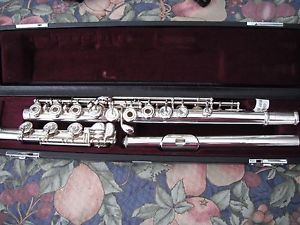
Yamaha 574HCT Professional Flute - C# trill key- offset G!
Estimated price for orientation: 1 900 $
Category: Flutes
Class:
Description Condition: Used: An item that has been used previously. The item may have some signs of cosmetic wear, but is fully operational and functions as intended. This item may be a floor model or store return that has been used. See the seller’s listing for full details and description of any imperfections. See all condition definitions- opens in a new window or tab ... Read moreabout the condition Brand: Yamaha Skill Level: Professional Body Material: Nickel Silver Model: 574 Headjoint Material: Silver Country/Region of Manufacture: Japan
Yamaha 574HCT Professional Flute in excellent condition.
Once you get to the 500 series, Yamaha flutes are considered in the professional category. The flute has been well maintained and the pads are in great condition. Plays very well. No dents or dings. This flute features a .925 solid sterling silver Yamaha CY headjoint. Open-hole, offset G. Drawn tone holes. Pointed french style key arms. Low B foot with Gizmo key. C# trill key. Includes Yamaha french style hard case, a blue soft case, and plastic cleaning rod.Same as the current Yamaha 577H flute, $2,935.
Written by Edward Johnson
Many people have asked about the C# trill key and what it does. The very name of the key causes confusion. Actually, this mechanism is one of the most useful on the flute. Basically, it moves several left hand movements to the right hand and simplifies a number of trills. It also provides an additional vent which clarifies several notes and octaves. The following examples will illustrate some of its many functions.
TRILLS
B to C# in the first and second octaves: Simply finger B and trill the C# trill key. The intonation is better and a two finger trill is eliminated.
High F# to G#: Finger high F# and trill the C# trill key. Anyone who has played the Grand Canyon Suite will appreciate this one.
C to C#, both octaves: This is a faster trill and allows for a more comfortable feel.
High G to Ab: Better in tune, and far more comfortable.
High G to A: Finger high G and trill the C# trill key AND the upper trill key. This trill alone is worth the price of the key.
High Ab to Bb: This trill, which shows up in many Mahler Symphonies, is played by fingering high Ab and trilling BOTH trill keys AND the C# trill key. The trill will be in tune.
Tremolos and shakes: First octave C, B, Bb, A, Ab and G can be tremoloed with C# by just using the C# trill key. The same notes can all be tremoloed with D natural by using the C# trill key and first trill key in combination. These notes may require some pitch adjustment, but there is no easy way to do these effects.
The use of the trill keys and the C# trill in combination can produce many startling effects, and experimentation can be very rewarding.
SPECIALTY NOTES
Pianissimo high Ab: How many of us have tried to play this note softly, and keep pitch and sonority? Play middle Ab with ALL the left hand keys depressed, add the C# trill and the high Ab will appear softly, and in tune.
Debussy C#: The middle C# which opens "L'apres-midi d'une faune" is often raw and hard to color. Use the C# trill key while fingering B natural, and you will get a C# which is full and able to be colored without losing pitch, since the resistance of the note is increased.
A word about mechanism is probably in order. Since this key has its own rod, it will not interfere with or complicate the existing mechanism. The placement of the key lever is not clumsy, since it is above and to the left of the Bb shake. A few moments of playing will convince the player of the ease of operation of both keys.
Careful comparison of identical flutes, with and without the C# trill, have convinced us that the additional hole does not affect tone.
There are many other effects which the C# trill could produce, and the ingenuity of flutists and composers will create and fulfill new demands. The modern flutist would do well to consider the C# trill an integral part of the instrument.
Description
| Condition: | Used: An item that has been used previously. The item may have some signs of cosmetic wear, but is fully operational and functions as intended. This item may be a floor model or store return that has been used. See the seller’s listing for full details and description of any imperfections. See all condition definitions- opens in a new window or tab ... Read moreabout the condition | Brand: | Yamaha |
| Skill Level: | Professional | Body Material: | Nickel Silver |
| Model: | 574 | Headjoint Material: | Silver |
| Country/Region of Manufacture: | Japan |
Once you get to the 500 series, Yamaha flutes are considered in the professional category. The flute has been well maintained and the pads are in great condition. Plays very well. No dents or dings. This flute features a .925 solid sterling silver Yamaha CY headjoint. Open-hole, offset G. Drawn tone holes. Pointed french style key arms. Low B foot with Gizmo key. C# trill key. Includes Yamaha french style hard case, a blue soft case, and plastic cleaning rod.Same as the current Yamaha 577H flute, $2,935.
Written by Edward Johnson
Many people have asked about the C# trill key and what it does. The very name of the key causes confusion. Actually, this mechanism is one of the most useful on the flute. Basically, it moves several left hand movements to the right hand and simplifies a number of trills. It also provides an additional vent which clarifies several notes and octaves. The following examples will illustrate some of its many functions.
TRILLS
B to C# in the first and second octaves: Simply finger B and trill the C# trill key. The intonation is better and a two finger trill is eliminated.
High F# to G#: Finger high F# and trill the C# trill key. Anyone who has played the Grand Canyon Suite will appreciate this one.
C to C#, both octaves: This is a faster trill and allows for a more comfortable feel.
High G to Ab: Better in tune, and far more comfortable.
High G to A: Finger high G and trill the C# trill key AND the upper trill key. This trill alone is worth the price of the key.
High Ab to Bb: This trill, which shows up in many Mahler Symphonies, is played by fingering high Ab and trilling BOTH trill keys AND the C# trill key. The trill will be in tune.
Tremolos and shakes: First octave C, B, Bb, A, Ab and G can be tremoloed with C# by just using the C# trill key. The same notes can all be tremoloed with D natural by using the C# trill key and first trill key in combination. These notes may require some pitch adjustment, but there is no easy way to do these effects.
The use of the trill keys and the C# trill in combination can produce many startling effects, and experimentation can be very rewarding.
SPECIALTY NOTES
Pianissimo high Ab: How many of us have tried to play this note softly, and keep pitch and sonority? Play middle Ab with ALL the left hand keys depressed, add the C# trill and the high Ab will appear softly, and in tune.
Debussy C#: The middle C# which opens "L'apres-midi d'une faune" is often raw and hard to color. Use the C# trill key while fingering B natural, and you will get a C# which is full and able to be colored without losing pitch, since the resistance of the note is increased.
A word about mechanism is probably in order. Since this key has its own rod, it will not interfere with or complicate the existing mechanism. The placement of the key lever is not clumsy, since it is above and to the left of the Bb shake. A few moments of playing will convince the player of the ease of operation of both keys.
Careful comparison of identical flutes, with and without the C# trill, have convinced us that the additional hole does not affect tone.
There are many other effects which the C# trill could produce, and the ingenuity of flutists and composers will create and fulfill new demands. The modern flutist would do well to consider the C# trill an integral part of the instrument.