Back to the main page Back to category Electronic Keyboards
musical instrument details
Wurlitzer Electric Piano 200B KIT: zero hum battery power: THE FUTURE
Estimated price for orientation: 1 050 $
Category: Electronic Keyboards
Class:
Description Condition: New: A brand-new, unused, unopened, undamaged item in its original packaging (where packaging is applicable). Packaging should be the same as what is found in a retail store, unless the item is handmade or was packaged by the manufacturer in non-retail packaging, such as an unprinted box or plastic bag. See the seller's listing for full details. See all condition definitions- opens in a new window or tab ... Read moreabout the condition Brand: Wurlistar Model: 200B Number of Keys: not applicable Country/Region of Manufacture: United States Type: alternative energy instrument Features: DC power/portable
'Gee Dad, it's a Wurlitzer!' The 200B was designed to run on batteries (DC) or with a DC converter (wall wart) producing a zero hum world class signal. No other Wurlitzer Electric Piano does this. How many 200B's are out there in the world? That remains a mystery. Most of the Wurlitzer Electric Piano's sold in 1981 were AC powered and were model 200's. If you were lucky enough to have purchased a model 200B then things were different at your house. . .If you lived out in the Tullies where there was no AC power then you'd have been looking for a battery powered piano and lo and behold, the Wurlitzer Company came up with the goods. If you got your 'Gee Dad, it's a Wurlitzer!' model 200B electric piano for Christmas 1981 then here's the way things would have stacked up: A CHRISTMAS STORY
So, it's Christmas morning, 1981 and you're setting up your new 200B Wurlitzer Electric Piano set up under the tree then. . .It's standing there on its chrome legs and you're reading your owners manual. Just standing there suspiciously unconnected to anything and your 'Chief' headphones plugged in and the volume up you play 'What I Say' by Ray Charles and it sounds wonderful. You plug it into your uncle Charlie's big guitar amp and it sounds even more wonderful. Then you notice there was a device in the box with the piano and you wonder what the heck it's for. Then you plug in this 'wall wart' thingy to see how that works and you stretch the cord far enough away from the piano to not alter the zero hum output. The wall-wart plugs into the wall at the wart end and into the piano with a little min-jack which fits into a hole in the back that says 'DC Power'. This connection allows uninterrupted operation of the 100% internal DC system if your house has wall plugs with AC power but here's the big shot though, the reason you bought it! YOU CAN GO OFF THE AC GRID!!! Power independence from Pacific Gas & Electric. So when you're off the AC grid somewhere, your piano can operate independently on DC power for two months (based on two hours operation/day). Not only do you have that 'off -grid' capability but also you can record/perform with your piano without having to filter out the objectionable 60Hz hum (and its attendant harmonics) giving you the best Wurly output signal in the known world. The wall wart option was engineered purely as a convenience factor, so you don't have to drain the system whenever AC power is available. The wall wart is an alternate method of powering your piano. The wall wart does not charge the batteries while it's connected. There could be that confusion as to its purpose since it's not really fully explained in the owners manual. It's purpose is to over-ride the single 9V battery to give you the option to operate on house power when it's available but let's say there's a bad storm and power goes out. . .you just unplug the wall-wart (at the piano end) and you're automatically switched over to DC power and you're up and running for months. Let's introduce another possibility. . .there's a revolution and the electricity is out all over the world. . .you'll be able to entertain the troops in the field with your trusty Wurly 200B. TECHNICAL STUFF There are two separate voltage source batteries in the system. The main battery runs for *approximately twenty five years before it has to be replaced. It's kind of mysterious because it's 'on' for the next twenty-five years. You forget it's even there. The other battery source, the one you DO have to be aware of is a single 9V battery in a little trap door compartment underneath the piano. That single 9V battery powers the pre-amp and amp-driver boards. It lasts for about two months with normal use. The only clue you have to the charge status of this battery is that the volume starts to gradually decrease and after a few days of this it will stop working altogether. At this point you either go down to the store and buy a new one to remain off grid or you plug in the wall wart to the nearest AC outlet to continue 'AC assisted' operation. EVENTUALLY THEN . . . Twenty-five Christmas' hence, long after you've forgotten you even had a 240V battery in your piano at all, it dies and your piano ceases to function after a long period of gradually reducing volume. This is a big problem because without your permission at all, the Wurlitzer Company who built your piano closed it doors in 1988. . .So how to replace your dead polarizing battery? Your owners manual lists a phone number in Dekalb Illinois that a recorded voice answers with 'I'm sorry, the Wurlitzer Company has closed'. What to do? So it's Christmas 2016 and your trusty Wurly has been in the closet since 2006. . .not because you got disinterested in it but because that's when it gave up. If it was a standard voltage battery then you could just run down to the store and buy one but it's not. What's also strange is that the piano doesn't operate even with the trusty wall wart plugged in. . .hmmmm. . .that's because you need the big polarizing battery to run the thing. . .PERIOD. It wasn't a problem for twenty five years. . .but now it is! It's a 240V battery and no-body makes it anymore. No-body that is except Wurlistar. Wurlistar designed a replacement for the main battery that is safe, lasts twenty-five years and uses twenty-five standard 9V alkaline batteries that you can buy down at Costco and simply plug into the board. The battery comes as part of the K-1 kit or for those of you that want to gamble that your electronics are still intact after that battery has been sitting inside your piano corroding for ten years or more. . .You might luck out if you'd disconnected it ten years ago when the piano stopped working. If your electronics is retrievable then. You can buy a replacement battery here on Ebay separately for $350. Of course you won't know wether the electronics are still good until you get the battery and fire it up. If it works. . .great! If not, then the K-1 kit is one way to resurrect your piano! You'll already have a battery yeah? So if this kind of situation occurs you can get the K-1 kit for the full price minus the price of the battery. Just let us know what happens in that case and we'll deal with that then. Pshew. . .that's alot of info but hey. . .That's what some of you out there are faced with if you want your Wurly back up and running for Christmas 2016! ORIGINAL ELECTRONIC DESIGN W/UPGRADED COMPONENTS
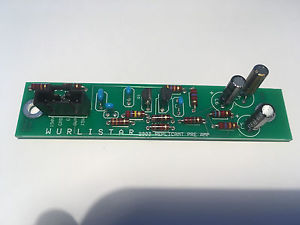
Since 1981 when the 200B was first designed, thirty-four Christmas' have passed and there have been significant advancements in all components. Although faithful to the original schematic, many of the components of the K-1 kit have been upgraded with modern low noise versions, closer tolerances and more durable and longer lasting materials. NOS components are used where it was critical to maintain original sonics. Much attention was made to duplicate the sound of the original ie. same IMD (inter-modulation distortion) and the same threshold clipping. In layman's terms then: the Wurly has a characteristic 'bark' when over-driven. That bark is maintained in the K-1 kit electronics. . .so. . .carbon composition resistors are used throughout along with monolithic and multi-layer ceramic capacitors which help maintain original sonics and offer more dependability/longevity than the NOS vesions. Vintage style signal transistors are used in the pre-amp. The prime-directives of the design project was to maintain the signature Wurly sound while increasing the over-all dependability and keeping the ZERO HUM achievement of the original 200B. More details on the Kit and pictures of all components can be seen at jakeandsallyart.com
I put the shot of a factory version 200B model tag in the gallery to show that the 200B was not just a myth. They were rare birds and you don't see many of them since people that were lucky enough to have one usually held on to them. They were recording studio favorites because of the zero hum characteristic. No soldering ! Allow two hours for installation. If you're 'converting' your piano to 200B specification, then it might take you that long just to strip the AC electronics out of your model. All connections made with 'positive lock' connectors. The instructions are written in English in such a way that anyone armed with a screw driver a pair of pliers and a drill can accomplish a successful installation in any model Wurlitzer Electric Piano converting it to 200B (battery powered) operation. You can consult with Wurlistar by phone or email in case you run into trouble. - IN SUPPORT OF BATTERY POWER-
There are two batteries that run the system. The main battery is a 240V DC low current type that lasts aprox. 25yrs. The original battery design has been changed to allow the use of standard 9V batteries as plug-ins to achieve the required 240V polarizing voltage along with surge protector and fuse. The secondary battery is a single 9V battery (standard alkaline) which supplies operation power to the two boards. It can last for months depending on the amount of 'on' time you use your piano. It helps the life of the 9V battery if you remember to turn the piano 'off'. The main battery is always on polarizing the pickup. There's no switch on it because it's operating at such a low current draw that it's best to just let it 'run out' for it's twenty-five year life span. If you're going to store your piano for a long period or if you're breaking it down for repairs or if you're shipping it to Bombay under rocket fire then you might want to disconnect BOTH batteries at the amp driver board and the pre-amp and disarm your piano. After awhile you forget that the polarizing (big) battery is even there. I use my 200B piano a lot, three or four hours a day and my single 9V (secondary) battery lasts about one month. The volume sags when the battery starts to get low which is annoying. To prevent the sag effect, I just replace the battery once a month regardless of how much I use my piano. There's no voltage gauge on it, so that's how I keep it ready for action. I keep the single 9V replacement battery always ready- duck tapped inside the compartment. I could just use the wall wart converter but I feel like that would be 'copping out' on the alternative energy DC plan. . .so if you're not concerned about that you could use your wall wart to over-ride the 9V battery and save it for when you don't have AC access. That's the way the Wurlitzer designers put it on the market and that's the way it can work for you. . .your choice. At the time that the 200B design first surfaced in 1981, I suppose the aspect of saving the planet was not so much of a hot topic. 'Alternative Energy' was not a big issue yet. I think what Wurlitzer Company was responding to was the competition. Fender Rhodes was offering a 'coil' pickup based piano with better output specs than the Wurly and so in response to that, Wurlitzer Company, rather than dumping the electrostatic system entirely optioned out to offer an alternative battery powered, zero hum version tagged the '200B' to more discriminating artists. The electro-static pickup system had an inherent design flaw in that it acted as an antenna with local AC interference, chiefly the on-board AC power supply. Earlier models suffered from this problem more because of the absence of the RF shield that they later developed to minimize the effect. Nice try but it didn't really 'solve' the problem, it merely minimized it and it was only effectual for EXTERNAL interference. The internal AC system continued to broadcast and be a problem. The signal derived from the 200B set-up was zero-hum so the engineers smiled and said 'this is the hot rod Wurly'. The marketing dept. was not as happy though because the public didn't respond to the idea. Only a small percentage of Wurli practitioners were concerned about zero hum or off-grid operation back then but when Fender Rhodes came along with their instantly popular instrument, it became a matter of keeping up with the competition. The evolution of the 200B never came to full fruition though because Wurlitzer closed its doors in 1988 so the whole thing became a mute point for them but they left a bunch of 200B's out there in the world with these 'time-bomb' proprietary batteries. NO WURLY LEFT BEHIND !
There's undoubtedly many model 200B's out there in the world with worn out batteries. The last 200B's were sold just before Wurlitzer Company closed its doors. The main factory installed battery was designed to last about twenty-five years. So 200B's would be 'wearing out' between 2006 and 2013 assuming a twenty-five year life span of the polarizing (main) battery and also assuming the owner left it connected. Other factors could be in play like ground interrupts or shorting or corrosion due to bad connections.
Since it could have been a long time since anyone read the owners manual some confusion might arise as to why the 200B was not working. Some owners might not even be aware that the piano ran on DC at all and they'd be looking around for a non-existent AC power cord. Change in ownership of the instrument could further confuse things.
We're here to bail you out. Wurlistar makes the K-1 battery available to 200B owners who want to bring their Wurly back to life. If you have a 200B in that condition then the instructions in the K-1B kit walks you through that. If you power your old equipment up with the new battery, Wurlistar can not however be held liable for technical problems that could arise. What we recommend is that you replace all your old 200B electronics with a new K-1 kit which is electronically identical to the original Wurlitzer design and get a fresh start! It's not 'stock NOS' replacement but unfortunately for the preservationist, stock parts no longer exist. The K-1 kit is as close to stock restoration as is practicable. Technically speaking, it's an upgrade. NOTE: The 200B system only delivers a signal to headphones and the aux output plug. There is no power signal to internal speakers like there is on all other Wurlitzer Electric Pianos. For some, I can see that could be hard to adapt. To get the sound up louder than your headphones you need to feed the aux out signal to some sort of amplifier. Typical would be a Fender Twin or the equivalent. Also there is no 'Vib' effect. I don't miss that much. The Vib effect was designed to imitate the sound of the Vibraphone which was a very popular jazz sound back when it was devised with the model 120. Also there is no pilot light because it would draw too much energy from the battery. So just looking at a 200B then, you can't tell where you stand with your 9V battery. Those are the technical 'trade-offs' you need to make to experience the benefits of the 200B which are primarily the zero hum signal and the Off-Grid capability. Recording Studios love the 200B because you're not faced with the task of filtering out the 60 Hz hum. Oh yeah. . .the absence of the speakers/transformer/amplifier make the 200B five pounds lighter than its production twin, the 200A. If you're in love with the 'Vib' effect (which is technically tremolo) there are wonderful effect units on the market that can accomplish that. Wurlitzer engineers continued with the 'Vib' effect in all later models except for the 200B. All the above might be 'TMI' for some people but there could be some interest in the development of the 200B since the 'Wurli' shows up in a surprisingly large number of historical and current recordings. The 200B brought the Wurli's output signal/noise ratio up to date with other modern keyboard instruments.
In an off-grid situation then to get amplified sound out of a 200B you need a battery powered amp. There are many good battery powered amps on the market today by: Fender, Vox, Pignose, Roland and others.NOTE: The model 200A constitutes most of the Wurli's in circulation now. That's the twin brother of the 200B battery powered version sold right along side it circa. 1981 to 1988. The 200A is the easiest conversion candidate for the kit since they were production twins however ANY Wurlitzer Electric Piano can be converted using the K-1 kit. Let us know when you order then which model you have so that we can trim the harness accordingly. The K-1 kit addresses the electronic aspect of the Wurly ONLY. The mechanical intricacies have been well covered by third party developers like Vintagevibe and parts sources like Morelock's Organ Supply. If you happen to live in the Santa Cruz or San Francisco Bay Area, Wurlistar offers services in All aspects of the Wurlitzer Electric Piano including tuning, action repairs, restoration etc. If you strictly want parts we recommend the above sources. If you've reached a point of frustration like many have with your Wurly then I would recommend starting by replacing the entire electronics with our K-1 kit. At least then your piano remains 'stock' to the original Wurlitzer 200B factory design standard. If you start replacing amplifiers and other modifications that the several third party developers sell as 'improvements' then your investment value decreases and your dependability factor as well. A simpler and more practical way to continue on with your piano is to have one reliable company help you keep it pumping out that beautiful Wurly sound on in to the future. KEEP IT SIMPLE! *main battery life based on Duracell technical specificationsJake Welsh- Wurlistar LLC
Description
| Condition: | New: A brand-new, unused, unopened, undamaged item in its original packaging (where packaging is applicable). Packaging should be the same as what is found in a retail store, unless the item is handmade or was packaged by the manufacturer in non-retail packaging, such as an unprinted box or plastic bag. See the seller's listing for full details. See all condition definitions- opens in a new window or tab ... Read moreabout the condition | Brand: | Wurlistar |
| Model: | 200B | Number of Keys: | not applicable |
| Country/Region of Manufacture: | United States | Type: | alternative energy instrument |
| Features: | DC power/portable |
'Gee Dad, it's a Wurlitzer!' The 200B was designed to run on batteries (DC) or with a DC converter (wall wart) producing a zero hum world class signal. No other Wurlitzer Electric Piano does this. How many 200B's are out there in the world? That remains a mystery. Most of the Wurlitzer Electric Piano's sold in 1981 were AC powered and were model 200's. If you were lucky enough to have purchased a model 200B then things were different at your house. . .If you lived out in the Tullies where there was no AC power then you'd have been looking for a battery powered piano and lo and behold, the Wurlitzer Company came up with the goods. If you got your 'Gee Dad, it's a Wurlitzer!' model 200B electric piano for Christmas 1981 then here's the way things would have stacked up: A CHRISTMAS STORY
So, it's Christmas morning, 1981 and you're setting up your new 200B Wurlitzer Electric Piano set up under the tree then. . .It's standing there on its chrome legs and you're reading your owners manual. Just standing there suspiciously unconnected to anything and your 'Chief' headphones plugged in and the volume up you play 'What I Say' by Ray Charles and it sounds wonderful. You plug it into your uncle Charlie's big guitar amp and it sounds even more wonderful. Then you notice there was a device in the box with the piano and you wonder what the heck it's for. Then you plug in this 'wall wart' thingy to see how that works and you stretch the cord far enough away from the piano to not alter the zero hum output. The wall-wart plugs into the wall at the wart end and into the piano with a little min-jack which fits into a hole in the back that says 'DC Power'. This connection allows uninterrupted operation of the 100% internal DC system if your house has wall plugs with AC power but here's the big shot though, the reason you bought it! YOU CAN GO OFF THE AC GRID!!! Power independence from Pacific Gas & Electric. So when you're off the AC grid somewhere, your piano can operate independently on DC power for two months (based on two hours operation/day). Not only do you have that 'off -grid' capability but also you can record/perform with your piano without having to filter out the objectionable 60Hz hum (and its attendant harmonics) giving you the best Wurly output signal in the known world. The wall wart option was engineered purely as a convenience factor, so you don't have to drain the system whenever AC power is available. The wall wart is an alternate method of powering your piano. The wall wart does not charge the batteries while it's connected. There could be that confusion as to its purpose since it's not really fully explained in the owners manual. It's purpose is to over-ride the single 9V battery to give you the option to operate on house power when it's available but let's say there's a bad storm and power goes out. . .you just unplug the wall-wart (at the piano end) and you're automatically switched over to DC power and you're up and running for months. Let's introduce another possibility. . .there's a revolution and the electricity is out all over the world. . .you'll be able to entertain the troops in the field with your trusty Wurly 200B.
TECHNICAL STUFF There are two separate voltage source batteries in the system. The main battery runs for *approximately twenty five years before it has to be replaced. It's kind of mysterious because it's 'on' for the next twenty-five years. You forget it's even there. The other battery source, the one you DO have to be aware of is a single 9V battery in a little trap door compartment underneath the piano. That single 9V battery powers the pre-amp and amp-driver boards. It lasts for about two months with normal use. The only clue you have to the charge status of this battery is that the volume starts to gradually decrease and after a few days of this it will stop working altogether. At this point you either go down to the store and buy a new one to remain off grid or you plug in the wall wart to the nearest AC outlet to continue 'AC assisted' operation. EVENTUALLY THEN . . . Twenty-five Christmas' hence, long after you've forgotten you even had a 240V battery in your piano at all, it dies and your piano ceases to function after a long period of gradually reducing volume. This is a big problem because without your permission at all, the Wurlitzer Company who built your piano closed it doors in 1988. . .So how to replace your dead polarizing battery? Your owners manual lists a phone number in Dekalb Illinois that a recorded voice answers with 'I'm sorry, the Wurlitzer Company has closed'. What to do?
So it's Christmas 2016 and your trusty Wurly has been in the closet since 2006. . .not because you got disinterested in it but because that's when it gave up. If it was a standard voltage battery then you could just run down to the store and buy one but it's not. What's also strange is that the piano doesn't operate even with the trusty wall wart plugged in. . .hmmmm. . .that's because you need the big polarizing battery to run the thing. . .PERIOD. It wasn't a problem for twenty five years. . .but now it is! It's a 240V battery and no-body makes it anymore. No-body that is except Wurlistar. Wurlistar designed a replacement for the main battery that is safe, lasts twenty-five years and uses twenty-five standard 9V alkaline batteries that you can buy down at Costco and simply plug into the board. The battery comes as part of the K-1 kit or for those of you that want to gamble that your electronics are still intact after that battery has been sitting inside your piano corroding for ten years or more. . .You might luck out if you'd disconnected it ten years ago when the piano stopped working. If your electronics is retrievable then. You can buy a replacement battery here on Ebay separately for $350. Of course you won't know wether the electronics are still good until you get the battery and fire it up. If it works. . .great! If not, then the K-1 kit is one way to resurrect your piano! You'll already have a battery yeah? So if this kind of situation occurs you can get the K-1 kit for the full price minus the price of the battery. Just let us know what happens in that case and we'll deal with that then. Pshew. . .that's alot of info but hey. . .That's what some of you out there are faced with if you want your Wurly back up and running for Christmas 2016! ORIGINAL ELECTRONIC DESIGN W/UPGRADED COMPONENTS
Since 1981 when the 200B was first designed, thirty-four Christmas' have passed and there have been significant advancements in all components. Although faithful to the original schematic, many of the components of the K-1 kit have been upgraded with modern low noise versions, closer tolerances and more durable and longer lasting materials. NOS components are used where it was critical to maintain original sonics. Much attention was made to duplicate the sound of the original ie. same IMD (inter-modulation distortion) and the same threshold clipping. In layman's terms then: the Wurly has a characteristic 'bark' when over-driven. That bark is maintained in the K-1 kit electronics. . .so. . .carbon composition resistors are used throughout along with monolithic and multi-layer ceramic capacitors which help maintain original sonics and offer more dependability/longevity than the NOS vesions. Vintage style signal transistors are used in the pre-amp. The prime-directives of the design project was to maintain the signature Wurly sound while increasing the over-all dependability and keeping the ZERO HUM achievement of the original 200B. More details on the Kit and pictures of all components can be seen at jakeandsallyart.com
I put the shot of a factory version 200B model tag in the gallery to show that the 200B was not just a myth. They were rare birds and you don't see many of them since people that were lucky enough to have one usually held on to them. They were recording studio favorites because of the zero hum characteristic. No soldering ! Allow two hours for installation. If you're 'converting' your piano to 200B specification, then it might take you that long just to strip the AC electronics out of your model. All connections made with 'positive lock' connectors. The instructions are written in English in such a way that anyone armed with a screw driver a pair of pliers and a drill can accomplish a successful installation in any model Wurlitzer Electric Piano converting it to 200B (battery powered) operation. You can consult with Wurlistar by phone or email in case you run into trouble. - IN SUPPORT OF BATTERY POWER-
There are two batteries that run the system. The main battery is a 240V DC low current type that lasts aprox. 25yrs. The original battery design has been changed to allow the use of standard 9V batteries as plug-ins to achieve the required 240V polarizing voltage along with surge protector and fuse. The secondary battery is a single 9V battery (standard alkaline) which supplies operation power to the two boards. It can last for months depending on the amount of 'on' time you use your piano. It helps the life of the 9V battery if you remember to turn the piano 'off'. The main battery is always on polarizing the pickup. There's no switch on it because it's operating at such a low current draw that it's best to just let it 'run out' for it's twenty-five year life span. If you're going to store your piano for a long period or if you're breaking it down for repairs or if you're shipping it to Bombay under rocket fire then you might want to disconnect BOTH batteries at the amp driver board and the pre-amp and disarm your piano.
Since 1981 when the 200B was first designed, thirty-four Christmas' have passed and there have been significant advancements in all components. Although faithful to the original schematic, many of the components of the K-1 kit have been upgraded with modern low noise versions, closer tolerances and more durable and longer lasting materials. NOS components are used where it was critical to maintain original sonics. Much attention was made to duplicate the sound of the original ie. same IMD (inter-modulation distortion) and the same threshold clipping. In layman's terms then: the Wurly has a characteristic 'bark' when over-driven. That bark is maintained in the K-1 kit electronics. . .so. . .carbon composition resistors are used throughout along with monolithic and multi-layer ceramic capacitors which help maintain original sonics and offer more dependability/longevity than the NOS vesions. Vintage style signal transistors are used in the pre-amp. The prime-directives of the design project was to maintain the signature Wurly sound while increasing the over-all dependability and keeping the ZERO HUM achievement of the original 200B. More details on the Kit and pictures of all components can be seen at jakeandsallyart.com
I put the shot of a factory version 200B model tag in the gallery to show that the 200B was not just a myth. They were rare birds and you don't see many of them since people that were lucky enough to have one usually held on to them. They were recording studio favorites because of the zero hum characteristic. No soldering ! Allow two hours for installation. If you're 'converting' your piano to 200B specification, then it might take you that long just to strip the AC electronics out of your model. All connections made with 'positive lock' connectors. The instructions are written in English in such a way that anyone armed with a screw driver a pair of pliers and a drill can accomplish a successful installation in any model Wurlitzer Electric Piano converting it to 200B (battery powered) operation. You can consult with Wurlistar by phone or email in case you run into trouble. - IN SUPPORT OF BATTERY POWER-
There are two batteries that run the system. The main battery is a 240V DC low current type that lasts aprox. 25yrs. The original battery design has been changed to allow the use of standard 9V batteries as plug-ins to achieve the required 240V polarizing voltage along with surge protector and fuse. The secondary battery is a single 9V battery (standard alkaline) which supplies operation power to the two boards. It can last for months depending on the amount of 'on' time you use your piano. It helps the life of the 9V battery if you remember to turn the piano 'off'. The main battery is always on polarizing the pickup. There's no switch on it because it's operating at such a low current draw that it's best to just let it 'run out' for it's twenty-five year life span. If you're going to store your piano for a long period or if you're breaking it down for repairs or if you're shipping it to Bombay under rocket fire then you might want to disconnect BOTH batteries at the amp driver board and the pre-amp and disarm your piano.
After awhile you forget that the polarizing (big) battery is even there. I use my 200B piano a lot, three or four hours a day and my single 9V (secondary) battery lasts about one month. The volume sags when the battery starts to get low which is annoying. To prevent the sag effect, I just replace the battery once a month regardless of how much I use my piano. There's no voltage gauge on it, so that's how I keep it ready for action. I keep the single 9V replacement battery always ready- duck tapped inside the compartment. I could just use the wall wart converter but I feel like that would be 'copping out' on the alternative energy DC plan. . .so if you're not concerned about that you could use your wall wart to over-ride the 9V battery and save it for when you don't have AC access. That's the way the Wurlitzer designers put it on the market and that's the way it can work for you. . .your choice. At the time that the 200B design first surfaced in 1981, I suppose the aspect of saving the planet was not so much of a hot topic. 'Alternative Energy' was not a big issue yet. I think what Wurlitzer Company was responding to was the competition. Fender Rhodes was offering a 'coil' pickup based piano with better output specs than the Wurly and so in response to that, Wurlitzer Company, rather than dumping the electrostatic system entirely optioned out to offer an alternative battery powered, zero hum version tagged the '200B' to more discriminating artists. The electro-static pickup system had an inherent design flaw in that it acted as an antenna with local AC interference, chiefly the on-board AC power supply. Earlier models suffered from this problem more because of the absence of the RF shield that they later developed to minimize the effect. Nice try but it didn't really 'solve' the problem, it merely minimized it and it was only effectual for EXTERNAL interference. The internal AC system continued to broadcast and be a problem. The signal derived from the 200B set-up was zero-hum so the engineers smiled and said 'this is the hot rod Wurly'. The marketing dept. was not as happy though because the public didn't respond to the idea. Only a small percentage of Wurli practitioners were concerned about zero hum or off-grid operation back then but when Fender Rhodes came along with their instantly popular instrument, it became a matter of keeping up with the competition. The evolution of the 200B never came to full fruition though because Wurlitzer closed its doors in 1988 so the whole thing became a mute point for them but they left a bunch of 200B's out there in the world with these 'time-bomb' proprietary batteries. NO WURLY LEFT BEHIND !
There's undoubtedly many model 200B's out there in the world with worn out batteries. The last 200B's were sold just before Wurlitzer Company closed its doors. The main factory installed battery was designed to last about twenty-five years. So 200B's would be 'wearing out' between 2006 and 2013 assuming a twenty-five year life span of the polarizing (main) battery and also assuming the owner left it connected. Other factors could be in play like ground interrupts or shorting or corrosion due to bad connections.
Since it could have been a long time since anyone read the owners manual some confusion might arise as to why the 200B was not working. Some owners might not even be aware that the piano ran on DC at all and they'd be looking around for a non-existent AC power cord. Change in ownership of the instrument could further confuse things.
We're here to bail you out. Wurlistar makes the K-1 battery available to 200B owners who want to bring their Wurly back to life. If you have a 200B in that condition then the instructions in the K-1B kit walks you through that. If you power your old equipment up with the new battery, Wurlistar can not however be held liable for technical problems that could arise. What we recommend is that you replace all your old 200B electronics with a new K-1 kit which is electronically identical to the original Wurlitzer design and get a fresh start! It's not 'stock NOS' replacement but unfortunately for the preservationist, stock parts no longer exist. The K-1 kit is as close to stock restoration as is practicable. Technically speaking, it's an upgrade. NOTE: The 200B system only delivers a signal to headphones and the aux output plug. There is no power signal to internal speakers like there is on all other Wurlitzer Electric Pianos. For some, I can see that could be hard to adapt. To get the sound up louder than your headphones you need to feed the aux out signal to some sort of amplifier. Typical would be a Fender Twin or the equivalent. Also there is no 'Vib' effect. I don't miss that much. The Vib effect was designed to imitate the sound of the Vibraphone which was a very popular jazz sound back when it was devised with the model 120. Also there is no pilot light because it would draw too much energy from the battery. So just looking at a 200B then, you can't tell where you stand with your 9V battery. Those are the technical 'trade-offs' you need to make to experience the benefits of the 200B which are primarily the zero hum signal and the Off-Grid capability. Recording Studios love the 200B because you're not faced with the task of filtering out the 60 Hz hum. Oh yeah. . .the absence of the speakers/transformer/amplifier make the 200B five pounds lighter than its production twin, the 200A. If you're in love with the 'Vib' effect (which is technically tremolo) there are wonderful effect units on the market that can accomplish that. Wurlitzer engineers continued with the 'Vib' effect in all later models except for the 200B. All the above might be 'TMI' for some people but there could be some interest in the development of the 200B since the 'Wurli' shows up in a surprisingly large number of historical and current recordings. The 200B brought the Wurli's output signal/noise ratio up to date with other modern keyboard instruments.
In an off-grid situation then to get amplified sound out of a 200B you need a battery powered amp. There are many good battery powered amps on the market today by: Fender, Vox, Pignose, Roland and others.NOTE: The model 200A constitutes most of the Wurli's in circulation now. That's the twin brother of the 200B battery powered version sold right along side it circa. 1981 to 1988. The 200A is the easiest conversion candidate for the kit since they were production twins however ANY Wurlitzer Electric Piano can be converted using the K-1 kit. Let us know when you order then which model you have so that we can trim the harness accordingly. The K-1 kit addresses the electronic aspect of the Wurly ONLY. The mechanical intricacies have been well covered by third party developers like Vintagevibe and parts sources like Morelock's Organ Supply. If you happen to live in the Santa Cruz or San Francisco Bay Area, Wurlistar offers services in All aspects of the Wurlitzer Electric Piano including tuning, action repairs, restoration etc. If you strictly want parts we recommend the above sources. If you've reached a point of frustration like many have with your Wurly then I would recommend starting by replacing the entire electronics with our K-1 kit. At least then your piano remains 'stock' to the original Wurlitzer 200B factory design standard. If you start replacing amplifiers and other modifications that the several third party developers sell as 'improvements' then your investment value decreases and your dependability factor as well. A simpler and more practical way to continue on with your piano is to have one reliable company help you keep it pumping out that beautiful Wurly sound on in to the future. KEEP IT SIMPLE! *main battery life based on Duracell technical specificationsJake Welsh- Wurlistar LLC
There's undoubtedly many model 200B's out there in the world with worn out batteries. The last 200B's were sold just before Wurlitzer Company closed its doors. The main factory installed battery was designed to last about twenty-five years. So 200B's would be 'wearing out' between 2006 and 2013 assuming a twenty-five year life span of the polarizing (main) battery and also assuming the owner left it connected. Other factors could be in play like ground interrupts or shorting or corrosion due to bad connections.
Since it could have been a long time since anyone read the owners manual some confusion might arise as to why the 200B was not working. Some owners might not even be aware that the piano ran on DC at all and they'd be looking around for a non-existent AC power cord. Change in ownership of the instrument could further confuse things.
We're here to bail you out. Wurlistar makes the K-1 battery available to 200B owners who want to bring their Wurly back to life. If you have a 200B in that condition then the instructions in the K-1B kit walks you through that. If you power your old equipment up with the new battery, Wurlistar can not however be held liable for technical problems that could arise. What we recommend is that you replace all your old 200B electronics with a new K-1 kit which is electronically identical to the original Wurlitzer design and get a fresh start! It's not 'stock NOS' replacement but unfortunately for the preservationist, stock parts no longer exist. The K-1 kit is as close to stock restoration as is practicable. Technically speaking, it's an upgrade. NOTE: The 200B system only delivers a signal to headphones and the aux output plug. There is no power signal to internal speakers like there is on all other Wurlitzer Electric Pianos. For some, I can see that could be hard to adapt. To get the sound up louder than your headphones you need to feed the aux out signal to some sort of amplifier. Typical would be a Fender Twin or the equivalent. Also there is no 'Vib' effect. I don't miss that much. The Vib effect was designed to imitate the sound of the Vibraphone which was a very popular jazz sound back when it was devised with the model 120. Also there is no pilot light because it would draw too much energy from the battery. So just looking at a 200B then, you can't tell where you stand with your 9V battery. Those are the technical 'trade-offs' you need to make to experience the benefits of the 200B which are primarily the zero hum signal and the Off-Grid capability. Recording Studios love the 200B because you're not faced with the task of filtering out the 60 Hz hum. Oh yeah. . .the absence of the speakers/transformer/amplifier make the 200B five pounds lighter than its production twin, the 200A. If you're in love with the 'Vib' effect (which is technically tremolo) there are wonderful effect units on the market that can accomplish that. Wurlitzer engineers continued with the 'Vib' effect in all later models except for the 200B. All the above might be 'TMI' for some people but there could be some interest in the development of the 200B since the 'Wurli' shows up in a surprisingly large number of historical and current recordings. The 200B brought the Wurli's output signal/noise ratio up to date with other modern keyboard instruments.
In an off-grid situation then to get amplified sound out of a 200B you need a battery powered amp. There are many good battery powered amps on the market today by: Fender, Vox, Pignose, Roland and others.NOTE: The model 200A constitutes most of the Wurli's in circulation now. That's the twin brother of the 200B battery powered version sold right along side it circa. 1981 to 1988. The 200A is the easiest conversion candidate for the kit since they were production twins however ANY Wurlitzer Electric Piano can be converted using the K-1 kit. Let us know when you order then which model you have so that we can trim the harness accordingly. The K-1 kit addresses the electronic aspect of the Wurly ONLY. The mechanical intricacies have been well covered by third party developers like Vintagevibe and parts sources like Morelock's Organ Supply. If you happen to live in the Santa Cruz or San Francisco Bay Area, Wurlistar offers services in All aspects of the Wurlitzer Electric Piano including tuning, action repairs, restoration etc. If you strictly want parts we recommend the above sources. If you've reached a point of frustration like many have with your Wurly then I would recommend starting by replacing the entire electronics with our K-1 kit. At least then your piano remains 'stock' to the original Wurlitzer 200B factory design standard. If you start replacing amplifiers and other modifications that the several third party developers sell as 'improvements' then your investment value decreases and your dependability factor as well. A simpler and more practical way to continue on with your piano is to have one reliable company help you keep it pumping out that beautiful Wurly sound on in to the future. KEEP IT SIMPLE! *main battery life based on Duracell technical specificationsJake Welsh- Wurlistar LLC