Back to the main page Back to category Speakers and Monitors
musical instrument details
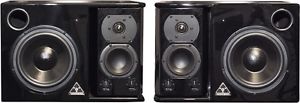
2 ( One Pair) TRIDENT AUDIO HG3 Near Field Monitors MSRP $10,000.00
Estimated price for orientation: 1 777 $
Category: Speakers and Monitors
Class:
Description Brand: Trident Active/Passive: Active Type: Studio Monitor System Features: 3-Way Configuration Model: HG3 RMS Power: 220W
2 Each (1 Pair) TRIDENT AUDIO HG3 ........MSRP $10,000.00 a pair Up for your consideration are my studio monitors in good condition visually with minor scratches and perfect condition sonically. The following is what the experts say about these amazing monitors. REVIEWS S.O.S. “SOUND ON SOUND MAGAZINE” “The HG3 can go surprisingly loud, if necessary, has very low quiescent noise, and is extremely transparent and neutral, indicating very low harmonic distortion levels.” “The HG3s generate stunning stereo images, with pin-sharp positional details, both left to right and front to back. The 'sweet spot' area is also larger than most, and the image remains stable with frequency. I've heard similarly precise imaging from small satellite speakers before, but very few conventional speakers of this size come anywhere close to this level of imaging precision.” “Tonally, the HG3s are very well balanced through the mid-range and high end, sounding open and airy at the top and ruthlessly detailed and revealing in the mid-range, without being obviously 'forward' or 'shouty' (a balance often employed by two-way designs to artificially enhance the impression of detail). As a result, these speakers aren't fatiguing, and I used them over long periods quite comfortably.” “It was easy to make EQ and dynamics decisions while mixing, and I had no nasty surprises when auditioning on other systems. Having the mid-range and HF level controls easily accessible on the front baffles also made it easy to tweak the balance quickly for sanity-checking purposes, too.” “The bass output from reflex cabinets usually only balances properly once you get the volume above a certain level, and that seems to be the case for the HG3s, too.” “When the monitors were used in this way, the bass was generally pretty tight and punchy, with surprisingly good extension when playing well-balanced music, while still ruthlessly exposing poorly balanced material!” “Overall the HG3s a lot, and the unusual design cleverly achieves excellent performance from a relatively compact cabinet, I liked. These are definitely worth auditioning if you're in the market for some high-performance monitor speakers.” RECORDING MAGAZINE Let's start at the bottom. Once you have the likes of Ray Brown, Victor Wooten, Marcus Miller ("Infatuation" off the album Tales, with a huge kick drum under his bass...), and Christian McBride coming through the HG3s, you realize why Trident calls the bass speaker the subwoofer and devotes two power amps to it. I don't know how the two amps share the task, but the fruits of their labor are marvelous. With all that tight and deep and balanced bass coming right from in front of you, there is no lack of cohesiveness within the entire spectrum you're hearing -- the bass simply "belongs". We always talk about bass being non-directional. Can you call bass "focused?" This one sounds focused. My conclusion: If ported bass cabs go against your belief system, maybe this one will convince you that there is merit on the other side of the aisle? MIDRANGE A bit further up we come to the mud range, but there is no mud here. Even mixes that sound doubtful on lesser speakers are being treated more kindly by the HG3, bringing out exceptional clarity and detail. Voices project well I was delighted to hear no shrillness on a fabulous recording that often suffers that fate on playback, Berg's "Lulu" (Boulez, DGG) -- even in the densest and most delightfully hysterical passages the voices remained balanced rather than shrieky. HIGHS High strings, high winds, triangles and bells were crystal clear, I couldn't discern the 3.5 kHz crossover range on any material. Brass bites when it is supposed to bite -- for a moment, turn the front controls to their minimum settings and experience what a "smiley" curve on pretty-sounding speakers is like by comparison. Quite educational... Suffice to say that with that kind of fidelity, drums, pianos, guitars and other wide-spectrum instruments sounded just great throughout their entire ranges, especially since I couldn't detect any fault with transients and abrupt changes in dynamics. No doubt the HG3s can remain distortion-free far beyond what I would consider reasonable listening levels, especially when used in a nearfield setup. I'm quite happy at 85 dB, but those who like it hotter will not be disappointed. What is even more impressive is the fullness and accuracy that the HG3s provide at low listening levels. Mes
Description
| Brand: | Trident | Active/Passive: | Active |
| Type: | Studio Monitor System | Features: | 3-Way Configuration |
| Model: | HG3 | RMS Power: | 220W |
2 Each (1 Pair) TRIDENT AUDIO HG3 ........MSRP $10,000.00 a pair Up for your consideration are my studio monitors in good condition visually with minor scratches and perfect condition sonically. The following is what the experts say about these amazing monitors. REVIEWS S.O.S. “SOUND ON SOUND MAGAZINE” “The HG3 can go surprisingly loud, if necessary, has very low quiescent noise, and is extremely transparent and neutral, indicating very low harmonic distortion levels.” “The HG3s generate stunning stereo images, with pin-sharp positional details, both left to right and front to back. The 'sweet spot' area is also larger than most, and the image remains stable with frequency. I've heard similarly precise imaging from small satellite speakers before, but very few conventional speakers of this size come anywhere close to this level of imaging precision.” “Tonally, the HG3s are very well balanced through the mid-range and high end, sounding open and airy at the top and ruthlessly detailed and revealing in the mid-range, without being obviously 'forward' or 'shouty' (a balance often employed by two-way designs to artificially enhance the impression of detail). As a result, these speakers aren't fatiguing, and I used them over long periods quite comfortably.” “It was easy to make EQ and dynamics decisions while mixing, and I had no nasty surprises when auditioning on other systems. Having the mid-range and HF level controls easily accessible on the front baffles also made it easy to tweak the balance quickly for sanity-checking purposes, too.” “The bass output from reflex cabinets usually only balances properly once you get the volume above a certain level, and that seems to be the case for the HG3s, too.” “When the monitors were used in this way, the bass was generally pretty tight and punchy, with surprisingly good extension when playing well-balanced music, while still ruthlessly exposing poorly balanced material!” “Overall the HG3s a lot, and the unusual design cleverly achieves excellent performance from a relatively compact cabinet, I liked. These are definitely worth auditioning if you're in the market for some high-performance monitor speakers.” RECORDING MAGAZINE Let's start at the bottom. Once you have the likes of Ray Brown, Victor Wooten, Marcus Miller ("Infatuation" off the album Tales, with a huge kick drum under his bass...), and Christian McBride coming through the HG3s, you realize why Trident calls the bass speaker the subwoofer and devotes two power amps to it. I don't know how the two amps share the task, but the fruits of their labor are marvelous. With all that tight and deep and balanced bass coming right from in front of you, there is no lack of cohesiveness within the entire spectrum you're hearing -- the bass simply "belongs". We always talk about bass being non-directional. Can you call bass "focused?" This one sounds focused. My conclusion: If ported bass cabs go against your belief system, maybe this one will convince you that there is merit on the other side of the aisle? MIDRANGE A bit further up we come to the mud range, but there is no mud here. Even mixes that sound doubtful on lesser speakers are being treated more kindly by the HG3, bringing out exceptional clarity and detail. Voices project well I was delighted to hear no shrillness on a fabulous recording that often suffers that fate on playback, Berg's "Lulu" (Boulez, DGG) -- even in the densest and most delightfully hysterical passages the voices remained balanced rather than shrieky. HIGHS High strings, high winds, triangles and bells were crystal clear, I couldn't discern the 3.5 kHz crossover range on any material. Brass bites when it is supposed to bite -- for a moment, turn the front controls to their minimum settings and experience what a "smiley" curve on pretty-sounding speakers is like by comparison. Quite educational... Suffice to say that with that kind of fidelity, drums, pianos, guitars and other wide-spectrum instruments sounded just great throughout their entire ranges, especially since I couldn't detect any fault with transients and abrupt changes in dynamics. No doubt the HG3s can remain distortion-free far beyond what I would consider reasonable listening levels, especially when used in a nearfield setup. I'm quite happy at 85 dB, but those who like it hotter will not be disappointed. What is even more impressive is the fullness and accuracy that the HG3s provide at low listening levels. Mes