Back to the main page Back to category Bodies
musical instrument details
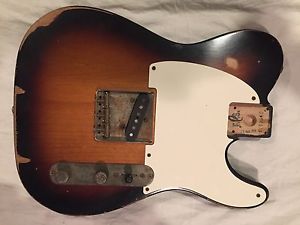
FENDER VINTAGE MEXICO MIM 50s RI ROAD WORN ESQUIRE LOADED BODY NITRO RELIC,TELE
Estimated price for orientation: 549 $
Category: Bodies
Class:
Description Condition: Used: An item that has been used previously. The item may have some signs of cosmetic wear, but is fully operational and functions as intended. This item may be a floor model or store return that has been used. See the seller’s listing for full details and description of any imperfections. See all condition definitions- opens in a new window or tab ... Read moreabout the condition Brand: Fender Country/Region of Manufacture: Mexico Model: ESQUIRE To Fit: Electric Guitar MPN: Does Not Apply UPC: Does not apply
Fig. 1 The schematic for the original 1950 Fender Esquire. Wiring diagram FENDER ESQUIER BASICS
I admit that the Fender Esquire is one of my favorite guitars ever, and I find its sound and simplicity very appealing. Most people think of it as a poor man’s Telecaster or a forerunner to the Tele, but this is simply wrong. Yes, the Esquire sports only a single bridge pickup, while the Telecaster has two pickups, but the Esquire is not a Telecaster with a missing neck pickup, but rather a distinct model with its own sound. This is because of its unique wiring and also because the lack of a neck pickup causes less magnetic pull on the strings. This reduced pull gives the Esquire a more percussive attack, more harmonic overtones, and makes it more responsive than a Telecaster.Some great players have chosen an Esquire for exactly these reasons. Steve Cropper played a ’62 Esquire on all his early recordings, including the classic “Green Onions.” Up until his untimely death in 1968, Luther Perkins used an Esquire to create his trademark “boomchicka- boom” sound while backing Johnny Cash. Bruce Springsteen played a heavily modified ’53/’54 Esquire that he bought in the early ’70s and used on Born in the USA and many more of his famous recordings.The Esquire (or to be precise, an Esquire prototype painted black) first appeared in the No. 2 Fender catalog in the spring of 1950, and was shown to the public at the Chicago NAMM show in July of that year. It had a list price of $139.95, plus $39.95 for the case. The original Esquire was built until late 1969, when CBS dropped it from the production line, very shortly after taking over Fender.The Esquire was Leo Fender’s first stroke of genius and an important step in his restless efforts to transport steel guitar tone to a standard electric guitar. The bridge pickup was very similar to the pickup he developed and built for his lap steel guitar, and the Esquire’s electronics clearly show this influence, too. As you may know, like the Tele, the Esquire has a 3-way switch, plus a master volume and master tone configuration. But on a single-pickup guitar, how do you use a “pickup selector” switch? Leo’s idea was to use the 3-way switch as a kind of tone-shaper. Here are the specifics:• Position #1. This corresponds to the solo bridge-pickup position on a Tele. On the Esquire, however, the pickup is routed through the volume control only, with the tone control bypassed for a hotter and louder lead sound with even more high-end.
• Position #2. In this middle setting, the Esquire’s pickup is routed through the volume and tone control—identical to position #1 on a standard Telecaster. It sounds a bit warmer compared to the Esquire’s #1 position.
• Position #3. Here, the tone control is again bypassed and the Esquire’s pickup is routed through the volume control and a fixed “treble roll-off ” capacitor/resistor network for a very dark tone that also has a slightly decreased output. Leo intended this as a “bass preset” that would allow the ’50s guitar player to enter bass territory by simply flipping the 3-way switch.Until the production of the Esquire was halted by CBS in late 1969, switching positions #1 and #2 stayed the same, but the value of the pots were changed several times. Switching position #3 was modified several times with different values for the caps and resistors, and the Esquire even had a “capacitor only” version for some time. This clearly indicates that #3 was not very popular among Esquire players, which is still the case today. Only a few players will find this option useful, but in the early ’80s Mike Stern and several other jazz players discovered that old Esquires and Telecasters (which had the same preset in the ’50s) were great workhorses and a good alternative to the well-known “jazz box.” Suddenly the old Fender preset wiring was something desirable, as it worked perfectly for those dark tones a lot of jazz players were looking for and a new hype was born. So if you are a jazz cat, this preset option may be worth a try. In closing, Fig. 1 shows the wiring of the original 1950 Esquire as a reference. Next month, we’ll start modifying the Esquire circuit, so study up on this schematic and stay tuned. I think you’ll be surprised how many different tones you can coax from a single bridge pickup. ****************************************************************************************************************************I offer Combined shipping so if you purchase another item, please wait for a new invoice before you pay so I can send you a new invoice with a special low shipping charge.Please see my other items for sale.
Take Care and Good Luck Bidding!
Conditions of Sale:By bidding on this item, you agree to all of the following terms:1) If you have negative feedback's, you must ask for bidding approval.2) If you don't have at least 10 positive feedback's, you must ask for bidding approval.3) All unauthorized bids will be cancelled. Payment & Reqirements:1) I only accept PayPal payments unless you make a prior arrangement me to accept another form of payment. You must make this new payment arrangement with me prior to biding.2) All unauthorized bids will be cancelled.3) Payment must be received within 48 hours after the end of the auction.4) All sales are final!5) All items MUST ship to a CONFIRMED eBay or PayPal address.
Description
| Condition: | Used: An item that has been used previously. The item may have some signs of cosmetic wear, but is fully operational and functions as intended. This item may be a floor model or store return that has been used. See the seller’s listing for full details and description of any imperfections. See all condition definitions- opens in a new window or tab ... Read moreabout the condition | Brand: | Fender |
| Country/Region of Manufacture: | Mexico | Model: | ESQUIRE |
| To Fit: | Electric Guitar | MPN: | Does Not Apply |
| UPC: | Does not apply |
Fig. 1 The schematic for the original 1950 Fender Esquire. Wiring diagram
I admit that the Fender Esquire is one of my favorite guitars ever, and I find its sound and simplicity very appealing. Most people think of it as a poor man’s Telecaster or a forerunner to the Tele, but this is simply wrong. Yes, the Esquire sports only a single bridge pickup, while the Telecaster has two pickups, but the Esquire is not a Telecaster with a missing neck pickup, but rather a distinct model with its own sound. This is because of its unique wiring and also because the lack of a neck pickup causes less magnetic pull on the strings. This reduced pull gives the Esquire a more percussive attack, more harmonic overtones, and makes it more responsive than a Telecaster.Some great players have chosen an Esquire for exactly these reasons. Steve Cropper played a ’62 Esquire on all his early recordings, including the classic “Green Onions.” Up until his untimely death in 1968, Luther Perkins used an Esquire to create his trademark “boomchicka- boom” sound while backing Johnny Cash. Bruce Springsteen played a heavily modified ’53/’54 Esquire that he bought in the early ’70s and used on Born in the USA and many more of his famous recordings.The Esquire (or to be precise, an Esquire prototype painted black) first appeared in the No. 2 Fender catalog in the spring of 1950, and was shown to the public at the Chicago NAMM show in July of that year. It had a list price of $139.95, plus $39.95 for the case. The original Esquire was built until late 1969, when CBS dropped it from the production line, very shortly after taking over Fender.The Esquire was Leo Fender’s first stroke of genius and an important step in his restless efforts to transport steel guitar tone to a standard electric guitar. The bridge pickup was very similar to the pickup he developed and built for his lap steel guitar, and the Esquire’s electronics clearly show this influence, too. As you may know, like the Tele, the Esquire has a 3-way switch, plus a master volume and master tone configuration. But on a single-pickup guitar, how do you use a “pickup selector” switch? Leo’s idea was to use the 3-way switch as a kind of tone-shaper. Here are the specifics:• Position #1. This corresponds to the solo bridge-pickup position on a Tele. On the Esquire, however, the pickup is routed through the volume control only, with the tone control bypassed for a hotter and louder lead sound with even more high-end.
• Position #2. In this middle setting, the Esquire’s pickup is routed through the volume and tone control—identical to position #1 on a standard Telecaster. It sounds a bit warmer compared to the Esquire’s #1 position.
• Position #3. Here, the tone control is again bypassed and the Esquire’s pickup is routed through the volume control and a fixed “treble roll-off ” capacitor/resistor network for a very dark tone that also has a slightly decreased output. Leo intended this as a “bass preset” that would allow the ’50s guitar player to enter bass territory by simply flipping the 3-way switch.Until the production of the Esquire was halted by CBS in late 1969, switching positions #1 and #2 stayed the same, but the value of the pots were changed several times. Switching position #3 was modified several times with different values for the caps and resistors, and the Esquire even had a “capacitor only” version for some time. This clearly indicates that #3 was not very popular among Esquire players, which is still the case today. Only a few players will find this option useful, but in the early ’80s Mike Stern and several other jazz players discovered that old Esquires and Telecasters (which had the same preset in the ’50s) were great workhorses and a good alternative to the well-known “jazz box.” Suddenly the old Fender preset wiring was something desirable, as it worked perfectly for those dark tones a lot of jazz players were looking for and a new hype was born. So if you are a jazz cat, this preset option may be worth a try. In closing, Fig. 1 shows the wiring of the original 1950 Esquire as a reference. Next month, we’ll start modifying the Esquire circuit, so study up on this schematic and stay tuned. I think you’ll be surprised how many different tones you can coax from a single bridge pickup. ****************************************************************************************************************************I offer Combined shipping so if you purchase another item, please wait for a new invoice before you pay so I can send you a new invoice with a special low shipping charge.Please see my other items for sale.
Take Care and Good Luck Bidding!
Conditions of Sale:By bidding on this item, you agree to all of the following terms:1) If you have negative feedback's, you must ask for bidding approval.2) If you don't have at least 10 positive feedback's, you must ask for bidding approval.3) All unauthorized bids will be cancelled. Payment & Reqirements:1) I only accept PayPal payments unless you make a prior arrangement me to accept another form of payment. You must make this new payment arrangement with me prior to biding.2) All unauthorized bids will be cancelled.3) Payment must be received within 48 hours after the end of the auction.4) All sales are final!5) All items MUST ship to a CONFIRMED eBay or PayPal address.