Back to the main page Back to category Gibson Les Paul Standard 50s Ele
musical instrument details
RARE 1970 Genuine Gibson Les Paul Electric 6 Guitar Mahogany Recording 69 70 71
Estimated price for orientation: 3 700 $
Category: Gibson Les Paul Standard 50s Ele
Class:
Description Brand: Gibson Body Color: Mahogany Body Type: Solid Body Material: Solid Wood MPN: Does Not Apply Country/Region of Manufacture: United States Model: Les Paul Recording Era: 1970 String Configuration: 6 String Features: Built-in Effects Dexterity: Right-Handed
GREAT BIRTHDAY OR HOLIDAY GIFT FOR THE COLLECTION !
LES PAULS FAVORITE GUITAR OF ALL TIME!
STAND UP!
Why buy a late model REPOPULATED VERSION, WHEN THIS IS AN ORIGINAL! For sale Today is a AMAZING CONDITION
Gibson Les Paul Recording Edition.
This guitar is an all original.
It has been tested and works.
MADE IN USA
Kalamazoo Plant, MI, USA
in 1968 (according to serial) Physical attributes such as volute,Logo missing dotted "i", Gibson logo interconnected "s" and "o"
Have narrowed the date to between 1968/1969/1970/1971
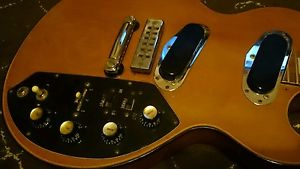
This guitar very well could've been assembled late 1968 or 1969! Making this one of the first years if not THE FIRST YEAR for this models existence. A TRUE TIMELESS PIECE OF MUSICAL HISTORY AND INNOVATION! With input into some of the world’s most iconic guitars, you may think Les Paul’s favorite Les Paul would be a “legendary” one. An original ’52 Gold Top, maybe? Or a sunburst ’59 Standard? But no. Les Paul’s favorite was the Les Paul Recording model of the 1970s. It never sold particularly well. But to Les himself, it was the ultimate Gibson Les Paul. In the “SG years” of 1961-’68, Les Paul didn’t have much input on Gibson electrics. But when the Gibson/Les Paul relationship resumed from 1968, new models were soon on the horizon. Single-cut Standards and Customs were back, in the 1970s there’d be the Les Paul Signature. But Les had his eye on the ultimate recording guitar, and he wanted low impedance pickups. In 1969 Gibson produced their first Low Impedance Guitars — the Les Paul Personal and Les Paul Professional Guitars – but they replaced in 1971/’72 by Les’s ultimate: the Gibson Les Paul Recording model. “For years I've worked to produce a multitude of distinctive guitar sounds,” said Les at the time. “The hang-up was to obtain everything in one guitar. Now I'm not talking about gimmickry, I'm talking about the real McCoy - authentic guitar sounds, the type of highs that can rip your ears off, the type of bass response that's clean and clear. Every note must be balanced and offer maximum sustain.” “Low Impedance For High Performance” From a distance, the Recording was shaped like a Les Paul Standard. But it was very different. It had two Low Impedance humbuckers, stacked and angled. It was designed to sound best when plugged into a mixing desk at (Low Impedance setting). When used with a regular amp, you had to engage the inbuilt impedance transformer. Controls were relatively complex — Volume, Treble, Bass, “Decade,” Microphone Volume, Pickup Selector, Tone Switch and Phase Switch on its large inlay panel. The Decade switch was designed to “tune”/alter treble harmonics, for "biting" or "silky" highs. And the Decade switch was feasibly the start of a guitar culture joke: although called the Decade, the selector switch had one more position. It actually went up to 11. Brochures were produced for the Low Impedance Les Paul Recording model and its sister, the Triumph bass. Each came with a demo flexi-disc demonstrating Les and Gibson’s work - played by Bruce Bolen, Les’s jazz guitarist friend who also worked for Gibson. And it still sounds visionary. The Recording could sound like anything you wanted – the “Want To Get Highs?” demo sounded akin to a Rickenbacker, “Country” sounded like a classic single-coil twanger, “Wes Montgomery Style” sounded like a big-bodied Gibson jazzbox. A Guitar Before Its Time? The Les Paul Recording was ahead of its time. In the early 1970s, most effects remained stompboxes, and most amps had simple controls. The Recording put “emulation” or “tone shifting” if you like, in the guitar itself and at your fingertips. The problem was, most guitarists weren’t ready. The Gibson Les Paul Standard was back in vogue by the early 1970s, but the Les Paul+Marshall sound was to dominate rock (heavier sounds than Les Paul himself liked) and the Recording model became, in the eyes of many Gibson buyers, something of an oddity. Low Impedance pickups do produce a clearer sound, which then can be manipulated… but audiophiles will soon enter debates about the guitar cord you’re using, the amp/desk, and many more differentials. Les Paul understood such studio-sound trickery, of course. Dudes who just wanted to rock? Maybe they didn’t. The Recording nevertheless sold decently. It hit a high in ‘73, with 1759 sold. But in 1979, after eight years of production and demand slumping – it was never going to be a punk/new wave choice - the Gibson Les Paul Recording model was discontinued. Few famous players, other than Les Paul himself, are renowned for playing the Recording. Although Jimmy Page certainly owns one – he was pictured on the cover of Musician magazine (1998) with a white Les Paul Recording. Les Paul’s Favorite But Les Paul continued to love his Recording. It was his go-to guitar for his latter career. When The Les Paul Foundation auctioned some of Les’s equipment in 2012, the second-highest sale was for a Gibson Les Paul Recording prototype. The guitar is serial number 001 and is, most likely, the first Recording model ever made. It was estimated to be auctioned for $20-$30,000, but sold for $180,000. Maybe because bidders knew this was Les Paul’s favorite Les Paul model. Lou Pallo – co guitarist in the Les Paul Trio for many years, and architect of the recent Thank You Les album – tells Gibson.com. “Les loved all the controls on the Recording. I had two of them… but you have to be an engineer to understand all those controls! But Les loved his Recording models. Every few weeks [with the Les Paul Trio] Les seemed to come in with a modified one — he’d been changing the electronics and whatever. “Les was… ‘fussy’ isn’t the word, but he was so into sound. He kept looking for his perfect sound… looking, looking, looking, even when he was 90 years old. He loved the Recording model for that. It was all about changing sounds. “But I even think of his sound on those early records with Mary Ford… You can get close to that sound, but you won’t sound like Les Paul. No-one ever will.” Even in one of his last-ever interviews with Guitarist magazine, Les Paul argued of any great guitar: "You should be able to add reverb to it, delay, flanging, fuzz – whatever you wish, whatever you can imagine that you want you should have on that instrument. I was going for the very clean sound, too. To this moment I want a very clear sound, and then I want to be able to take that very clear sound and warp it or change it to the different sounds of the other player." The Gibson Les Paul Recording didn’t quite do everything, but it was a pioneering idea of 40 years ago. It arguably fired the starting pistol for the do-it-all guitars of today. The Gibson Les Paul Recording model may still be viewed as an “oddity” by some, but it proved that Les Paul was not only a great player, but also a visionary who never stopped “chasing sound.” Features- Two oblong low-impedance pickups, trapezoid inlays, four control knobs, phase switch, tone selector switch, high/low impedance selector, bound fingerboard, stopbar tailpiece and Tune-o-matic bridge
This has been sitting in a case under my bed for the last 30 years. It doesnt come with the original case and will be shipped in the absolutely best methods possible to ensure no damage whatsoever occurs on the way to it's new home.
There are a few very minor cosmetic issues most just buckle scratching on the back(see photo). Also there is a small amount of oxidation on the bridge and a little bit on the metal on the neck. The black spot on the neck is a some sort of small damage I suppose but I have no idea what from. Very minimal! As you can see, The side of the fret board is missing a piece that came off and I regrettably misplaced the peice. The neck looks great and this guitar is amazing to say the least. Tuners look good. A good cleaning and it will shine even more. Other than the issue with the fret board side piece missing this guitars quality surpasses ALMOST EVERY SINGLE ONE I have ever seen on the Internet for sale. Someone will be receiving a great instrument and it speaks for itself! Serious Buyers Only!
Shipment Will Be Prompt upon receiving payment !
Contact me for any questions you may have!
Buy With Confidence! Thanks for looking and God bless
Description
| Brand: | Gibson | Body Color: | Mahogany |
| Body Type: | Solid | Body Material: | Solid Wood |
| MPN: | Does Not Apply | Country/Region of Manufacture: | United States |
| Model: | Les Paul Recording | Era: | 1970 |
| String Configuration: | 6 String | Features: | Built-in Effects |
| Dexterity: | Right-Handed |
GREAT BIRTHDAY OR HOLIDAY GIFT FOR THE COLLECTION !
LES PAULS FAVORITE GUITAR OF ALL TIME!
STAND UP!
Why buy a late model REPOPULATED VERSION, WHEN THIS IS AN ORIGINAL! For sale Today is a AMAZING CONDITION
Gibson Les Paul Recording Edition.
This guitar is an all original.
It has been tested and works.
MADE IN USA
Kalamazoo Plant, MI, USA
in 1968 (according to serial) Physical attributes such as volute,Logo missing dotted "i", Gibson logo interconnected "s" and "o"
Have narrowed the date to between 1968/1969/1970/1971
This guitar very well could've been assembled late 1968 or 1969! Making this one of the first years if not THE FIRST YEAR for this models existence. A TRUE TIMELESS PIECE OF MUSICAL HISTORY AND INNOVATION! With input into some of the world’s most iconic guitars, you may think Les Paul’s favorite Les Paul would be a “legendary” one. An original ’52 Gold Top, maybe? Or a sunburst ’59 Standard? But no. Les Paul’s favorite was the Les Paul Recording model of the 1970s. It never sold particularly well. But to Les himself, it was the ultimate Gibson Les Paul. In the “SG years” of 1961-’68, Les Paul didn’t have much input on Gibson electrics. But when the Gibson/Les Paul relationship resumed from 1968, new models were soon on the horizon. Single-cut Standards and Customs were back, in the 1970s there’d be the Les Paul Signature. But Les had his eye on the ultimate recording guitar, and he wanted low impedance pickups. In 1969 Gibson produced their first Low Impedance Guitars — the Les Paul Personal and Les Paul Professional Guitars – but they replaced in 1971/’72 by Les’s ultimate: the Gibson Les Paul Recording model. “For years I've worked to produce a multitude of distinctive guitar sounds,” said Les at the time. “The hang-up was to obtain everything in one guitar. Now I'm not talking about gimmickry, I'm talking about the real McCoy - authentic guitar sounds, the type of highs that can rip your ears off, the type of bass response that's clean and clear. Every note must be balanced and offer maximum sustain.” “Low Impedance For High Performance” From a distance, the Recording was shaped like a Les Paul Standard. But it was very different. It had two Low Impedance humbuckers, stacked and angled. It was designed to sound best when plugged into a mixing desk at (Low Impedance setting). When used with a regular amp, you had to engage the inbuilt impedance transformer. Controls were relatively complex — Volume, Treble, Bass, “Decade,” Microphone Volume, Pickup Selector, Tone Switch and Phase Switch on its large inlay panel. The Decade switch was designed to “tune”/alter treble harmonics, for "biting" or "silky" highs. And the Decade switch was feasibly the start of a guitar culture joke: although called the Decade, the selector switch had one more position. It actually went up to 11. Brochures were produced for the Low Impedance Les Paul Recording model and its sister, the Triumph bass. Each came with a demo flexi-disc demonstrating Les and Gibson’s work - played by Bruce Bolen, Les’s jazz guitarist friend who also worked for Gibson. And it still sounds visionary. The Recording could sound like anything you wanted – the “Want To Get Highs?” demo sounded akin to a Rickenbacker, “Country” sounded like a classic single-coil twanger, “Wes Montgomery Style” sounded like a big-bodied Gibson jazzbox. A Guitar Before Its Time? The Les Paul Recording was ahead of its time. In the early 1970s, most effects remained stompboxes, and most amps had simple controls. The Recording put “emulation” or “tone shifting” if you like, in the guitar itself and at your fingertips. The problem was, most guitarists weren’t ready. The Gibson Les Paul Standard was back in vogue by the early 1970s, but the Les Paul+Marshall sound was to dominate rock (heavier sounds than Les Paul himself liked) and the Recording model became, in the eyes of many Gibson buyers, something of an oddity. Low Impedance pickups do produce a clearer sound, which then can be manipulated… but audiophiles will soon enter debates about the guitar cord you’re using, the amp/desk, and many more differentials. Les Paul understood such studio-sound trickery, of course. Dudes who just wanted to rock? Maybe they didn’t. The Recording nevertheless sold decently. It hit a high in ‘73, with 1759 sold. But in 1979, after eight years of production and demand slumping – it was never going to be a punk/new wave choice - the Gibson Les Paul Recording model was discontinued. Few famous players, other than Les Paul himself, are renowned for playing the Recording. Although Jimmy Page certainly owns one – he was pictured on the cover of Musician magazine (1998) with a white Les Paul Recording. Les Paul’s Favorite But Les Paul continued to love his Recording. It was his go-to guitar for his latter career. When The Les Paul Foundation auctioned some of Les’s equipment in 2012, the second-highest sale was for a Gibson Les Paul Recording prototype. The guitar is serial number 001 and is, most likely, the first Recording model ever made. It was estimated to be auctioned for $20-$30,000, but sold for $180,000. Maybe because bidders knew this was Les Paul’s favorite Les Paul model. Lou Pallo – co guitarist in the Les Paul Trio for many years, and architect of the recent Thank You Les album – tells Gibson.com. “Les loved all the controls on the Recording. I had two of them… but you have to be an engineer to understand all those controls! But Les loved his Recording models. Every few weeks [with the Les Paul Trio] Les seemed to come in with a modified one — he’d been changing the electronics and whatever. “Les was… ‘fussy’ isn’t the word, but he was so into sound. He kept looking for his perfect sound… looking, looking, looking, even when he was 90 years old. He loved the Recording model for that. It was all about changing sounds. “But I even think of his sound on those early records with Mary Ford… You can get close to that sound, but you won’t sound like Les Paul. No-one ever will.” Even in one of his last-ever interviews with Guitarist magazine, Les Paul argued of any great guitar: "You should be able to add reverb to it, delay, flanging, fuzz – whatever you wish, whatever you can imagine that you want you should have on that instrument. I was going for the very clean sound, too. To this moment I want a very clear sound, and then I want to be able to take that very clear sound and warp it or change it to the different sounds of the other player." The Gibson Les Paul Recording didn’t quite do everything, but it was a pioneering idea of 40 years ago. It arguably fired the starting pistol for the do-it-all guitars of today. The Gibson Les Paul Recording model may still be viewed as an “oddity” by some, but it proved that Les Paul was not only a great player, but also a visionary who never stopped “chasing sound.” Features- Two oblong low-impedance pickups, trapezoid inlays, four control knobs, phase switch, tone selector switch, high/low impedance selector, bound fingerboard, stopbar tailpiece and Tune-o-matic bridge
This has been sitting in a case under my bed for the last 30 years. It doesnt come with the original case and will be shipped in the absolutely best methods possible to ensure no damage whatsoever occurs on the way to it's new home.
There are a few very minor cosmetic issues most just buckle scratching on the back(see photo). Also there is a small amount of oxidation on the bridge and a little bit on the metal on the neck. The black spot on the neck is a some sort of small damage I suppose but I have no idea what from. Very minimal! As you can see, The side of the fret board is missing a piece that came off and I regrettably misplaced the peice. The neck looks great and this guitar is amazing to say the least. Tuners look good. A good cleaning and it will shine even more. Other than the issue with the fret board side piece missing this guitars quality surpasses ALMOST EVERY SINGLE ONE I have ever seen on the Internet for sale. Someone will be receiving a great instrument and it speaks for itself! Serious Buyers Only!
Shipment Will Be Prompt upon receiving payment !
Contact me for any questions you may have!
Buy With Confidence! Thanks for looking and God bless
LES PAULS FAVORITE GUITAR OF ALL TIME!
STAND UP!
Why buy a late model REPOPULATED VERSION, WHEN THIS IS AN ORIGINAL! For sale Today is a AMAZING CONDITION
Gibson Les Paul Recording Edition.
This guitar is an all original.
It has been tested and works.
MADE IN USA
Kalamazoo Plant, MI, USA
in 1968 (according to serial) Physical attributes such as volute,Logo missing dotted "i", Gibson logo interconnected "s" and "o"
Have narrowed the date to between 1968/1969/1970/1971
This guitar very well could've been assembled late 1968 or 1969! Making this one of the first years if not THE FIRST YEAR for this models existence. A TRUE TIMELESS PIECE OF MUSICAL HISTORY AND INNOVATION! With input into some of the world’s most iconic guitars, you may think Les Paul’s favorite Les Paul would be a “legendary” one. An original ’52 Gold Top, maybe? Or a sunburst ’59 Standard? But no. Les Paul’s favorite was the Les Paul Recording model of the 1970s. It never sold particularly well. But to Les himself, it was the ultimate Gibson Les Paul. In the “SG years” of 1961-’68, Les Paul didn’t have much input on Gibson electrics. But when the Gibson/Les Paul relationship resumed from 1968, new models were soon on the horizon. Single-cut Standards and Customs were back, in the 1970s there’d be the Les Paul Signature. But Les had his eye on the ultimate recording guitar, and he wanted low impedance pickups. In 1969 Gibson produced their first Low Impedance Guitars — the Les Paul Personal and Les Paul Professional Guitars – but they replaced in 1971/’72 by Les’s ultimate: the Gibson Les Paul Recording model. “For years I've worked to produce a multitude of distinctive guitar sounds,” said Les at the time. “The hang-up was to obtain everything in one guitar. Now I'm not talking about gimmickry, I'm talking about the real McCoy - authentic guitar sounds, the type of highs that can rip your ears off, the type of bass response that's clean and clear. Every note must be balanced and offer maximum sustain.” “Low Impedance For High Performance” From a distance, the Recording was shaped like a Les Paul Standard. But it was very different. It had two Low Impedance humbuckers, stacked and angled. It was designed to sound best when plugged into a mixing desk at (Low Impedance setting). When used with a regular amp, you had to engage the inbuilt impedance transformer. Controls were relatively complex — Volume, Treble, Bass, “Decade,” Microphone Volume, Pickup Selector, Tone Switch and Phase Switch on its large inlay panel. The Decade switch was designed to “tune”/alter treble harmonics, for "biting" or "silky" highs. And the Decade switch was feasibly the start of a guitar culture joke: although called the Decade, the selector switch had one more position. It actually went up to 11. Brochures were produced for the Low Impedance Les Paul Recording model and its sister, the Triumph bass. Each came with a demo flexi-disc demonstrating Les and Gibson’s work - played by Bruce Bolen, Les’s jazz guitarist friend who also worked for Gibson. And it still sounds visionary. The Recording could sound like anything you wanted – the “Want To Get Highs?” demo sounded akin to a Rickenbacker, “Country” sounded like a classic single-coil twanger, “Wes Montgomery Style” sounded like a big-bodied Gibson jazzbox. A Guitar Before Its Time? The Les Paul Recording was ahead of its time. In the early 1970s, most effects remained stompboxes, and most amps had simple controls. The Recording put “emulation” or “tone shifting” if you like, in the guitar itself and at your fingertips. The problem was, most guitarists weren’t ready. The Gibson Les Paul Standard was back in vogue by the early 1970s, but the Les Paul+Marshall sound was to dominate rock (heavier sounds than Les Paul himself liked) and the Recording model became, in the eyes of many Gibson buyers, something of an oddity. Low Impedance pickups do produce a clearer sound, which then can be manipulated… but audiophiles will soon enter debates about the guitar cord you’re using, the amp/desk, and many more differentials. Les Paul understood such studio-sound trickery, of course. Dudes who just wanted to rock? Maybe they didn’t. The Recording nevertheless sold decently. It hit a high in ‘73, with 1759 sold. But in 1979, after eight years of production and demand slumping – it was never going to be a punk/new wave choice - the Gibson Les Paul Recording model was discontinued. Few famous players, other than Les Paul himself, are renowned for playing the Recording. Although Jimmy Page certainly owns one – he was pictured on the cover of Musician magazine (1998) with a white Les Paul Recording. Les Paul’s Favorite But Les Paul continued to love his Recording. It was his go-to guitar for his latter career. When The Les Paul Foundation auctioned some of Les’s equipment in 2012, the second-highest sale was for a Gibson Les Paul Recording prototype. The guitar is serial number 001 and is, most likely, the first Recording model ever made. It was estimated to be auctioned for $20-$30,000, but sold for $180,000. Maybe because bidders knew this was Les Paul’s favorite Les Paul model. Lou Pallo – co guitarist in the Les Paul Trio for many years, and architect of the recent Thank You Les album – tells Gibson.com. “Les loved all the controls on the Recording. I had two of them… but you have to be an engineer to understand all those controls! But Les loved his Recording models. Every few weeks [with the Les Paul Trio] Les seemed to come in with a modified one — he’d been changing the electronics and whatever. “Les was… ‘fussy’ isn’t the word, but he was so into sound. He kept looking for his perfect sound… looking, looking, looking, even when he was 90 years old. He loved the Recording model for that. It was all about changing sounds. “But I even think of his sound on those early records with Mary Ford… You can get close to that sound, but you won’t sound like Les Paul. No-one ever will.” Even in one of his last-ever interviews with Guitarist magazine, Les Paul argued of any great guitar: "You should be able to add reverb to it, delay, flanging, fuzz – whatever you wish, whatever you can imagine that you want you should have on that instrument. I was going for the very clean sound, too. To this moment I want a very clear sound, and then I want to be able to take that very clear sound and warp it or change it to the different sounds of the other player." The Gibson Les Paul Recording didn’t quite do everything, but it was a pioneering idea of 40 years ago. It arguably fired the starting pistol for the do-it-all guitars of today. The Gibson Les Paul Recording model may still be viewed as an “oddity” by some, but it proved that Les Paul was not only a great player, but also a visionary who never stopped “chasing sound.” Features- Two oblong low-impedance pickups, trapezoid inlays, four control knobs, phase switch, tone selector switch, high/low impedance selector, bound fingerboard, stopbar tailpiece and Tune-o-matic bridge
This has been sitting in a case under my bed for the last 30 years. It doesnt come with the original case and will be shipped in the absolutely best methods possible to ensure no damage whatsoever occurs on the way to it's new home.
There are a few very minor cosmetic issues most just buckle scratching on the back(see photo). Also there is a small amount of oxidation on the bridge and a little bit on the metal on the neck. The black spot on the neck is a some sort of small damage I suppose but I have no idea what from. Very minimal! As you can see, The side of the fret board is missing a piece that came off and I regrettably misplaced the peice. The neck looks great and this guitar is amazing to say the least. Tuners look good. A good cleaning and it will shine even more. Other than the issue with the fret board side piece missing this guitars quality surpasses ALMOST EVERY SINGLE ONE I have ever seen on the Internet for sale. Someone will be receiving a great instrument and it speaks for itself! Serious Buyers Only!
Shipment Will Be Prompt upon receiving payment !
Contact me for any questions you may have!
Buy With Confidence! Thanks for looking and God bless