Back to the main page Back to category Sequential Circuits Prophet5 Key
musical instrument details
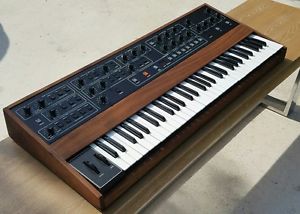
Sequential Circuits Prophet 5 Rev.2 custom firmware restored & flight case.
Estimated price for orientation: 6 999 $
Category: Sequential Circuits Prophet5 Key
Class:
Description Brand: Sequential Circuits MPN: Prophet-5 Type: Keyboard Synthesizer Model: Prophet-5 Number of Keys: 61 Features: Modulation Wheel UPC: 9786139128198
Recently gave this P5 a clean bill of health.
I bought it in bad condition and have brought her back. The following is a list of works carried out. - Operating system updated with a custom version that gives a tonne of super useful new features including extra software based LFOs which allow for loads more flexibility in sound designing. Features listed here:FIRMWARE UPGRADE FOR SCI PROPHET 5 REV2 New features are:- Edit mode is toggled by turning any programmable pot (with black knob) or pressing programmable (black) switches. Preset button works as in stock P5 switching between manual / preset mode or return from edit mode back to preset mode (recall patch)- Autotune is bypassed on start up. It uses previous values stored on NVRAM. Autotune does not reset the synth and it will instead return back on same state where it was before autotune. It also displays voice being tuned on preset button leds. (1-5 shows voice, led 8 indicates the voice b.) Now the P5 will boot if autotune fails to get reference count from OSC 1A. Autotune is engaged from PS1+PS4 on rev1 Prophets.- Filter preset toggles reference A440. It tracks the keyboard (last note priority) so in can be used as monophonic DCO. It's also used for tape load as in stock P5. The ref A440 is not used on rev1 due the need of extra hardware. (Don't ask me how to do this, I still do not own the rev1.) - Unison button has 3 positions, off (poly) - Unison 5 - Unison 1. Mode changes on cycle. Unison mode is stored on current patch.- Mod preset enables page 2 for (software based) 2nd LFO. When switched on LFO speed sets the frequency and PMOD MIX sets the amplitude for second LFO. Waveform switches and PMOD destination switches are used for waveform selection and modulation destination. FREQ1 and FREQ2 modulates the mixer OSC1 and OSC2 VCAs. PWs and FILT are routed as named. Mod Preset button is also used for tape storage.- Edit button (or PS5+PS8 on rev1) enables setting page. Values are stored to NVRAM.
* PS1: Factory preset bank enable. Original Factory patches are stored on ROM. These are editable and can be stored to NVRAM.
* PS2: 2nd LFO enable.
* PS3: Minimoog unison keycode enable. This chooses 6.1c or 7.0 unison keycode.
* PS4: Amount of voices, 1 or 2, used on Unison 1 mode
* PS5: 2nd LFO reset on keypress enable
* PS6: 2nd LFO single cycle mode enable (kind of envelope mode)
* PS7: Disable playable ref440
* PS8: Enable pot value display (shows HEX values)- New preset button combinations:
* PS1 + PS2 not used (was used to toggle the A440 on rev2)
* PS1 + PS3 toggles voice watch display (PS1-PS5 leds)
* PS1 + PS5 toggles NVRAM Viewer (Unison pot selects pot and switch value offset, 0-23, for current patch. PS1-8 shows stored value. The data output is on reversed order, PS1 led is bit0, PS8 bit7.)- Patch memory locations and tape format is compatible with the old firmware.- Manual mode doesn't store the switch values to RAM any longer (these memory locations are used for second LFO). All switches are cleared when manual mode is entered. The manual mode can be regarded as blank canvas for new sound creation.- Foot switch toggles the state of Release button from the programmed value.- Pot value display shows HEX values of the pot being turned. PS1-8 leds shows if the pot is on stored patch value of direction where to turn it. - Full Recap
- Modified the power supply (removed regulators for +5V -5V and -12V leaving just +/- 15v regulation) Modified internal firmware eprom to a more modern chip, negating the need to -5v -12v added a modern switching DC/DC convertor to supply +5V for digital side of the synth, this puts the power supply under MUCH LESS strain, the original design gave off a LOT of heat.- Complete pot replacement - All the original pots were missing when I purchased it I have replaced with all brand new pots that feel silky smooth. - Full set of solid machined aluminium knobs - These are high quality knobs that cost me a pretty penny, have a great weighty feel.- Logic (and other) ICs that were replaced during the restoration were all socketed. - Wooden chassis was taken apart, stripped sanded and sealed with Watco Danish Oil- Original mains lead removed and replaced with a 3 prong standard IEC power socket.- Control panel replaced - the original control panel fascia was in poor condition I purchased one in far better and brighter condition from wine country, still with a couple of marks, but overall nice and clean.- Keybed stripped and completely rebushed - As with most old pratt reed keybed like these the rubber bushings perish, making the keyboard very clicky and clangy. I replaced every one with a new lubricated bush, this gives the keybed a lovely damped feel like it came straight from the factory.Negatives:
Of course, I want to be honest about the synth, so here are I would say are the negatives.- There is a scratch on the control panel (illustrated in the photos)
- Some of the corners of the wood were beaten when I got, of course I have tidied them up and the wood has been stripped, sanded and treated but the corners are a bit rounded off as a result.
- Two of the badges are missing (front and top) I had to remove them to restore the wood, meant to purchase more but didn't get round to it. There was a split in one of the end panels. This has been repaired with strong wood glue and is solid, but you can see it (in photos)All in all, this has had an extensive amount of work done and I believe it will be a very reliable synth for years to come as a result. Oh, did I say just how sexy this thing sounds too??? Will be supplied with a flight case that I originally got with it, not the prettiest ever, but functional and will protect the synth during shipping. Thanks for reading, and I'm happy to answer any questions.
Description
| Brand: | Sequential Circuits | MPN: | Prophet-5 |
| Type: | Keyboard Synthesizer | Model: | Prophet-5 |
| Number of Keys: | 61 | Features: | Modulation Wheel |
| UPC: | 9786139128198 |
Recently gave this P5 a clean bill of health.
I bought it in bad condition and have brought her back. The following is a list of works carried out.
- Modified the power supply (removed regulators for +5V -5V and -12V leaving just +/- 15v regulation)
- Some of the corners of the wood were beaten when I got, of course I have tidied them up and the wood has been stripped, sanded and treated but the corners are a bit rounded off as a result.
- Two of the badges are missing (front and top) I had to remove them to restore the wood, meant to purchase more but didn't get round to it. There was a split in one of the end panels. This has been repaired with strong wood glue and is solid, but you can see it (in photos)All in all, this has had an extensive amount of work done and I believe it will be a very reliable synth for years to come as a result. Oh, did I say just how sexy this thing sounds too??? Will be supplied with a flight case that I originally got with it, not the prettiest ever, but functional and will protect the synth during shipping. Thanks for reading, and I'm happy to answer any questions.
I bought it in bad condition and have brought her back. The following is a list of works carried out.
- Operating system updated with a custom version that gives a tonne of super useful new features including extra software based LFOs which allow for loads more flexibility in sound designing. Features listed here:FIRMWARE UPGRADE FOR SCI PROPHET 5 REV2 New features are:- Edit mode is toggled by turning any programmable pot (with black knob) or pressing programmable (black) switches. Preset button works as in stock P5 switching between manual / preset mode or return from edit mode back to preset mode (recall patch)- Autotune is bypassed on start up. It uses previous values stored on NVRAM. Autotune does not reset the synth and it will instead return back on same state where it was before autotune. It also displays voice being tuned on preset button leds. (1-5 shows voice, led 8 indicates the voice b.) Now the P5 will boot if autotune fails to get reference count from OSC 1A. Autotune is engaged from PS1+PS4 on rev1 Prophets.- Filter preset toggles reference A440. It tracks the keyboard (last note priority) so in can be used as monophonic DCO. It's also used for tape load as in stock P5. The ref A440 is not used on rev1 due the need of extra hardware. (Don't ask me how to do this, I still do not own the rev1.) - Unison button has 3 positions, off (poly) - Unison 5 - Unison 1. Mode changes on cycle. Unison mode is stored on current patch.- Mod preset enables page 2 for (software based) 2nd LFO. When switched on LFO speed sets the frequency and PMOD MIX sets the amplitude for second LFO. Waveform switches and PMOD destination switches are used for waveform selection and modulation destination. FREQ1 and FREQ2 modulates the mixer OSC1 and OSC2 VCAs. PWs and FILT are routed as named. Mod Preset button is also used for tape storage.- Edit button (or PS5+PS8 on rev1) enables setting page. Values are stored to NVRAM.
* PS1: Factory preset bank enable. Original Factory patches are stored on ROM. These are editable and can be stored to NVRAM.
* PS2: 2nd LFO enable.
* PS3: Minimoog unison keycode enable. This chooses 6.1c or 7.0 unison keycode.
* PS4: Amount of voices, 1 or 2, used on Unison 1 mode
* PS5: 2nd LFO reset on keypress enable
* PS6: 2nd LFO single cycle mode enable (kind of envelope mode)
* PS7: Disable playable ref440
* PS8: Enable pot value display (shows HEX values)- New preset button combinations:
* PS1 + PS2 not used (was used to toggle the A440 on rev2)
* PS1 + PS3 toggles voice watch display (PS1-PS5 leds)
* PS1 + PS5 toggles NVRAM Viewer (Unison pot selects pot and switch value offset, 0-23, for current patch. PS1-8 shows stored value. The data output is on reversed order, PS1 led is bit0, PS8 bit7.)- Patch memory locations and tape format is compatible with the old firmware.- Manual mode doesn't store the switch values to RAM any longer (these memory locations are used for second LFO). All switches are cleared when manual mode is entered. The manual mode can be regarded as blank canvas for new sound creation.- Foot switch toggles the state of Release button from the programmed value.- Pot value display shows HEX values of the pot being turned. PS1-8 leds shows if the pot is on stored patch value of direction where to turn it.
- Full Recap* PS1: Factory preset bank enable. Original Factory patches are stored on ROM. These are editable and can be stored to NVRAM.
* PS2: 2nd LFO enable.
* PS3: Minimoog unison keycode enable. This chooses 6.1c or 7.0 unison keycode.
* PS4: Amount of voices, 1 or 2, used on Unison 1 mode
* PS5: 2nd LFO reset on keypress enable
* PS6: 2nd LFO single cycle mode enable (kind of envelope mode)
* PS7: Disable playable ref440
* PS8: Enable pot value display (shows HEX values)- New preset button combinations:
* PS1 + PS2 not used (was used to toggle the A440 on rev2)
* PS1 + PS3 toggles voice watch display (PS1-PS5 leds)
* PS1 + PS5 toggles NVRAM Viewer (Unison pot selects pot and switch value offset, 0-23, for current patch. PS1-8 shows stored value. The data output is on reversed order, PS1 led is bit0, PS8 bit7.)- Patch memory locations and tape format is compatible with the old firmware.- Manual mode doesn't store the switch values to RAM any longer (these memory locations are used for second LFO). All switches are cleared when manual mode is entered. The manual mode can be regarded as blank canvas for new sound creation.- Foot switch toggles the state of Release button from the programmed value.- Pot value display shows HEX values of the pot being turned. PS1-8 leds shows if the pot is on stored patch value of direction where to turn it.
- Modified the power supply (removed regulators for +5V -5V and -12V leaving just +/- 15v regulation)
Modified internal firmware eprom to a more modern chip, negating the need to -5v -12v added a modern switching DC/DC convertor to supply +5V for digital side of the synth, this puts the power supply under MUCH LESS strain, the original design gave off a LOT of heat.
- Complete pot replacement - All the original pots were missing when I purchased it I have replaced with all brand new pots that feel silky smooth. - Full set of solid machined aluminium knobs - These are high quality knobs that cost me a pretty penny, have a great weighty feel.
- Logic (and other) ICs that were replaced during the restoration were all socketed. - Wooden chassis was taken apart, stripped sanded and sealed with Watco Danish Oil- Original mains lead removed and replaced with a 3 prong standard IEC power socket.- Control panel replaced - the original control panel fascia was in poor condition I purchased one in far better and brighter condition from wine country, still with a couple of marks, but overall nice and clean.
- Keybed stripped and completely rebushed - As with most old pratt reed keybed like these the rubber bushings perish, making the keyboard very clicky and clangy. I replaced every one with a new lubricated bush, this gives the keybed a lovely damped feel like it came straight from the factory.Negatives:
Of course, I want to be honest about the synth, so here are I would say are the negatives.
- There is a scratch on the control panel (illustrated in the photos)Of course, I want to be honest about the synth, so here are I would say are the negatives.
- Some of the corners of the wood were beaten when I got, of course I have tidied them up and the wood has been stripped, sanded and treated but the corners are a bit rounded off as a result.
- Two of the badges are missing (front and top) I had to remove them to restore the wood, meant to purchase more but didn't get round to it. There was a split in one of the end panels. This has been repaired with strong wood glue and is solid, but you can see it (in photos)All in all, this has had an extensive amount of work done and I believe it will be a very reliable synth for years to come as a result. Oh, did I say just how sexy this thing sounds too??? Will be supplied with a flight case that I originally got with it, not the prettiest ever, but functional and will protect the synth during shipping. Thanks for reading, and I'm happy to answer any questions.