Back to the main page Back to category Preamps and Channel Strips
musical instrument details
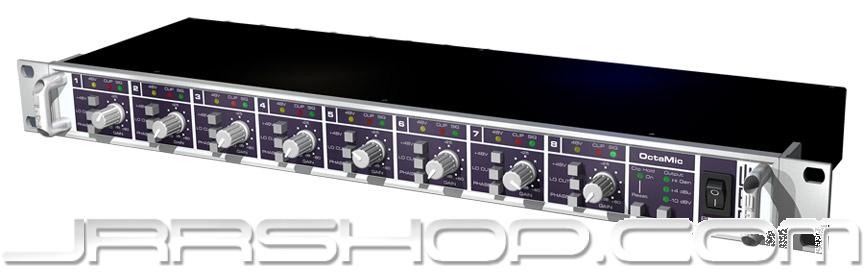
RME OctaMic D Mic Preamp New JRR Shop
Estimated price for orientation: 1 199 $
Category: Preamps and Channel Strips
Class:
Description Condition: New: A brand-new, unused, unopened, undamaged item in its original packaging (where packaging is applicable). Packaging should be the same as what is found in a retail store, unless the item is handmade or was packaged by the manufacturer in non-retail packaging, such as an unprinted box or plastic bag. See the seller's listing for full details. See all condition definitions- opens in a new window or tab ... Read moreabout the condition Brand: RME MPN: OctaMic D Type: Microphone Preamp Number of Channels: 8 Model: OctaMic D UPC: Does Not Apply
Products from RME normally ship in 2-3 days. Please be aware of this delay before ordering. JRR Shop accepts returns for exchange or money back. There is no restocking fee on exchanges but there is a 15% restocking fee on money back. If you receive a defective unit, we will send you a new replacement for it with no restocking fee. JRR Shop adds a signature requirement to all orders. Please message us immediately if you wish to remove the signature requirement from your order.
Please note, that once the order has been shipped we cannot remove the signature requirement. The OctaMic D includes the optional OctaMic ADC module, which can also be added to the OctaMic basic version later on. The ADC module adds 8 channels of pristine 192 kHz AD-conversion, available as double ADAT output (S/MUX, up to 96 kHz), and simultaneously via DB-25 connector as 4 AES outputs (up to 192 kHz). The ADC can be clocked internally (master), and externally via word clock and AES sync.
RME's outstanding SteadyClock™ ensures perfect AD-conversion, as jitter on the external sync-sources is nearly completely removed. All settings are done via DIP-switches on the back of the OctaMic D. Analog outputs and both digital outputs operate fully simultaneously. The choice of reference level affects the analog outputs only, the signal/clip indication and the AD-conversion will react only to the Gain-pots.
Description
| Condition: | New: A brand-new, unused, unopened, undamaged item in its original packaging (where packaging is applicable). Packaging should be the same as what is found in a retail store, unless the item is handmade or was packaged by the manufacturer in non-retail packaging, such as an unprinted box or plastic bag. See the seller's listing for full details. See all condition definitions- opens in a new window or tab ... Read moreabout the condition | Brand: | RME |
| MPN: | OctaMic D | Type: | Microphone Preamp |
| Number of Channels: | 8 | Model: | OctaMic D |
| UPC: | Does Not Apply |
Products from RME normally ship in 2-3 days. Please be aware of this delay before ordering. JRR Shop accepts returns for exchange or money back. There is no restocking fee on exchanges but there is a 15% restocking fee on money back. If you receive a defective unit, we will send you a new replacement for it with no restocking fee. JRR Shop adds a signature requirement to all orders. Please message us immediately if you wish to remove the signature requirement from your order.
Please note, that once the order has been shipped we cannot remove the signature requirement. The OctaMic D includes the optional OctaMic ADC module, which can also be added to the OctaMic basic version later on. The ADC module adds 8 channels of pristine 192 kHz AD-conversion, available as double ADAT output (S/MUX, up to 96 kHz), and simultaneously via DB-25 connector as 4 AES outputs (up to 192 kHz). The ADC can be clocked internally (master), and externally via word clock and AES sync.
RME's outstanding SteadyClock™ ensures perfect AD-conversion, as jitter on the external sync-sources is nearly completely removed. All settings are done via DIP-switches on the back of the OctaMic D. Analog outputs and both digital outputs operate fully simultaneously. The choice of reference level affects the analog outputs only, the signal/clip indication and the AD-conversion will react only to the Gain-pots.
Please note, that once the order has been shipped we cannot remove the signature requirement. The OctaMic D includes the optional OctaMic ADC module, which can also be added to the OctaMic basic version later on. The ADC module adds 8 channels of pristine 192 kHz AD-conversion, available as double ADAT output (S/MUX, up to 96 kHz), and simultaneously via DB-25 connector as 4 AES outputs (up to 192 kHz). The ADC can be clocked internally (master), and externally via word clock and AES sync.
RME's outstanding SteadyClock™ ensures perfect AD-conversion, as jitter on the external sync-sources is nearly completely removed. All settings are done via DIP-switches on the back of the OctaMic D. Analog outputs and both digital outputs operate fully simultaneously. The choice of reference level affects the analog outputs only, the signal/clip indication and the AD-conversion will react only to the Gain-pots.